Going on Vacation: How to Keep Your Plants Alive
Every tip to keep your plants healthy while you're on holiday: automatic watering, prep and DIY solutions.
By SPRAIA editorial team · Method: botanical sources, field feedback and editorial validation
It’s every plant parent’s nightmare: leaving for a holiday and returning to a wilted jungle. Drooped leaves, fallen stems, soil hard as concrete… The disaster scenario is real if you don’t prepare anything. The good news: with a bit of anticipation and the right techniques, your plants can survive — even thrive — during your absence. Whether you’re gone a week or a month, this guide covers every solution, from free DIY systems to automated installations.
En pratique, étape par étape
The 7 actions to perform in the days before departure to maximise plant survival.
-
Water deeply the day before
Give a generous watering until water flows through drainage holes. For tropicals, opt for a 20-min bottom soak in a bucket of water.
-
Move away from direct sun
Move plants 1-2 m from south-facing windows. Aim for bright indirect light: east- or north-facing room, or south with sheer curtain. This reduces evaporation.
-
Group all plants in one spot
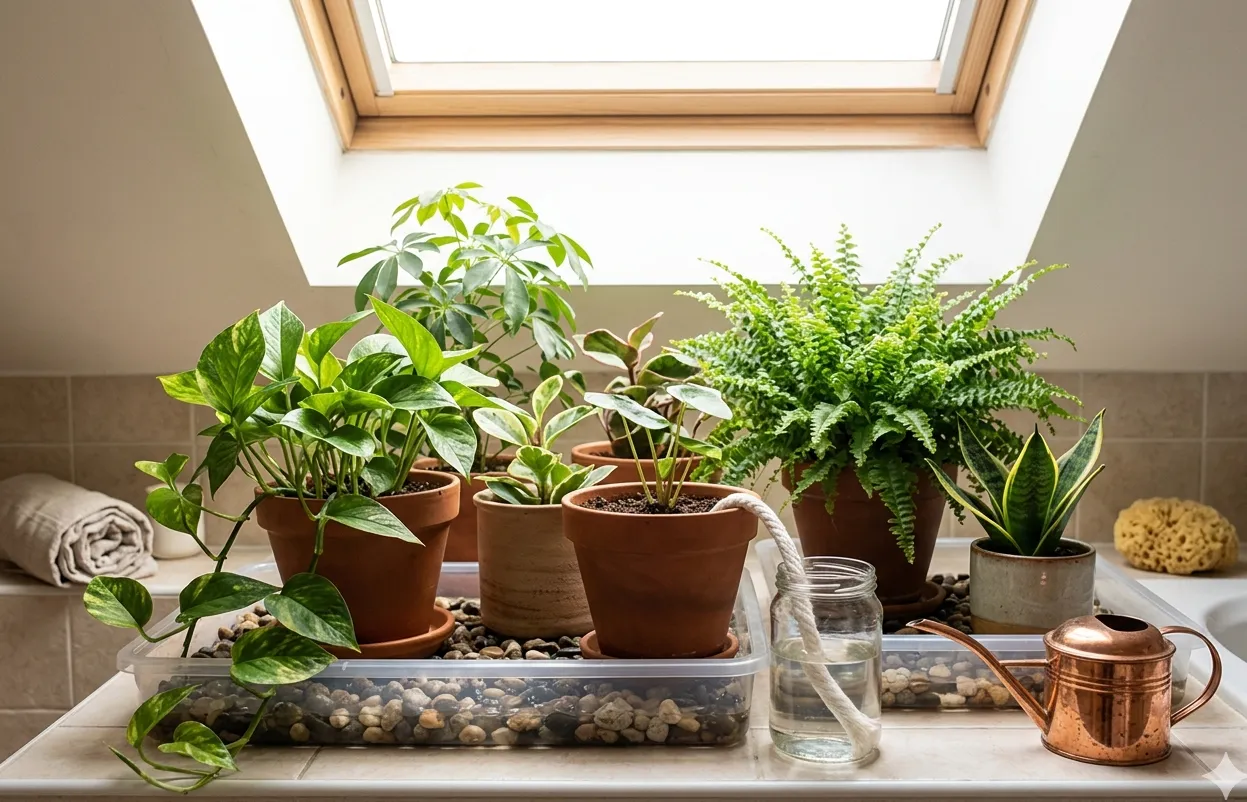
Gather your plants in the bathroom or kitchen (tile = no water damage). Together they create a humid microclimate via collective evapotranspiration.
-
Dust the leaves
Wipe each leaf with a damp cloth, top and bottom. Clean leaves photosynthesise better and resist water stress better.
-
Remove dead or yellowed leaves
Cut all damaged leaves at the base: they consume energy uselessly and can attract pests or fungi during your absence.
-
Stop fertilising two weeks before
Fertiliser stimulates growth, hence water needs. Suspend any feed at least 14 days before departure to put the plant in energy-saving mode.
-
Inspect and treat pests before leaving
Check leaf undersides under a lamp: mealybugs, thrips, spider mites. A minor problem can become a major infestation in 2 weeks unsupervised — treat preventively.
Pre-departure preparation checklist
The key is what you do before closing the door. These simple actions make all the difference, no matter how long you’re gone.
Water deeply the day before
Give each plant a deep watering the day before or the morning of departure. Water slowly until water flows through drainage holes. For plants that tolerate it (tropicals, ferns), a 20-minute soak in a bucket of water is even more effective.
Move away from direct sun
Move your plants a few metres from south-facing windows. Direct sun accelerates evaporation and increases water needs. The goal: bright indirect light without excessive heat. A north- or east-facing room is ideal.
Group your plants
Gather all your plants in one room, preferably the bathroom or kitchen (tile = no damage in case of leak). Grouped together, plants create a humid microclimate thanks to collective evapotranspiration. Particularly beneficial for tropical species.
Clean the leaves
Dust leaves with a damp cloth. Clean leaves photosynthesise better and resist water stress better. Also remove any dead, yellowed or damaged leaves — they consume energy uselessly and can attract pests.
Stop fertilising
Don’t fertilise in the two weeks before departure. Fertiliser stimulates growth, increasing water needs. During your absence, the plant should be in energy-saving mode, not full growth surge.
Check for pests
Inspect each plant for mealybugs, aphids or thrips. A minor pre-departure problem can become a major infestation in two weeks unsupervised. Treat preventively if needed.
Short absence (1-2 weeks): DIY solutions
For one to two weeks, no expensive equipment needed. These home methods work remarkably well and cost almost nothing.
The bathtub method
The simplest and most reliable for a one-week absence:
- Place an old towel or absorbent cloth in the bottom of your bathtub
- Pour 2-3 cm of water into the tub
- Set your plants (in their drainage-hole pots) directly on the damp towel
- Pull the shower curtain halfway to filter light
Plants absorb water by capillarity through drainage holes. The bathroom offers naturally high humidity and filtered light — ideal survival-mode conditions.
Caution: this method isn’t suitable for succulents and cacti, which risk rot with constant moisture at the roots.
The plastic-bag mini-greenhouse
Perfect for tropical plants that love humidity:
- Water the plant well
- Insert 2-3 sticks (wooden skewers, chopsticks) into the substrate to keep plastic away from the foliage
- Wrap the entire plant in a clear plastic bag — pot included
- Close loosely at the pot base
The bag creates a greenhouse effect: water evaporates, condenses on the plastic and falls back onto the substrate. It’s a closed cycle that can keep a plant hydrated for 10-15 days. Place the plant in indirect light — never direct sun, otherwise the temperature inside the bag becomes lethal.
The cotton wick (DIY self-watering)
A devastatingly effective passive watering system:
- Take a cotton string or absorbent fabric wick (cut an old T-shirt into strips)
- Push one end of the wick 5-6 cm into the substrate, in the centre of the pot
- Dip the other end into a water container placed beside (or slightly above) the pot
- Water rises by capillarity and keeps the substrate moist continuously
Tip: moisten the wick before installation to prime capillarity. The thicker the wick, the higher the flow. Test the system 2-3 days before departure to adjust flow and check the water container is large enough.
The inverted bottle
The travelling plant parent’s classic:
- Take a plastic water bottle (50 cl for a small pot, 1.5 L for a large one)
- Pierce 2-3 small holes in the cap with a heated needle
- Fill the bottle with water
- Invert it and push the neck 3-4 cm into moist substrate
Water flows slowly by gravity, paced by substrate absorption. A 1.5 L bottle can feed a medium pot for about 7-10 days. Test the flow before leaving: if the holes are too big, the bottle empties in hours.
SPRAIA tip: some plants tolerate temporary dryness well — beginner plants like the Pothos, Snake Plant or ZZ can easily go two weeks without water. Prioritise your DIY systems for the most sensitive plants (ferns, calatheas, alocasias) and let the resilient ones manage.
The damp towel
For plants in small pots:
- Spread a thick towel on a counter or in the bathtub
- Soak it generously with water
- Place your plants (drainage-hole pots) on top
- Add an open water container beside to maintain ambient humidity
Same principle as the bathtub method, in portable version. Ideal for grouping 4-5 small pots.
Medium absence (2-3 weeks): semi-automatic solutions
Beyond two weeks, DIY methods reach their limits. Time to invest a bit — but nothing ruinous.
Water-reservoir pots
Self-watering pots (Lechuza, Elho, or generic models) feature an integrated reservoir under the substrate. The plant draws water by capillarity as needed. A well-filled Lechuza pot can sustain a plant for 3-4 weeks without intervention.
- Advantage: zero overwatering risk, the plant self-regulates
- Drawback: the initial investment (€15-50 depending on size) and the need to repot if your plants aren’t already in this type of pot
If you don’t want to swap all your pots, reserve them for your thirstiest plants.
Ollas (terracotta cones)
Ollas are porous terracotta reservoirs you push into substrate. Water seeps slowly through the microporous wall — the drier the substrate, the faster the diffusion. The pottery-irrigation principle, used for millennia.
- Fill the olla before leaving
- A standard-sized olla irrigates a 15-25 cm pot for 7-14 days
- Cost: €5-15 per unit depending on size
There are also ceramic cones that screw onto a standard water bottle, working on the same principle with a larger reservoir.
The capillary mat
The capillary mat is a special absorbent fabric used in horticulture:
- Place the mat on a flat surface (table, low shelf)
- Soak one end in a water tray placed slightly lower
- Set your plants on the mat
The mat absorbs water from the tray and distributes it evenly. Each pot absorbs what it needs through drainage holes. The ideal solution to water many plants at once with a single reservoir.
SPRAIA tip: before leaving, photograph each plant with SPRAIA. On return, compare with current state to quickly detect a problem — even subtle — you wouldn’t have noticed by eye.
Long absence (3 weeks and more): human and automated solutions
Beyond three weeks, even the best passive solutions show their limits. Plan a human intervention or an automated irrigation system.
Entrust your plants to a relative
The most reliable solution remains asking a friend, neighbour or family member to come water your plants. But beware: not everyone has a green thumb. To make it work:
- Group all your plants in one room to simplify the visit
- Prepare clear written instructions: which plants to water, how much, how often
- Use coloured labels on pots: green = little water (1×/week), orange = moderate (2×/week), red = thirsty (every 3 days)
- Leave a pre-filled watering can and a sprayer at hand
- Specify the plants to never water (succulents, cacti) to avoid well-meaning overwatering
A visit every 4-5 days suffices for most collections.
Plant-sitting
Yes, it exists. Platforms and Facebook groups connect plant lovers for mutual sitting. The principle: someone comes to your home to care for your plants while you’re away, and you do the same for them another time.
You can also post on local plant-lover groups — the community is often very supportive. It’s free and your plants will be in the hands of someone who really knows how to care for them.
Automatic drip irrigation
For large collections or frequent absences, investing in a micro-irrigation system pays off quickly:
- A battery timer plugs into a tap or reservoir
- Capillary tubes deliver water plant by plant
- Each emitter is individually adjustable
Complete kits (timer + 10-20 emitters + tubes) are available between €30 and €80. Brands like Gardena, Hozelock or Claber offer indoor-specific kits.
The only catch: initial setup takes time. Plan to install and test the system at least a week before departure.
Methods comparison table
| Method | Max duration | Cost | Reliability | Effort |
|---|---|---|---|---|
| Bathtub / damp towel | 7-10 days | Free | Good | Low |
| Plastic bag (mini-greenhouse) | 10-15 days | Free | Medium | Low |
| Cotton wick | 10-14 days | Free | Good | Medium |
| Inverted bottle | 7-10 days | Free | Medium | Medium |
| Ollas / terracotta cones | 7-14 days | €5-15 | Good | Low |
| Reservoir pot | 3-4 weeks | €15-50 | Excellent | Low |
| Capillary mat | 2-3 weeks | €10-20 | Very good | Medium |
| Friend / plant-sitter | Unlimited | Free | Variable | Medium |
| Auto drip irrigation | Unlimited | €30-80 | Excellent | High (setup) |
SPRAIA tip: combine methods. For a two-week trip, leave succulents and cacti without anything (they’ll hold), put resilient plants on a damp towel in the bathtub, and reserve cotton wicks or ollas for your most sensitive specimens.
Return: the right reintroduction steps
You push the door, you rush to see your plants… and it’s the critical moment. How to handle the recovery:
Check overall state
Tour each plant. Spot yellowed leaves, soft stems, signs of dryness or — rarer if you prepared well — overwatering. Don’t panic if some lower leaves have dried: the plant sacrificed them to save water. A normal survival mechanism.
Water gradually
If the substrate is fully dry and has shrunk (peeled away from pot edges), don’t pour a litre at once. The water would run down the sides without penetrating. Prefer a bottom soak: dip the pot in a water bucket for 20-30 minutes so the substrate rehydrates uniformly.
Reintroduce light gradually
If you’d moved your plants from the windows, don’t put them straight back in the sun. After a low-light period, foliage is more sensitive. Move them gradually back to their usual spot over 3-4 days.
Inspect for pests
Stagnant moisture and lack of airflow during your absence can encourage mould, mealybugs or fungus gnats. Check leaf undersides, axils and substrate surface. Treat immediately if you spot anything.
Resume fertilising
Wait a week after return before refertilising. Let the plant stabilise and resume its normal watering rhythm before stimulating growth.
Frequently asked questions before going on vacation
Everything you wonder about preparing your plants for a short or extended absence.
- It depends hugely on species and season. On average: succulents and cacti last 4-6 weeks no problem, Sansevieria and Zamioculcas 3-4 weeks, tropical plants (Monstera, Philodendron) 7-14 days depending on light and warmth, and Calatheas or ferns 3-5 days max. For 2-3 day absences, a good pre-departure watering is enough for most plants.
- Yes, for 7 to 14 days of absence depending on plant and pot volume. Terracotta cones (ollas) release water at the pace of substrate dryness — the most reliable method. Water globes (hydrogel) are less precise and suit mostly low-thirst plants. Test the system at least 5 days before leaving to calibrate flow.
- Yes, group them in a bright but sunless room (bathroom, hallway). Grouping creates a humid microclimate that limits evaporation. Move them away from heat sources (radiators, south-facing bay windows) and close shutters to reduce light and therefore the plant's water consumption.
- Yes, it's one of the most robust DIY methods for 1 to 3 weeks. Dip a cotton wick or natural fiber cord in a large water container placed higher than the pot; the other end in the soil. Water travels up by capillary action as needed. Mandatory test before departure: observe flow for 48 h.
- Diagnose before acting. Very dry plant: 30-min soaking, no fertilizer for 2-3 weeks. Waterlogged plant (from overdone automatic watering): unpot to check the roots, see our [guide to root rot](/en/blog/root-rot-save-overwatered-plant/). Leaves sun-burned during absence: prune dead parts, move to shade, wait for new growth.
Conclusion
Going on holiday should never stress a plant parent. With a bit of preparation and the right method, even a multi-week absence goes very well. The most important thing is to anticipate: prepare your plants a few days before departure, test your watering system, and group your plants for easier management.
And if you entrust your plants to someone, consider sharing your SPRAIA care sheets directly from the app. Your plant-sitter will know exactly when to water, how much to give and what signs to watch — even with no gardening experience. Your plants have never been so well cared for.