When and How to Water Indoor Plants: The Complete Guide
Practical guide to watering your plants properly: frequency, techniques, warning signs and mistakes to avoid. Tips adapted to each type.
By SPRAIA editorial team · Method: botanical sources, field feedback and editorial validation
Watering is the #1 indoor plant care skill. Master it and 80 % of common problems disappear. Get it wrong and even the most beautiful plant fades within weeks. The good news: there are no rocket-science rules to memorise — just a few solid principles to apply consistently.
The golden rule: forget the calendar
The biggest beginner mistake: watering on a fixed schedule. “Every Sunday I water my plants.” Wrong reflex. A plant doesn’t need water because it’s the weekend, but because its substrate is dry.
Many factors influence drying speed: pot size, substrate type, ambient temperature, light, humidity, season, the plant’s own consumption. A Monstera in a sunny living room in summer drinks 3× more than the same Monstera in winter in a cool corner.
The right method: check before each watering. The finger test takes 5 seconds and saves dozens of plants.
The finger method (60 seconds, foolproof)
- Push your index finger 3-4 cm into the substrate
- Wet, cool: don’t water yet, wait
- Dry on the surface but moist underneath: water for moisture-loving plants (Calathea, Maranta, Spathiphyllum)
- Dry on 3-4 cm: water now for most plants (Monstera, Philodendron, Pothos)
- Bone dry: water immediately for succulents and dry-tolerant plants (Sansevieria, ZZ, Crassula)
Watering profiles by plant type
| Type | Frequency | Method | Examples |
|---|---|---|---|
| Tropicals (most) | Top 3 cm dry | Soak then drain | Monstera, Philodendron, Ficus |
| Marantaceae | Slightly moist always | Filtered water | Calathea, Maranta |
| Succulents | Completely dry | Sparing | Echeveria, Aloe, Haworthia |
| Cacti | Bone dry | Very sparing | Cereus, Mammillaria |
| Ferns | Constantly moist | Frequent | Boston fern, maidenhair |
| Carnivorous | Wet | Distilled water only | Drosera, Sundew |
How to water properly
Frequency is one thing, technique is another. A correct watering follows these rules:
- Water deeply until water flows through drainage holes
- Empty the saucer 15 minutes after — never let the plant sit in water
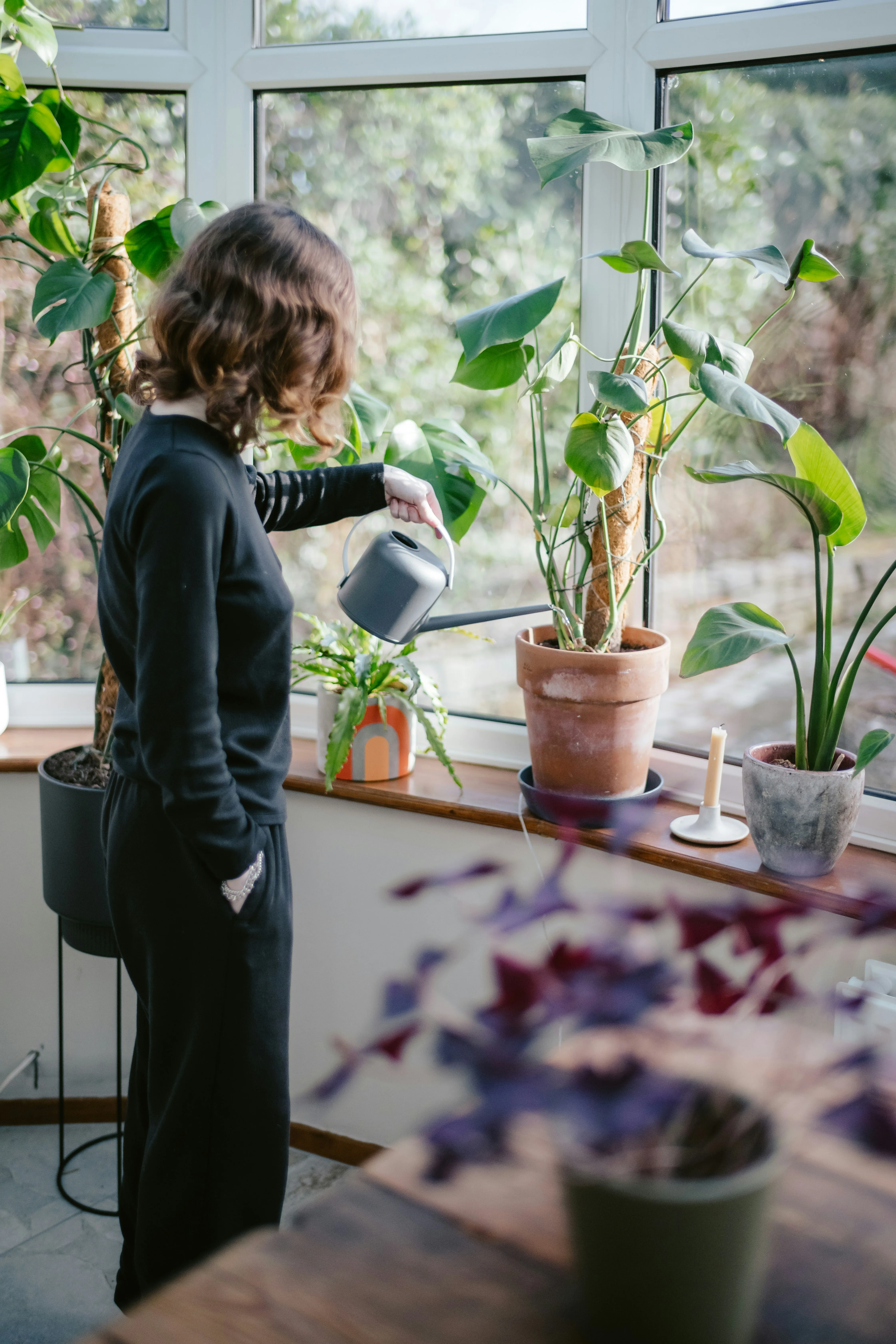
- Water the substrate, not the leaves (except for tropical leaves benefiting from misting)
- Use room-temperature water — never iced water from the tap
- In the morning ideally — leaves dry before night, less fungus risk
Bottom watering: an underrated technique
For some plants (Calathea, African violets, Cyclamen), bottom watering is gentler and safer than top:
- Place the pot in a saucer or basin filled with 2-3 cm of water
- The substrate absorbs water by capillarity
- After 15-20 minutes, remove the pot and drain excess
- Substrate is uniformly moistened, no risk of leaf rot
What water to use?
- Tap water: OK for most easy plants if rested 24 h to off-gas chlorine
- Filtered water: ideal everywhere, especially in hard-water regions
- Rainwater: the gold standard, free, naturally soft, slightly acidic — perfect for Calathea, Maranta, Carnivores
- Distilled water: only for the most demanding (Carnivores, some Alocasias)
- Avoid: softened water (too much sodium), iced or boiling water
Seasonal adjustments
Plants don’t drink the same year-round. Adapt your frequency:
- Spring/summer: peak growth, max consumption. A Monstera can need watering every 5-7 days.
- Autumn: gradual decline. Space out waterings.
- Winter: dormancy for most plants. Some go 3-4 weeks without water (Sansevieria, ZZ).
Warning signs
Underwatering
- Limp, drooping leaves
- Curled-down leaf edges
- Dry crispy leaves
- Substrate pulled away from pot
- Pot abnormally light
Overwatering
- Soft yellow leaves
- Wet substrate, mouldy smell
- Spongy stem base
- Black fungus gnats
- Soft brown leaf spots
If you spot one of these signals, our 9 yellow-leaf causes guide details the diagnosis.
The 5 most common watering mistakes
- Fixed schedule: water without checking → kills 50 % of beginner plants.
- Cold water: thermal shock to roots, especially in winter.
- Saucer kept full: plant sits in stagnant water → root rot in days.
- Misting only: doesn’t hydrate the substrate, the plant slowly dies of thirst.
- Too much water at once on a dry plant: hyperhydration shock, drop everything to absorb.
Going on vacation?
Two solutions before leaving:
- 1-2 weeks: water deeply the day before, group plants in a humid bathroom, away from direct sun. Most tropicals survive 10-14 days like this.
- Over 2 weeks: install a wick irrigation system (cotton string from a water reservoir to the pot), or ask a friend.
For more, see our guide on keeping plants alive while on vacation.
Watering FAQ
The most common questions about indoor plant watering.
- There's no universal frequency. Use the finger method: poke 3-4 cm into the substrate. If wet, wait. If dry on the top 3 cm, water deeply. On average: every 7-10 days for most tropicals in summer, every 14-21 days in winter. Succulents: every 14-30 days year-round.
- No, never. Stagnant water suffocates roots and triggers rot in 24-48 h. Always empty the saucer 15 minutes after watering. The only exception: certain water-loving plants (Cyperus, papyrus) which are bog plants.
- Misting boosts ambient humidity but doesn't replace watering. Beneficial for tropicals (Monstera, Calathea, Ferns) in dry winter. Useless for succulents and cacti. Best alternative: a humidifier maintaining 50-60 % humidity.
- Not necessarily. Drooping can mean too little OR too much water (paradoxical). Always check the substrate first: wet = stop watering, dry = water deeply. The Spathiphyllum droops dramatically when thirsty and recovers in 30 min — but a Monstera with rotten roots also droops, watering it kills it faster.
- Morning is ideal: leaves dry by night, reducing fungal risk. Avoid evening watering, especially in winter where moisture stagnates. For succulents and cacti, midday OK. The most important is consistency, not the exact time.
Conclusion
Watering well isn’t about following a schedule, it’s about observing and adapting. The finger method takes 5 seconds and is foolproof. Add it to your routine and watch most of your indoor plant problems disappear. Use SPRAIA to get reminders adapted to your species, your home and the season — but always end with checking the substrate before watering.