Haworthia
Haworthia fasciata
The shade succulent: tolerates partial shade, perfect for offices or north-facing rooms. Compact, non-toxic, ideal for small spaces.
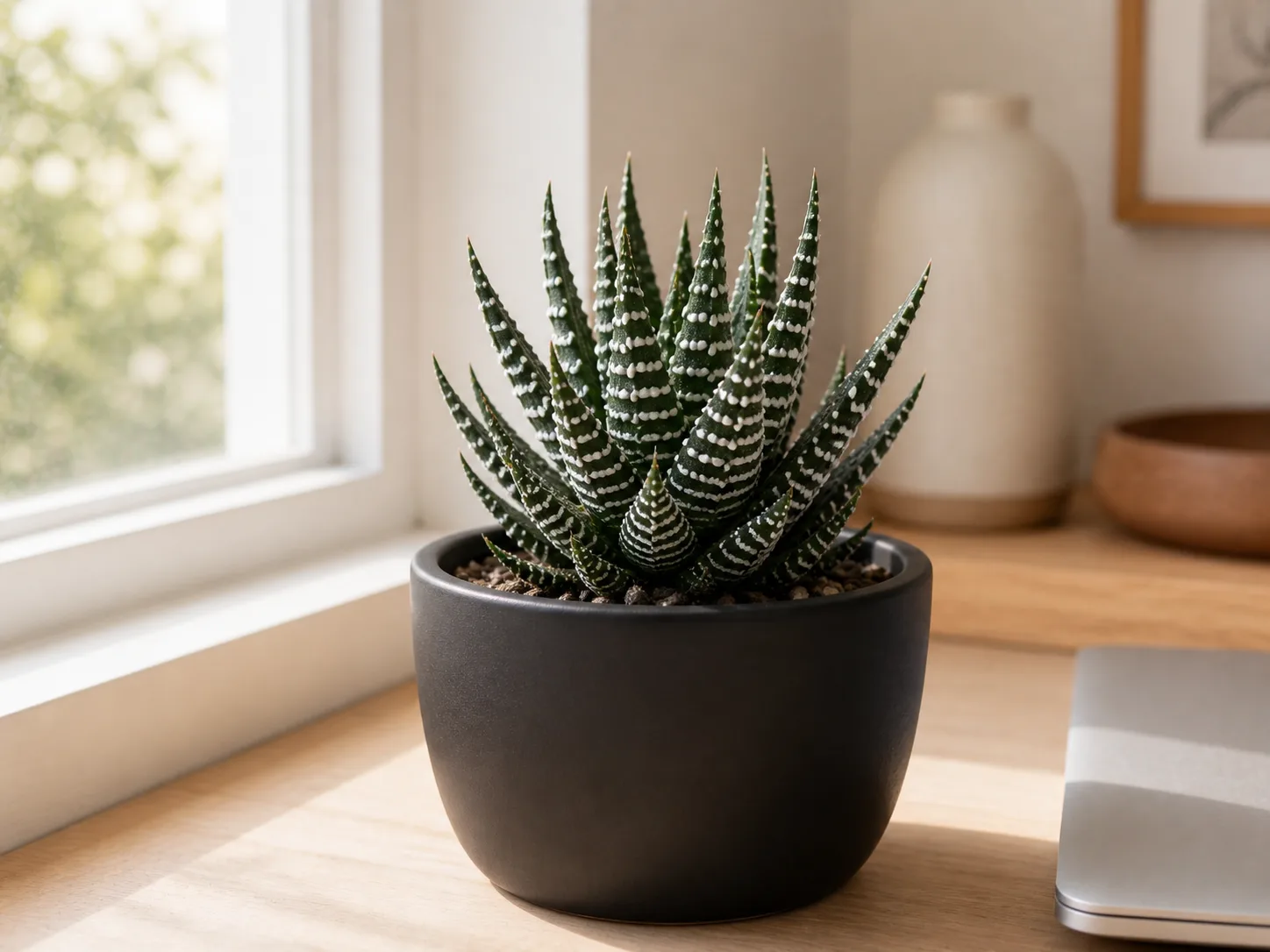
The Haworthia is a rare exception among succulents: it tolerates partial shade. Native to South Africa, it grows naturally sheltered by larger shrubs and enjoys filtered light. It’s the perfect succulent for a north-facing apartment or a low-light office where no cactus or Echeveria would survive.
What you really need to know
Compact plant (10-20 cm), ideal in a small pot on a desk, shelf or window sill. Non-toxic to pets and children. Slow but steady growth. Endless multiplication by offsets.
Light
Medium to bright indirect. Tolerates partial shade — north-facing windows or rooms without direct sun. Avoids intense sun which reddens then burns leaves. In low light, the plant stretches.
Watering
Every 21 to 30 days. Substrate completely dry between waterings. The Haworthia stores water in its fleshy leaves: it survives perfectly without water for 1-2 months. Avoid water in the centre of the rosette (rot).
Substrate
Cactus/succulent specific: very free-draining. Small pot (prefers being root-bound). Terracotta ideal.
Humidity and temperature
Indifferent to humidity (30-60 %). Tolerates 5-30 °C. Ideal 13-27 °C.
Mistakes to avoid
- Overwatering: root rot
- Intense direct sun: reddened then burnt leaves
- Pot too large: prefers being root-bound, otherwise water retention
- Standard potting soil: too much moisture
Toxicity
✅ Non-toxic to cats, dogs and children. Ideal for pet households.
Propagation
By offsets: the Haworthia regularly produces small plants at the base. Detach with their roots in spring. Leaf cutting possible but slow (2-3 months).
Popular cultivars
- Haworthia fasciata: typical white stripes
- Haworthia attenuata: very close, often confused
- Haworthia cooperi: transparent leaves (glass effect)
- Haworthia retusa: flat star-shaped leaves
Frequently asked questions
How often should I water this plant?
Water Haworthia every 21-30 days, adjusting for season, pot size and available light. Always check that the top of the substrate has started to dry before watering.
Is this plant toxic to cats and dogs?
Haworthia is classified as "non toxic". As a precaution, keep it away from pets that chew leaves and contact a vet if ingestion causes symptoms.
Why are its leaves turning yellow?
Yellow leaves on Haworthia most often come from overwatering, low light or recent stress. First check substrate moisture, root condition and placement.
Where should I place it at home?
Haworthia prefers medium light. Place it near a bright window without harsh direct sun, then adjust if leaves fade, brown or growth slows.
Is it beginner-friendly?
Haworthia is a good beginner plant if watering stays moderate and regular.
Sources and method
This fact sheet is based on public botanical references, recognized horticultural recommendations and the SPRAIA editorial method.
- Royal Botanic Gardens, Kew
- Missouri Botanical Garden
- Royal Horticultural Society
- GBIF
Diagnose and track this plant
SPRAIA is in private beta. Join the list to test plant identification, visual diagnosis and reminders tailored to each plant.
Join the private beta