Identifying the Main Indoor Plant Families
Learn to identify the main indoor plant families: Araceae, Marantaceae, Moraceae, Crassulaceae and more.
By SPRAIA editorial team · Method: botanical sources, field feedback and editorial validation
You’ve probably noticed some of your plants resemble each other — same leaf shapes, same water needs, same reactions to light. That’s no coincidence: they often belong to the same botanical family. And understanding these families gives you a powerful shortcut to know how to care for them.
Rather than learning each species’ needs one by one, knowing a plant’s family instantly gives you reliable clues about its watering, ideal light, substrate and weaknesses. It’s the difference between memorising 200 sheets and grasping 8 key principles. If you’re starting out, this guide perfectly complements our easy plants for beginners selection.
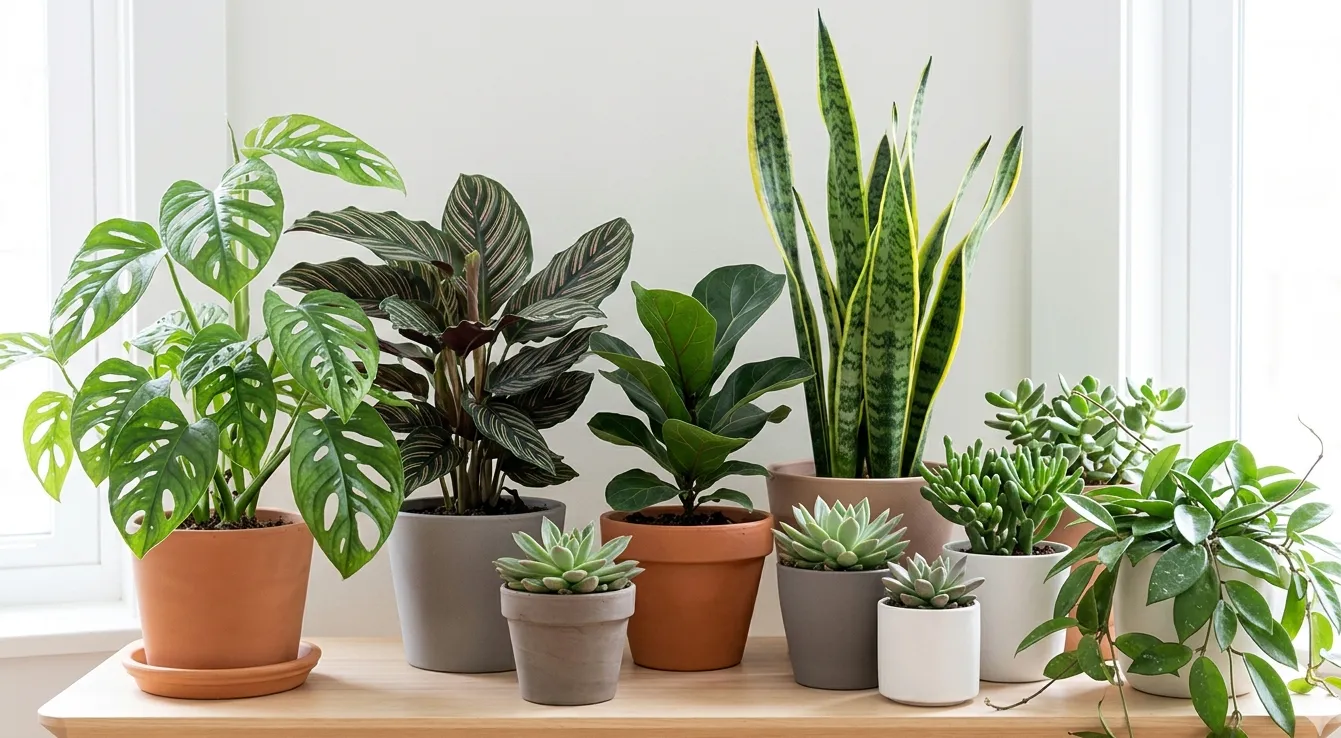
Here are the main families you’ll encounter most often indoors — and what they reveal about care.
Araceae — the tropical foliage stars
This is the queen family of indoor plants. If you own at least one houseplant, chances are it’s an Araceae. The family includes over 3,700 species, many of which have become must-haves in our homes.
Best-known members
- Monstera (deliciosa, adansonii) — the iconic fenestrated leaves. See our complete Monstera guide for everything.
- Philodendron (scandens, gloriosum, pink princess) — climbing or trailing, always spectacular
- Pothos (Epipremnum aureum) — the “impossible to kill” plant, perfect for beginners
- Alocasia — architectural foliage with pronounced veins. See our dedicated Alocasia guide.
- Anthurium — waxy flowers in coloured spathes
- Spathiphyllum (peace lily) — elegant white blooms, shade-tolerant
Common traits to recognise
Araceae share several distinctive features:
- Aerial roots: most develop visible roots along the stem, a legacy of their epiphytic life in tropical forests
- Spadix inflorescence: their typical flower is a spike (spadix) surrounded by a spathe, clearly visible on Anthurium and Spathiphyllum
- Often large, glossy leaves, sometimes perforated or deeply divided
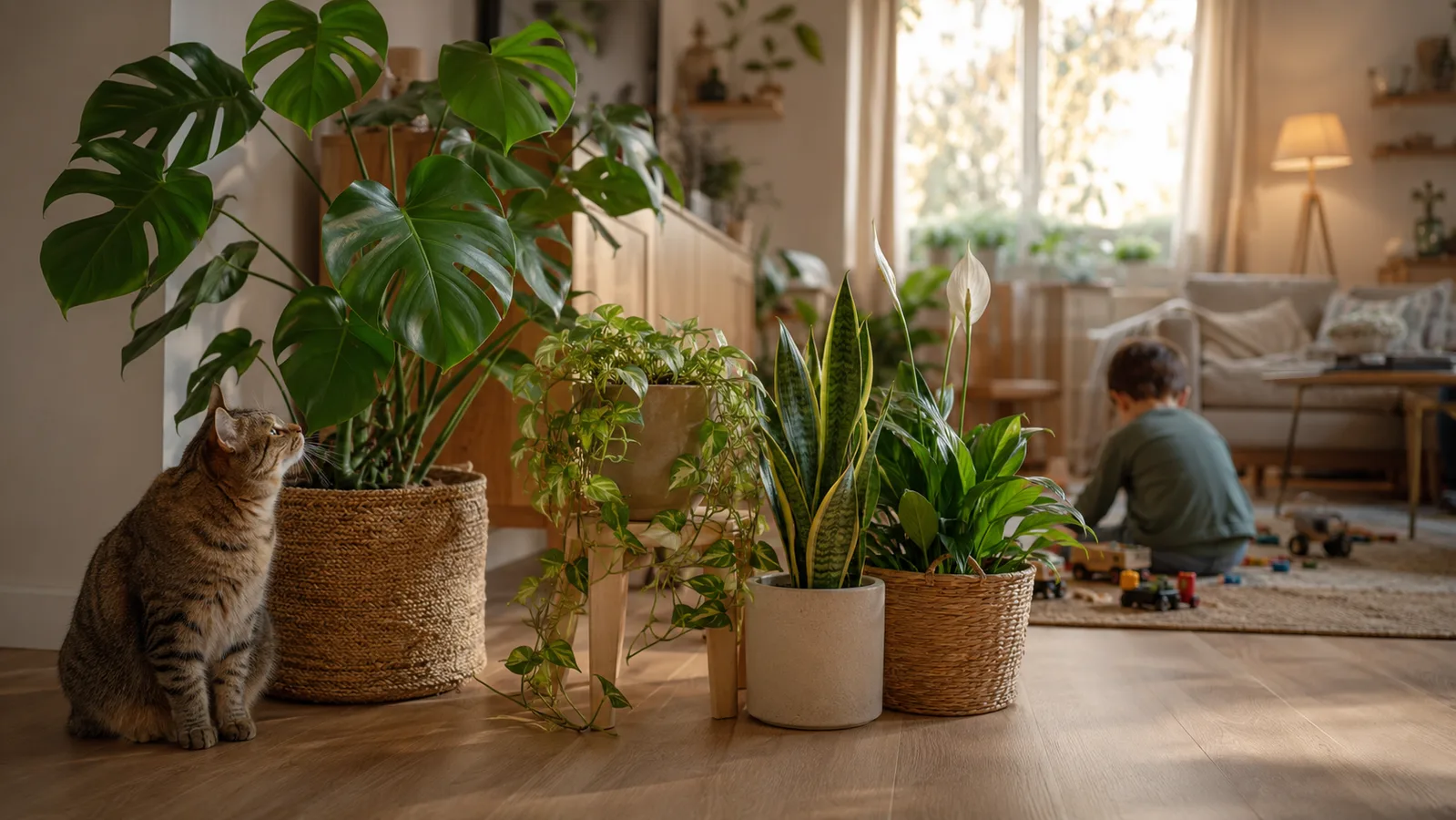
- Irritating sap: most contain calcium oxalate crystals — caution with kids and pets
Araceae family care
The golden rule: think tropical forest. Bright indirect light, high humidity, regular watering letting the substrate dry slightly between waterings. An aerated, free-draining substrate (potting soil, perlite, bark) suits almost all of them.
SPRAIA tip: photograph any Araceae with the app and SPRAIA identifies not just the exact species but also the family, giving adapted care recommendations. Identify your plants in 30 seconds with visual recognition.
Marantaceae — the moving plants
If you’ve ever seen a plant fold its leaves at night and unfold them in the morning, you’ve met a Marantaceae. This fascinating movement, called nyctinasty, earns them the nickname “prayer plants”.
Best-known members
- Calathea (orbifolia, medallion, lancifolia) — hand-painted-looking foliage patterns
- Maranta (leuconeura) — the original “prayer plant”, compact and colourful
- Stromanthe (triostar) — variegated foliage in pink, cream and green
- Ctenanthe (burle-marxii) — fascinating geometric patterns
Common traits to recognise
- Nyctinastic movement: leaves rise at night and lower during the day thanks to a swelling (pulvinus) at the petiole base
- Elaborate foliage patterns: stripes, spots, gradients — each species is a living painting
- Often purple leaf undersides: flip a leaf over, you’ll see purple or burgundy
- Compact, spreading habit: they generally stay low and bushy
Marantaceae family care
Marantaceae are the humidity divas. They demand high humidity (60 % minimum, ideally 70-80 %). Dry air is enemy #1: leaf edges brown and patterns fade.
- Light: moderate to filtered, never direct sun (leaves burn fast)
- Watering: substrate constantly slightly moist, with filtered or demineralised water (they hate limescale)
- Temperature: 18-24 °C, no cold drafts
- Substrate: rich, aerated, slightly moisture-retentive
SPRAIA tip: the app monitors your Marantaceae’s conditions and alerts you when humidity drops too low — before the tips brown.
Moraceae — the majestic Ficus
The Moraceae family includes figs, and indoors that translates to Ficus — a collection of plants as diverse as they are elegant.
Best-known members
- Ficus elastica (rubber plant) — large thick glossy leaves, dark green or burgundy
- Ficus lyrata (fiddle-leaf fig) — giant violin-shaped leaves, decor magazine star
- Ficus benjamina — small dense foliage, graceful tree habit
- Ficus microcarpa (ginseng) — often grown as bonsai with twisted aerial roots
Common traits to recognise
- White latex: break a stem or leaf, milky sticky sap flows out — the Moraceae signature. Caution, this latex can irritate skin.
- Tree-like habit: unlike many indoor plants, Ficus have a real tree silhouette with trunk and branches
- Alternate leaves: arranged alternately along the stem
- Stipules: small protective sheaths cover buds before new leaves emerge
Moraceae family care
Ficus love stability. They hate being moved and react to the slightest change (light, temperature, draft) by dropping leaves — especially Ficus benjamina.
- Light: bright, with some tolerated direct sun (except for variegated cultivars)
- Watering: moderate, let the substrate dry between waterings
- Temperature: 16-25 °C, stable
- Substrate: classic, well-drained
SPRAIA tip: when your Ficus drops leaves, photograph it with SPRAIA for a diagnosis. The app distinguishes normal leaf drop (acclimatisation) from a real problem (overwatering, lack of light).
Crassulaceae — the drought champions
Welcome to the world of succulents. Crassulaceae are the exact opposite of Marantaceae: where the latter demand humidity, Crassulaceae thrive in dryness.
Best-known members
- Echeveria — compact rosettes in pastel hues (pink, blue, pale green)
- Crassula ovata (Jade plant) — thick trunk and fleshy leaves, exceptional longevity
- Sedum — trailing or upright varieties, abundant blooms
- Kalanchoe — colourful long-lasting flowers, often given as gifts
Common traits to recognise
- Thick, fleshy leaves: water-engorged, they act as reservoirs — that’s the very principle of succulence
- Rosettes or compact habit: many form decorative symmetrical rosettes
- Thick cuticle or pruina: a waxy or powdery layer protects leaves from evaporation
- Slow growth: these plants aren’t in a hurry and live long
Crassulaceae family care
The rule is simple: less is more. Trap #1 is overwatering — a Crassulaceae watered like a Pothos rots within weeks.
- Light: maximum. Direct sun welcome, at least 4-6 hours per day
- Watering: copious but very spaced. Let substrate dry completely between waterings. In winter, once a month can suffice.
- Temperature: 10-30 °C, tolerate winter cool well
- Substrate: very free-draining, special cactus mix (coarse sand, perlite, little potting soil)
Asparagaceae — the shade survivors
Formerly scattered across several families (Liliaceae, Agavaceae, Dracaenaceae), these plants are now grouped under Asparagaceae. Good news: they share bulletproof resilience.
Best-known members
- Sansevieria (snake plant) — rigid upright leaves, near-indestructible
- Dracaena (marginata, fragrans, trifasciata) — small palm-tree habit, very decorative
- Aspidistra — “cast-iron plant”, Victorian shade survivor
Common traits to recognise
- Linear or blade-like leaves: long, often rigid, sometimes edged in yellow or cream
- Underground rhizomes: they spread via horizontal underground stems
- Neglect tolerance: they handle shade, drought, missed waterings and dry air
- Slow but steady growth: these plants last for years with minimum care
Asparagaceae family care
This is the family for those who “don’t have a green thumb”. Their tolerance is remarkable:
- Light: from shade to indirect sun, they adapt to almost anything
- Watering: infrequent. Let dry well between waterings. The Sansevieria can survive a month without water.
- Temperature: 10-28 °C, very adaptable
- Substrate: well-drained, no particular requirement
Apocynaceae — Hoyas and their wax flowers
The Apocynaceae family is vast, but indoors it’s mostly the Hoya genus that shines — literally, thanks to its wax-like leaves and flowers.
Distinctive Hoya traits
- Thick waxy leaves: often succulent, sometimes spotted or variegated
- Umbel flowers: clustered into spherical bouquets, fragrant, with a porcelain or candy look — hence the nickname “porcelain flower”
- Climbing or trailing habit: perfect for hanging baskets or trellises
- Milky sap: like Moraceae, Hoyas produce white latex
Hoya family care
- Light: bright indirect, a few hours of direct sun encourage flowering
- Watering: moderate, let dry between waterings. They tolerate dryness better than excess.
- Humidity: appreciated but not essential (unlike Marantaceae)
- Don’t cut peduncles: Hoyas rebloom on the same flower stalks year after year
Frequently asked questions about plant families
Classic questions on botanical classification applied to houseplants.
- Because plants from the same family often share the same needs (light, humidity, substrate type) and the same vulnerabilities (diseases, pests). Knowing your new plant is an Araceae tells you immediately it likes bright indirect light, free-draining substrate and is likely toxic to pets — without searching fact sheet by fact sheet.
- The Araceae (aroids) dominate: Monstera, Philodendron, Pothos, Anthurium, Alocasia, Spathiphyllum, Dieffenbachia, ZZ plant. They share a characteristic inflorescence (spathe + spadix), a preference for tropical humidity and indirect light, and a common toxicity linked to calcium oxalate crystals.
- Yes, they are two distinct genera in the Araceae family. They look very similar but the Monstera develops fenestrations (holes and splits in the leaves) with maturity, while Philodendrons generally keep entire heart-shaped or lobed leaves. Their care needs are nearly identical.
- No, "succulent" is a descriptive term (water-storing plants), not a botanical family. Succulents span several families: Crassulaceae (Echeveria, Crassula, Sedum, Kalanchoe), Asparagaceae (Sansevieria, formerly separate), Asphodelaceae (Aloe, Haworthia), Cactaceae (cacti). Needs vary by family — an Echeveria and a Sansevieria don't water the same way.
- Three reliable clues: leaf shape (entire, divided, fleshy, in a rosette), flower type if present (spathe for Araceae, star-shaped for Crassulaceae), and sap characteristics (white latex = Moraceae or Euphorbiaceae). Photo identification (via SPRAIA or a botany book) remains the fastest way to confirm.
Special mention: Orchidaceae and Begoniaceae
Orchidaceae (Orchids)
The largest flowering plant family in the world (about 28,000 species). Indoors, you’ll mostly find the Phalaenopsis — the moth orchid. Epiphytic in nature, they demand a bark substrate, indirect light and a weekly soak. Their spectacular blooms last for months.
Begoniaceae (Begonias)
A family surprising in its diversity: metallic, spiralled, spotted foliage, and abundant blooms. Begonia rex are grown for their extraordinary leaves, while tuberous Begonias offer spectacular double flowers. They love humidity, indirect light and rich aerated substrate.
Family comparison table
| Family | Distinctive trait | Watering | Light | Humidity | Examples |
|---|---|---|---|---|---|
| Araceae | Aerial roots, spadix | Regular, slightly moist soil | Bright indirect | High (60 %+) | Monstera, Pothos, Alocasia |
| Marantaceae | Nyctinastic movement | Constant, soft water | Moderate to filtered | Very high (70 %+) | Calathea, Maranta |
| Moraceae | White latex, tree habit | Moderate, let dry | Bright, some sun | Medium | Ficus elastica, lyrata |
| Crassulaceae | Fleshy leaves | Very spaced | Direct sun | Low | Echeveria, Crassula |
| Asparagaceae | Rigid leaves, rhizomes | Infrequent | Shade to indirect | Low to medium | Sansevieria, Dracaena |
| Apocynaceae | Waxy leaves, umbel flowers | Moderate | Bright indirect | Medium | Hoya |
| Orchidaceae | Epiphytes, complex flowers | Weekly soak | Indirect | High | Phalaenopsis |
| Begoniaceae | Metallic foliage | Regular | Indirect | High | Begonia rex |
Why knowing the family changes everything
Understanding botanical families gives you a mental framework to anticipate any plant’s needs, even if you’ve never seen it before:
- Buying a plant labelled “Philodendron” with no further detail? You know it’s an Araceae: indirect light, humidity, regular watering.
- Someone gives you an unknown plant with thick rosette leaves? Think Crassulaceae: sun and minimal watering.
- Striped leaves moving at night? Marantaceae: maximum humidity and soft water.
This logic transforms a baffled beginner into a confident gardener. Instead of panicking before an unknown plant, you observe, classify, and act.
Conclusion: from classification to personalised care
Botanical families aren’t just a matter for white-coated scientists. They’re a practical daily tool for all plant lovers. By learning to recognise each family’s distinctive traits — aerial roots, fleshy leaves, nocturnal movement, white latex — you develop an expert eye that serves you with every new plant encounter.
To take it further, SPRAIA combines this botanical knowledge with artificial intelligence. Photograph any plant: the app identifies the species, tells you the family, and provides a complete personalised care plan. Botany made accessible — in your pocket, in 30 seconds.
SPRAIA tip: the app doesn’t just identify your plants. It groups your collection by family and adjusts watering, repotting and fertilising reminders based on each group’s specific needs. No more beginner mistakes.