Alocasias: Origins, Species and Care Secrets
Discover the Alocasias, fascinating tropical plants. Origins, popular species, and what they love or hate.
By SPRAIA editorial team · Method: botanical sources, field feedback and editorial validation
With their architectural leaves and pronounced veins, Alocasias rank among the most spectacular indoor plants. Nicknamed “elephant ears” for their characteristic foliage shape, they fascinate as much as they intimidate. Rightly so: Alocasias have a reputation for being demanding. But by understanding their origins, you’ll hold the key to keeping them in top form.
🌿 Quick fact sheet: Alocasia Amazonica care summary on its dedicated page.
Origins: Southeast Asian tropical forests
Alocasias are native to the humid tropical forests of Southeast Asia — mainly Borneo, the Philippines, Malaysia and parts of India and Sri Lanka. They naturally grow under dense canopy, in an environment that is:
- Hot and stable (22-30 °C year-round)
- Very humid (often 80 %+)
- Filtered-lit (rarely direct sun)
- Free-draining substrate (rich in decomposing organic matter)
Reproducing these conditions indoors is the entire challenge.
Popular species
- Alocasia × amazonica (Polly): dark green, silver-veined heart-shaped leaves
- Alocasia frydek: emerald velvet, silvery veins
- Alocasia black velvet: small black velvet leaves, white veins
- Alocasia stingray: leaves shaped like… a stingray
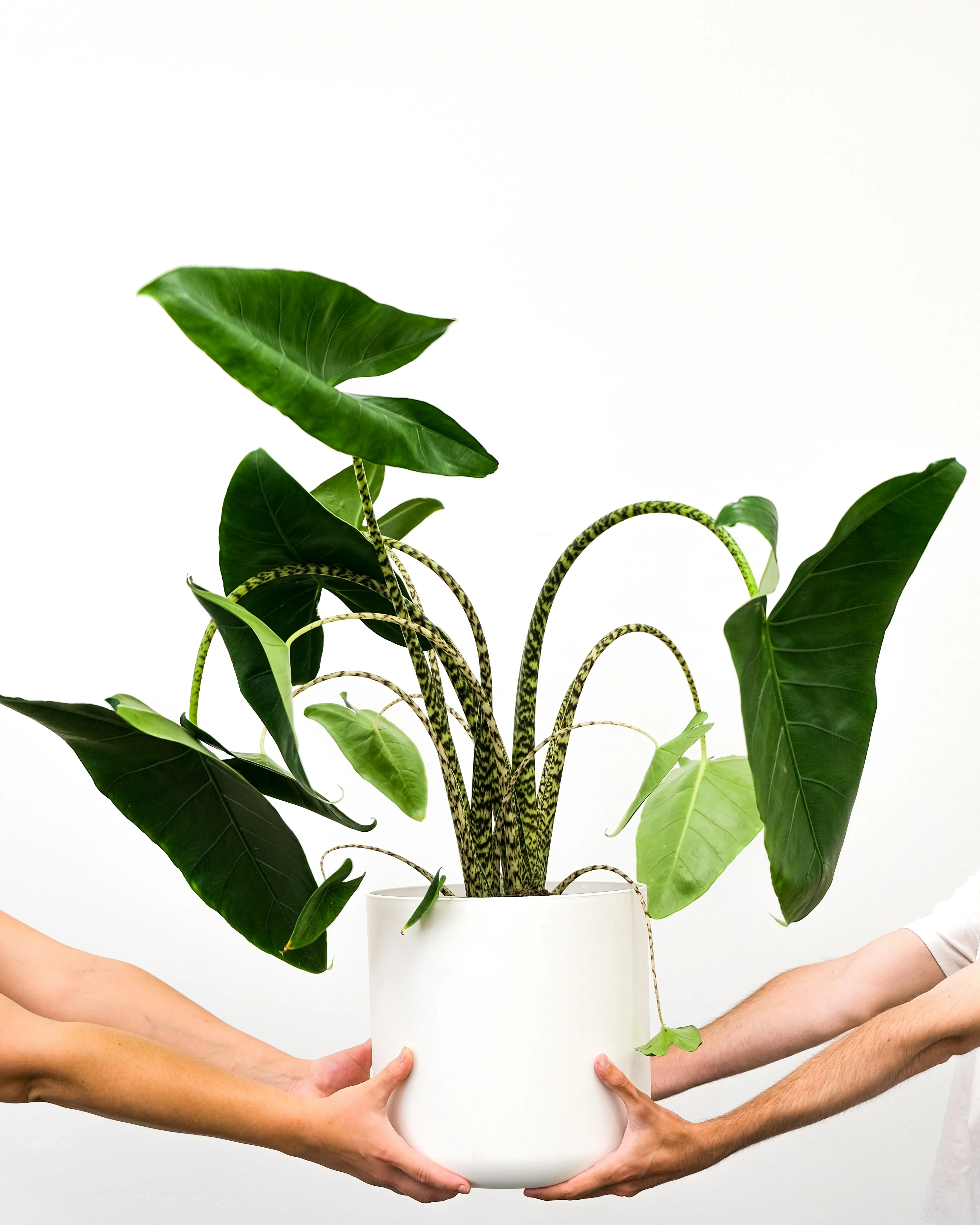
- Alocasia zebrina: zebra-striped petioles
- Alocasia reginula “Black Velvet”: nearly black leaves, dramatic
- Alocasia dragon scale: green textured leaves like dragon scales
Light: bright indirect, mandatory
Alocasias need a lot of light, but never direct. Without sufficient light: stalled growth, smaller leaves, plant declines. With direct sun: scorched leaves, dehydration.
The ideal spot: 1-2 m from a south-facing window with sheer curtain, or directly facing east/west. For more, see our indoor plant light guide.
Watering: the right balance
Alocasias hate two extremes equally:
- Overwatering: rapid root rot, especially in low light
- Drying out: leaves curl, brown edges, drop
The right protocol: water when the top 2-3 cm of substrate are dry. Use filtered or rain water (sensitive to limescale). On average every 5-7 days in summer, every 7-14 in winter.
Humidity: 60 % minimum
This is the most demanding point. Below 50 % humidity, leaf edges brown within weeks. Solutions:
- Air humidifier (most effective)
- Group with other tropicals
- Pebble tray + water under pots
- Daily misting (less effective alone)
Substrate
A free-draining, aerated mix: 40 % houseplant potting soil + 30 % perlite + 20 % orchid bark + 10 % activated charcoal. Pot with drainage holes mandatory.
Common problems
Yellow leaves
Often overwatering. Unpot, check roots, cut black ones. See our yellow leaves guide.
Brown edges
Insufficient humidity or hard water. Add a humidifier, switch to filtered water.
Winter dormancy
Alocasias often go dormant in winter (leaf drop). Don’t panic, reduce watering, wait for spring.
Pests
Spider mites and thrips love them. Inspect underside of leaves regularly. See our thrips and mealybug guides.
Toxicity
⚠️ Highly toxic to cats, dogs and humans (calcium oxalate). Wear gloves when repotting.
Frequently asked questions about Alocasias
The questions that come up most when facing these capricious but spectacular elephant ears.
- Not necessarily. Many Alocasia species go dormant in winter and shed their entire foliage while the corm (underground bulb) stays alive. Reduce watering sharply, keep the substrate barely moist, maintain a minimum of 18 °C and place the pot in a bright corner. New shoots appear within 4 to 8 weeks in spring.
- Either a natural cycle: Alocasias often keep only 4 to 6 leaves at a time; when a new one forms, an old one is dropped. Or overwatering, the most common cause. Check drainage, space out watering and feel the substrate before each session. If several leaves yellow rapidly, unpot to inspect the roots.
- When the top 2-3 cm of substrate feel dry to the touch — about every 5 to 7 days in summer, every 2 to 3 weeks in winter. Alocasia hates a permanently soaked substrate but doesn't tolerate prolonged drought either. Use a very free-draining substrate (potting soil + perlite + orchid bark) to limit rot risk.
- Yes, strongly. All Araceae (Alocasia, Monstera, Philodendron, Anthurium) contain calcium oxalate crystals that cause intense oral irritation, vomiting and mouth swelling. Alocasia is even more concentrated than its cousins. Keep it out of reach of cats, dogs and young children.
- Either sun burn (place it behind a sheer curtain), or lack of ambient humidity (Alocasia likes 60-80% humidity), or a thrips or spider mite attack. Inspect the leaf undersides with a magnifier — if you see small moving dots or fine webs, treat immediately with soft soap.
Conclusion
Alocasias are stunning plants that reward those who understand their tropical needs. Demanding but not impossible. SPRAIA helps you track humidity, watering and the warning signs of these divas — for foliage that wows year-round.