Mealybugs and Scale Insects: Identify and Eliminate These Stubborn Pests
Complete guide to recognising and treating mealybugs and scale insects on indoor plants. Natural methods, alcohol, Castile soap and prevention.
By SPRAIA editorial team · Method: botanical sources, field feedback and editorial validation
If thrips are the most dreaded pests, scale insects come second among the most frequent indoor plant parasites. These small sap-sucking insects are particularly stubborn: protected by a waxy shell or cottony clump, they resist many classic treatments. Don’t panic though — with the right methods and a bit of perseverance, you can wipe them out. Here’s everything you need to identify, eliminate and prevent their return.
Recognising mealybugs and scales
The different scale-insect types
Not all scales look the same. Knowing the varieties helps you adapt your treatment.
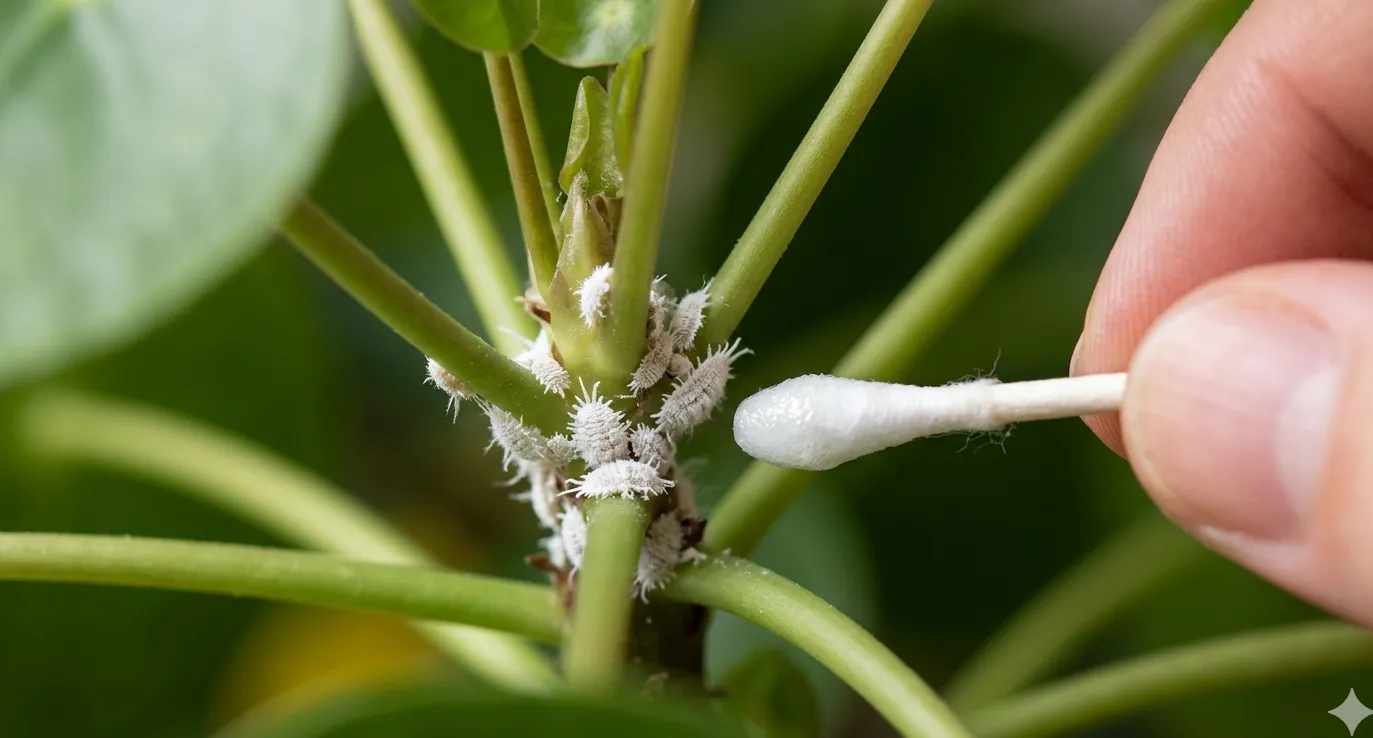
- Mealybugs — the most common indoors. They appear as white cottony clumps, often nested in leaf axils, along stems and under leaves. They’re 2-5 mm and move slowly.
- Soft scale — recognisable by their brown or beige shell, flat and oval, glued to stems and leaves. They look immobile and resemble small natural plant outgrowths. That’s what makes them hard to spot.
- Armoured scale — similar to soft scale but with a more domed, often darker shell. They abundantly secrete honeydew, a sticky substance that attracts ants and encourages sooty mould (a black fungus).
Signs of an infestation
Even without seeing the insects directly, certain clues should alert you:
- White cottony clumps in leaf axils and along stems
- Sticky substance (honeydew) on leaves and around the pot
- Sooty mould — a black powdery deposit on leaves, caused by a fungus growing on the honeydew
- Yellowing or prematurely falling leaves (see our guide on yellow leaves and their causes)
- Slowed or distorted growth, stunted new growth
- Ants climbing up and down stems — they “farm” scales to harvest their honeydew
SPRAIA tip: photograph suspect clumps with the app and our AI distinguishes mealybugs from limescale residues or white moulds in seconds. Early diagnosis is the key to fast treatment.
Most-targeted plants
Some plants are real scale magnets:
- Ficus (elastica, lyrata, benjamina) — woody stems offer ideal hiding spots
- Succulents and cacti — mealybugs love nesting between fleshy leaves
- Orchids — especially Phalaenopsis, in leaf sheaths
- Indoor citrus (lemon, orange) — historic scale targets
- Monstera — nodes and leaf sheaths are perfect refuges (see our complete Monstera guide)
- Indoor palms (Areca, Kentia)
- Strelitzia and Banana plants
If you own several of these, regular inspection is essential. Scales spread easily from one plant to another, especially when grouped together.
Method 1: isopropyl alcohol (shock treatment)
This is the most immediate and effective method against mealybugs, and the one most experienced collectors recommend.
Materials:
- 70 % isopropyl alcohol (rubbing alcohol, from pharmacy)
- Cotton swabs or makeup pads
- A small spray bottle (optional)
Application:
- Soak a cotton swab in 70 % alcohol
- Apply directly to each visible mealybug — alcohol instantly dissolves their waxy coating
- For more widespread infestations, spray a 50/50 alcohol-water mix on affected areas
- Focus on leaf axils, along veins and under leaves
- Repeat every 3 days for 2-3 weeks
Precautions: test first on one leaf. Some sensitive plants (ferns, Calathea) can react badly to pure alcohol. If so, dilute more.
The advantage? Action is instant: the mealybug dies on contact. The ideal first-line treatment.
Method 2: Castile soap (natural treatment)
Castile soap is an indispensable ally in biological control, effective against many pests — as covered in our thrips guide.
Recipe:
- 1 tbsp liquid Castile soap (real, olive- or linseed-oil based)
- 1 L lukewarm water
- Optional: 1 tsp 70 % alcohol to boost action
Application:
- Mix the soap into lukewarm water until fully dissolved
- Spray generously on the whole plant, top and bottom of leaves
- Focus on infested areas and classic hiding spots (axils, nodes, sheaths)
- Let act 1-2 hours
- Rinse with clean water in the shower
- Repeat 2 times per week for 4 weeks
Castile soap acts by suffocation: it blocks the insect’s breathing pores. It also softens the waxy shell of scales, making them vulnerable.
Method 3: neem oil
Neem oil is a natural insecticide that acts both by contact and ingestion. It disrupts the scales’ hormonal cycle and prevents larvae from developing.
Recipe:
- 5 mL pure neem oil (cold-pressed)
- 1 L lukewarm water
- 2-3 drops of liquid soap (acts as emulsifier)
Application:
- Mix vigorously — oil and water don’t mix naturally
- Spray in the evening (neem oil degrades in direct light)
- Cover the whole plant, focus under leaves and in folds
- Repeat weekly for 4 to 6 weeks
- Don’t spray in full sun to avoid leaf burns
Neem oil has a unique advantage: its residual effect. Even after drying, it continues repelling scales for several days.
Method 4: biological control (Cryptolaemus)
For large collections or persistent infestations, biological allies are an elegant and lasting solution.
The champion of anti-mealybug control is Cryptolaemus montrouzieri, a small Australian ladybug specialised in mealybug predation. Its larva, covered in white filaments, itself looks like a mealybug — perfect camouflage to infiltrate colonies.
Other useful allies:
- Leptomastix dactylopii — microscopic parasitoid wasp that lays eggs in mealybugs
- Anagyrus pseudococci — another highly effective complementary parasitoid
- Chrysoperla carnea (lacewings) — larvae devour young mealybugs
Success conditions:
- Temperature above 20 °C (allies are inactive below)
- Adequate ambient humidity (> 50 %)
- Don’t use chemical insecticides in parallel (they also kill the allies)
- Order from suppliers specialised in biological control
This method is ideal for greenhouses and large collections, but can also work in a well-heated apartment.
Method 5: systemic insecticides (last resort)
When all natural methods have failed and the infestation is out of control, systemic insecticides represent the nuclear option.
- Products based on spirotetramat — disrupt lipid synthesis in scales
- Insecticides based on acetamiprid — systemic neonicotinoid, root-absorbed
- Products containing spinosad — naturally derived (bacterial fermentation), allowed in organic farming
Caution:
- These products are absorbed by the plant and circulate in the sap — they kill scales feeding on it
- Toxic to pollinators and biological allies
- Use only indoors and as a last resort
- Strictly respect the doses and intervals on the packaging
- Keep out of reach of children and pets
Methods summary
| Method | Effectiveness | Difficulty | Eco-friendly | Cost |
|---|---|---|---|---|
| 70 % alcohol | ★★★★ | Easy | Yes | € |
| Castile soap | ★★★☆ | Easy | Yes | € |
| Neem oil | ★★★☆ | Easy | Yes | € |
| Biological control | ★★★★ | Medium | Yes | €€€ |
| Systemic insecticide | ★★★★ | Easy | No | €€ |
Our recommendation: start with alcohol for immediate shock treatment, then follow up with Castile soap as background treatment. Neem oil as a complement offers residual protection. Combining these three methods is the most effective strategy for most plant parents.
Prevention: stopping mealybugs from returning
The best treatment is the one you never need to apply. Essential preventive gestures:
- Systematic quarantine — isolate every new plant for 3 weeks before adding to your collection. Inspect every nook thoroughly.
- Regular inspections — examine leaf undersides, axils and nodes at least once a week. Mealybugs hide where you don’t look.
- Leaf cleaning — wipe leaves with a damp cloth once or twice a month. This removes any eggs and young larvae before they settle.
- Airflow — mealybugs thrive in stagnant warm air. Ensure good circulation around your plants.
- Avoid over-fertilising — excess nitrogen produces rich sap and tender growth, a feast for mealybugs. Fertilise moderately.
- Space your plants — don’t pack them against each other. Adequate space limits spread in case of infestation.
- Monthly shower — a good rinse in the shower mechanically dislodges any pests and cleans leaves.
SPRAIA tip: enable inspection reminders in the app. Regular visual checks with comparison photos let you detect a budding infestation well before it becomes problematic. The AI spots subtle changes the naked eye might miss.
How long to eradicate mealybugs?
Honest answer: mealybugs are slower to eliminate than thrips. A mealybug life cycle lasts 4 to 8 weeks depending on temperature. Scale insects can take even longer.
Realistic treatment calendar
- Week 1-2: intensive treatment with alcohol + Castile soap every 3 days. You’ll see a visible decrease.
- Week 3-4: continue Castile soap twice weekly. Add neem oil. New hatches treated as they appear.
- Week 5-8: reduce to one treatment per week. Stay vigilant — hidden eggs may hatch.
- Week 9-12: regular inspections without active treatment. If no new mealybugs appear for 3 weeks, you’ve won.
Golden rule: continue treatment at least 3 weeks after the last mealybug seen. Patience makes the difference between complete eradication and recurrence.
Common mistakes to avoid
- Treating once and thinking it’s done — eggs survive all contact treatments
- Treating only the infested plant — inspect and treat all neighbours
- Forgetting to clean the pot and saucer — mealybugs can hide in crevices
- Reintegrating the plant too soon without an observation period
Frequently asked questions about mealybugs
The questions that come up when you discover these stubborn pests on your plants.
- Mealybugs look like small cottony white clusters, often in leaf axils or under petioles; they're mobile and move slowly. Scale insects (lecanium or armored scales) form small brown or beige bumps, attached to stems and the underside of leaves, motionless to the naked eye. Treatment is the same but scales need more patience.
- Count 4 to 8 weeks of regular treatment (once a week), sometimes more for armored varieties. Eggs resist treatments and hatch in successive waves, so you must repeat applications to cover the entire cycle. Only stop treating after 3 weeks with no visible pests.
- Yes, it's one of the fastest treatments: applied with a cotton swab to each pest, alcohol immediately dissolves the waxy coating and kills the insect. For light infestations it's enough; for heavy ones, combine with a Castile soap spray (5% in warm water) over the entire plant.
- Three common causes: eggs hidden at the base of leaves or in the substrate, contamination from a neighbouring plant, or favorable conditions (dry heat, plant stressed by watering or fertilizer). Isolate the treated plant, inspect everything around it and correct the environment (humidity, light, moderate fertilization).
- Not always. As long as 30-50% of foliage stays healthy and the main stem isn't covered, treat it in quarantine. If the plant is dying, heavily defoliated, and mealybugs have colonized the entire base, it's better to sacrifice it to avoid contaminating the rest of your collection — disinfect the pot before reusing.
Conclusion
Mealybugs are stubborn opponents but far from invincible. Success rests on three pillars: fast identification, combined regular treatment, and rigorous prevention. Isopropyl alcohol for immediate action, Castile soap for background treatment, and regular inspections to prevent recurrence — that’s the winning formula.
If you suspect an infestation, don’t delay. The earlier you act, the simpler and faster the treatment. And with SPRAIA, you have a pocket ally: instant photo diagnosis, precise scale-type identification, treatment reminders and visual progress tracking. Your plants deserve protection as serious as your passion.