Thrips: How to Get Rid of Them Effectively
Complete guide to identifying and eliminating thrips on your plants. Natural, chemical and preventive methods.
By SPRAIA editorial team · Method: botanical sources, field feedback and editorial validation
Thrips are one of the most dreaded pests by plant collectors. These tiny insects (1-2 mm) feed on your plants’ sap and can cause major damage in record time. Good news: with the right methods, you can wipe them out.
Recognising thrips
What do they look like?
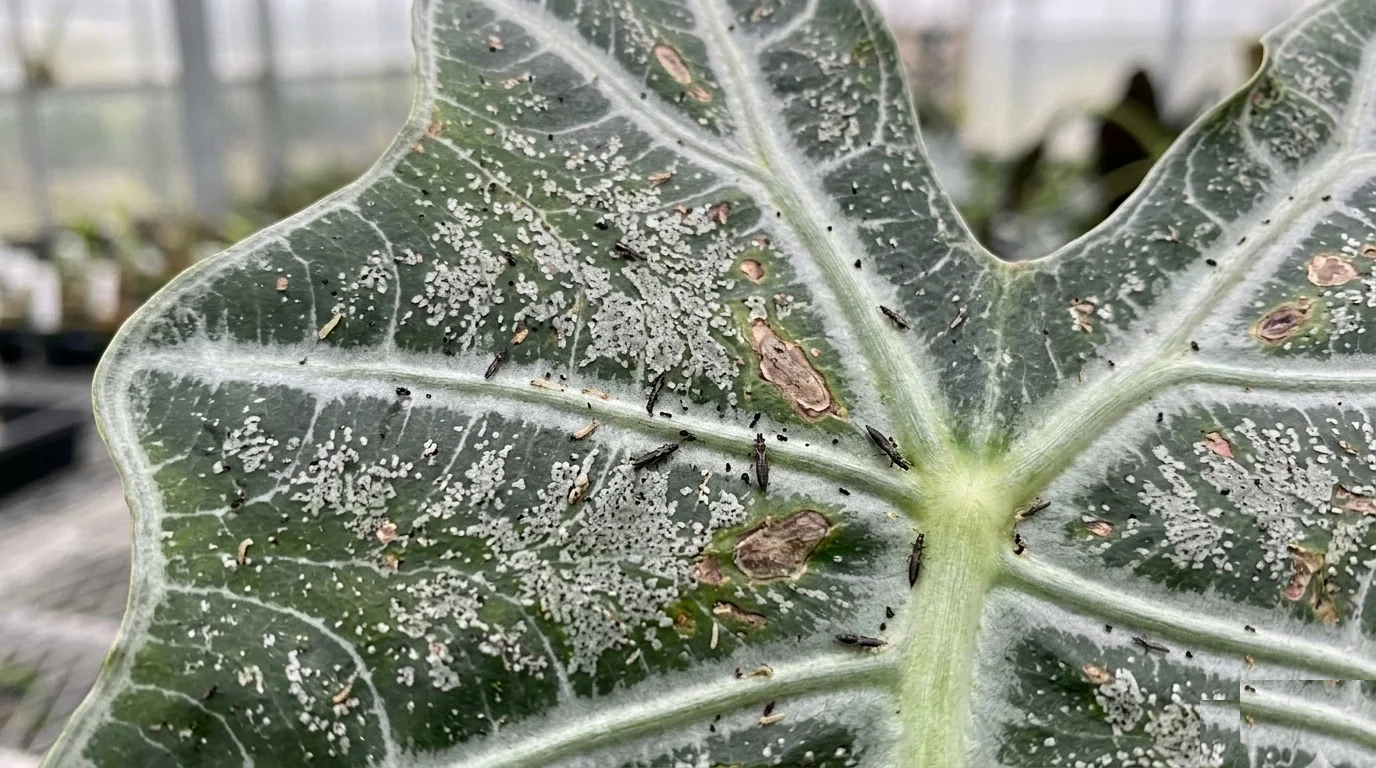
Thrips are tiny elongated insects (1-2 mm), white to beige as larvae and brown to black as adults. They have fringed wings but mostly move by jumping. Their wingless larvae are the most voracious.
Characteristic damage
- Silvery patches on leaves (cells emptied of content)
- Tiny black dots (excrement) on top and bottom of leaves
- Deformed, curled or shrivelled leaves
- Slowed or stopped growth
SPRAIA tip: photograph the damage and our AI identifies the problem in seconds. Often more reliable than the naked eye.
If you also see yellowing leaves, thrips could be the cause.
Most affected plants
- Monstera and Philodendron
- Alocasia (Alocasia guide)
- Ficus (elastica, lyrata)
- Orchids
- Flowering plants (thrips love pollen)
En pratique, étape par étape
Complete protocol from spotting to eradicating a thrips infestation over 6-9 weeks.
-
Confirm the diagnosis
Inspect undersides of leaves under bright light. Look for silvery patches, black dots (excrement) and tiny elongated insects. A close-up photo analysed by SPRAIA confirms ID quickly.
-
Isolate affected plants
Move infested plants away from the rest of the collection immediately. Thrips spread fast, especially on Monstera, Alocasia, Ficus and orchids.
-
Shower the plant in lukewarm water
Run the plant under lukewarm water to dislodge as many adults and larvae as possible. Focus under leaves. Let dry a few hours before next step.
-
Spray Castile soap solution
Mix 1 tbsp Castile soap in 1 L lukewarm water. Spray generously top and bottom. Let act 30 min then rinse with clean water.
-
Set up blue sticky traps
Place blue traps near infested plants: they catch winged adults and let you monitor progress. Always combine with direct treatment.
-
Renew every 3-4 days for 3 weeks
Castile soap doesn't kill eggs. To break the breeding cycle (2-3 weeks depending on temperature), treat 3 full cycles, i.e. 6-9 weeks minimum, without slacking.
-
Switch to neem oil if persistent
If after 3 weeks of soap the infestation continues, switch to 5 mL neem oil + a few drops of soap in 1 L water, sprayed in the evening once a week for 4 weeks.
Method 1: Castile soap (natural)
Castile soap is the first line of defence and the preferred eco-friendly method.
Recipe: 1 tbsp liquid Castile soap + 1 L lukewarm water + optional drops of neem oil.
Application: spray generously top and bottom, let sit 30 min, rinse, repeat every 3-4 days for 3 weeks minimum. The soap suffocates larvae and adults but doesn’t kill eggs — repetition is key.
Method 2: blue sticky traps
Thrips are attracted to blue (unlike fungus gnats attracted to yellow).
- Place blue traps near infested plants
- They mainly catch winged adults
- Useful for monitoring infestation scale
- Combine with direct treatment
Method 3: neem oil
Neem oil is a natural insecticide that disrupts thrips’ reproductive cycle.
Recipe: 5 mL pure neem oil + 1 L lukewarm water + a few drops of soap (emulsifier).
Application: mix well, spray in the evening (neem degrades in light), cover the whole plant, repeat weekly for 4 weeks.
Method 4: biological predators
For large collections or severe infestations:
- Amblyseius cucumeris — predatory mites that devour thrips larvae
- Orius laevigatus — predatory bugs eating all stages
- Steinernema feltiae — nematodes applied to soil for pupating larvae
Order online and release directly on plants. The most ecological method.
Prevention: avoiding thrips’ return
The best treatment is prevention:
- Inspect every new plant for 2 weeks before adding to your collection
- Shower your plants once a month — thrips hate water
- Maintain high humidity (>60 %) — thrips thrive in dry air
- Clean leaves regularly with a damp cloth
- Monitor undersides of leaves regularly, especially new growth
How long to get rid of them?
A complete thrips cycle lasts 2-3 weeks depending on temperature. So treat for at least 3 cycles (6-9 weeks) to be sure all generations, including eggs, are eliminated. Don’t drop your guard too soon.
Frequently asked questions about thrips
Everything you need to know about these tiny but formidable pests.
- Typical signs: small silvery or leaden spots on leaves, black dots (frass) on the underside, leaves that deform and brown at the edges, slowed growth. Adult thrips measure 1-2 mm, thin and elongated, brown or black; they move quickly when disturbed. Inspect the leaf undersides and new growth with a magnifier.
- Three reasons: they have a short life cycle (10-15 days) with several stages — larvae, soil nymphs, winged adults — each requiring specific treatment. They lay their eggs inside plant tissue, out of reach of sprays. And they fly from plant to plant, quickly contaminating the whole collection. You must treat 6 to 9 weeks to cover 3 full cycles.
- On houseplants, the winning combination: diluted Castile soap (5%) sprayed weekly on adults and larvae, blue sticky traps to catch flying adults, and neem oil to smother eggs and larvae. For massive infestations, biological predators (predatory mites Amblyseius cucumeris or Orius laevigatus) are devastating but require some expertise.
- Very rarely and harmlessly. A few thrips species can occasionally bite human skin when disturbed, causing a mild short-lived itch. No risk of disease transmission — they feed only on plant sap. Your plants are the only real victims.
- Systematic 3-4 week quarantine for any new plant before integrating into the collection, weekly inspection of leaf undersides, immediate removal of severely affected plants, and regular cleaning of the environment (dust, plant debris). Blue traps left permanently alert you at the slightest return.
Conclusion
Thrips are persistent but with consistency you’ll beat them. SPRAIA helps you set treatment reminders, track progress with photos, and document what works for your plants. Speed is key: the earlier you act, the less damage.