Fungus Gnats: How to Eliminate Them Permanently
Complete guide to getting rid of fungus gnats (sciarids): natural methods, traps, organic treatments and lasting prevention.
By SPRAIA editorial team · Method: botanical sources, field feedback and editorial validation
It’s probably the most annoying indoor-gardening pest — without being the most dangerous. Fungus gnats (or sciarids) are those tiny black flies that take off by the dozen the moment you touch a pot, that crash into your evening glass of wine and end up in your eyes or nose. Beyond the nuisance, their larvae harm young roots and weaken cuttings. Good news: they’re eliminable for good with a methodical approach. Here’s what you need to know.
Identifying fungus gnats
First: don’t confuse pests. Several similar small fliers exist indoors but require different treatments.
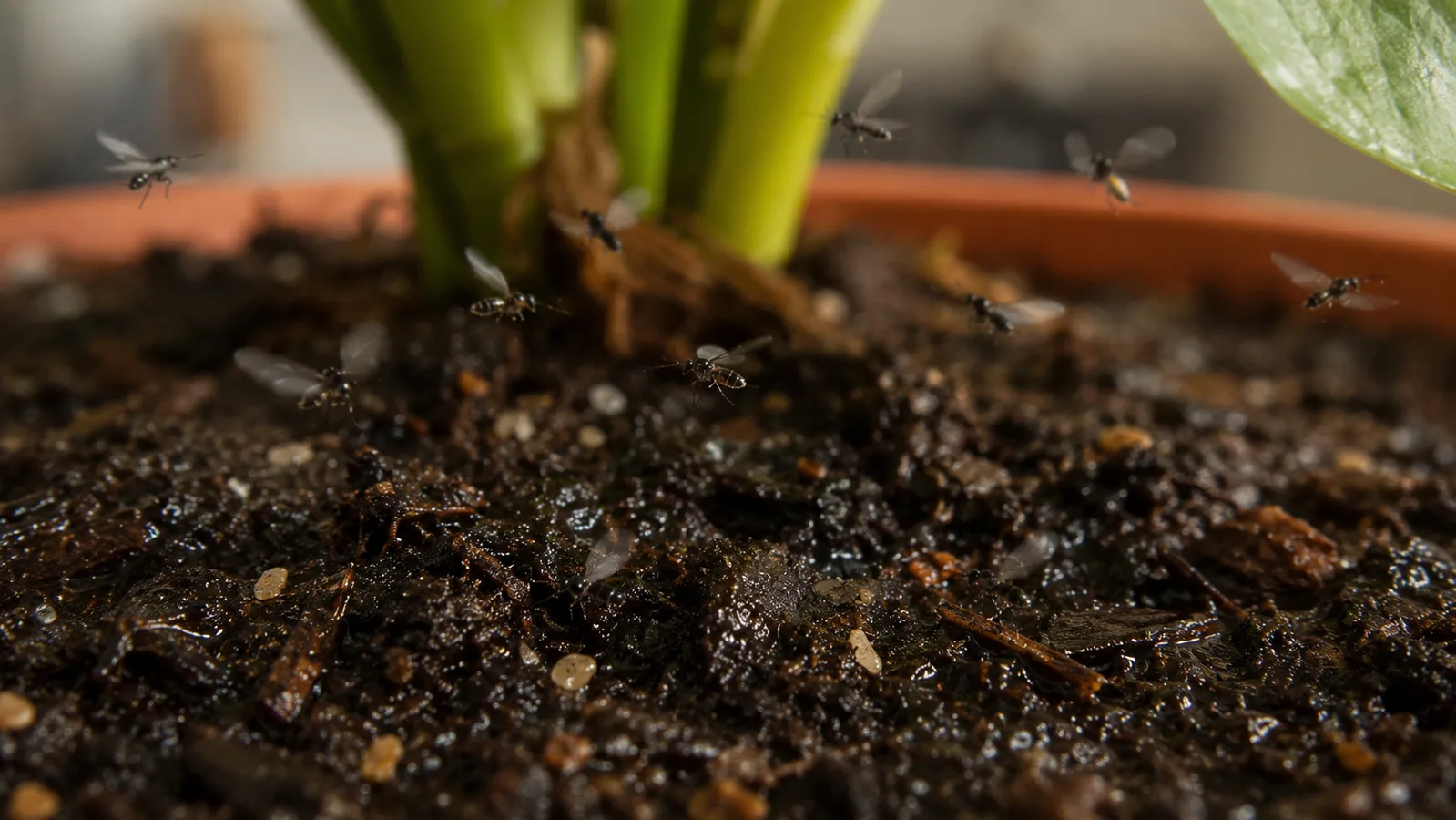
True fungus gnats (sciarids)
- Family: Sciaridae (black flies)
- Size: 2 to 4 mm, very thin, elongated
- Colour: matte black or very dark grey
- Flight: erratic, slow, zigzagging near the ground
- Habitat: around and on moist substrate, under lower leaves
- Larvae: translucent white maggots with black heads, living in the top centimetres of substrate
What they aren’t
- Fruit flies (Drosophila) — reddish-brown body, attracted to vinegar, wine, ripe fruit. Not in soil.
- Whiteflies — tiny white moths on leaves, very different treatment.
- Thrips — they take off in a grey column from foliage, see our complete thrips guide.
Quick test: tap the pot — if clouds of small insects rise from the substrate (not from foliage), they’re sciarids.
Understand their life cycle
To eliminate them permanently, you have to break the full cycle, not just kill visible adults.
The 4 stages
- Eggs: laid on or just below the moist substrate surface. A female lays up to 300 eggs in a few days.
- Larvae: hatch in 4-6 days. Small white larvae feeding on decomposing organic matter, microscopic fungi and — here’s the problem — the young roots and rootlets of plants.
- Pupae: transformation after 10-14 days
- Adults: emergence in 4-7 days, live 1 week only, during which they lay eggs again
Full cycle: 3 to 4 weeks. If you treat only adults, they reappear within days via eggs and larvae left in the substrate.
Why they settle in
Sciarids need two conditions:
- A substrate constantly moist (at least at the surface)
- Decomposing organic matter (rich potting mix, fresh compost, fallen leaf bits)
Remove either condition and they can’t reproduce. That’s the foundation of the elimination strategy.
Are they dangerous?
To the plant
Adults are harmless. The larvae cause the trouble: they devour rootlets and young roots. Consequences:
- Healthy mature plants: minimal impact, barely noticeable
- Cuttings rooting: marked slowdown, even total failure
- Young seedlings: can decline
- Weakened plants: gateway to fungal disease
They’re also vectors of fungal spores (notably Pythium and Fusarium, responsible for root rot). Prolonged infestation increases the risk of root rot.
To humans and pets
No danger: they don’t bite, don’t sting, don’t transmit disease to humans. But their presence is unpleasant and signals a watering issue.
3-step elimination strategy
To get rid of them definitively, work on three fronts simultaneously: dry the surface, trap adults, neutralize larvae.
Step 1 — Dry the surface (immediate action)
This is the most important step. No surface moisture, no laying.
- Stop watering from the top. Switch to bottom watering (pot sits 15 minutes in a basin, substrate absorbs by capillarity, drain well).
- Space waterings: let the substrate dry more than before. Often gnats signal chronic overwatering.
- Cover the surface with a layer of 1-2 cm of dry material: coarse sand, gravel, clay pebbles, pine bark, or mineral substrate. This layer prevents females from laying and blocks adult emergence.
This single step drastically reduces the population in 2-3 weeks.
Step 2 — Trap adults
To speed up visible reduction:
Yellow sticky traps
- Sold everywhere (garden centres, hardware stores, online)
- Yellow attracts sciarids; they stick and die
- Place 1 trap per infested plant, at foliage height
- Replace when saturated (often within 1 week)
Homemade apple cider vinegar trap
- Small container (glass, saucer)
- Apple cider vinegar + 2-3 drops of dish soap (breaks surface tension)
- Place near pots
- Adults drown in it
Handheld vacuum
- Simple but surprisingly effective: vacuum swarms when they fly up
- Repeat daily for 1-2 weeks
Step 3 — Neutralize larvae
This is the key to permanent elimination. Several natural methods, alone or combined.
Bacillus thuringiensis israelensis (Bti)
The nuclear weapon against sciarids — and 100 % natural. This specific bacterium attacks only the larvae of mosquitoes, sciarids and some aquatic insects. Harmless to humans, animals and winged adults.
- Sold as tablets (Mosquito Bits, Mosquito Dunks) or powder
- 1 crushed tablet in 5 litres of water, or follow manufacturer doses
- Water normally with this water once a week for 4 weeks
- Larvae die in 24-48 h, eggs no longer produce viable larvae
By far the most effective and lasting method.
Nematodes Steinernema feltiae
Microscopic worms parasitic on larvae. Even more effective than Bti but pricier and trickier to store.
- Order online (refrigerated delivery)
- Dilution in watering water per dose
- Apply once, sufficient in 80 % of cases
- Optimal conditions: moist substrate, 15-25 °C
Hydrogen peroxide
Mild chemical method, immediate:
- Mix 1 volume H₂O₂ 3 % + 4 volumes water
- Water the plant normally with this dilution
- Fizzing effect kills larvae on contact, oxygenates roots in passing
- Repeat 2-3 times spaced one week apart
Cinnamon powder
Natural antifungal that deprives larvae of their food (microscopic fungi):
- Sprinkle 1 teaspoon on the substrate surface
- Preventive and limiting effect, weak alone on big infestation
- More effective combined with other methods
Typical treatment timeline
For a moderate infestation, here’s the sequence that almost always works:
Day 1
- Stop top watering
- Cover surfaces with 2 cm of gravel or mineral substrate
- Place 1 yellow trap per infested plant
- First Bti water by capillarity
Day 7
- Vacuum remaining adults
- Replace saturated traps
- Second Bti watering
Day 14
- Check status (typically 80-90 % improvement)
- Continue weekly Bti for 2 more weeks
Day 28
- Residual population near zero
- Keep surface dry between waterings
- Stop Bti, keep monitoring
Special cases
Multiple infested plants
Treat all plants at the same time. Otherwise adults migrate from pot to pot and the infestation persists indefinitely. Even apparently healthy plants should get preventive treatment.
Hydroponic or PON mineral substrate plants
Good news: sciarids barely reproduce in PON mineral substrate or hydroponics. One of the hidden benefits of these systems. If you constantly struggle with gnats, it might be time to consider the switch.
Carnivorous plants
Sundews, Sarracenia and Venus flytraps naturally consume sciarids. A carnivorous plant in the room visibly reduces the population — eco bonus.
Freshly bought substrate
Many commercial potting mixes arrive already infested (eggs and dormant larvae). To prevent:
- Store bags dry
- For future use, sterilize substrate: 30 min in oven at 80 °C, or several hours in freezer, or boiling-water soak
- Prefer reputable quality brands packaging in airtight bags
Lasting prevention
Once the infestation is eliminated, these habits keep them away:
- Capillary watering — substrate surface stays dry
- Permanent gravel layer on pots — physical barrier
- Empty saucers systematically 15 minutes after watering
- No decomposing organic matter on pots — pick up fallen leaves
- Room ventilation — dry, moving air isn’t their friend
- Quarantine newly bought plants (3 weeks in an isolated room)
- Mature compost only if you add some to your pots — fresh compost is a sciarid nest
- Monthly inspection of substrate surfaces — if a few gnats appear, act before they multiply
Common mistakes
- Treating only visible adults — larvae keep producing the next generation
- Watering to “drown” larvae — you make it worse, they love moisture
- Using a strong chemical insecticide — ineffective on larvae in substrate, toxic to the plant
- Changing potting mix without anything else — you carry eggs over and the new mix gets infested
- Leaving a single infested plant in the room — restart point
- Confusing sciarids with fruit flies — traps and treatments differ
To distinguish pests, our houseplant families guide offers useful observation basics, and SPRAIA identifies the right pest in a photo with its recommendations.
Frequently asked questions about fungus gnats
The questions that come up most about these annoying but eliminable little black flies.
- Most often from the substrate itself: sciarid eggs are already present in most commercial potting soils, and just wait for damp surface conditions to hatch. More rarely they come via an already infested new plant or through open windows in summer. The number 1 cause remains chronic over-humidity of the soil.
- Adults are mostly a nuisance. However the larvae, which live in the top centimeters of substrate, feed on fine roots and young shoots. An adult plant copes well, but cuttings, seedlings and already fragile plants can die from them. So you should treat, especially during propagation.
- Adult sciarids are attracted to bright yellow as they would be to flowers. Yellow glue traps catch flying adults, which breaks the reproduction cycle. They don't kill larvae in the substrate — combine with soil treatment (Bti, sand, letting it dry).
- Yes, it's one of the safest solutions available. Bti is a natural bacterium that only targets mosquito and sciarid larvae; harmless to plants, pets and humans. Sold as dissolvable pellets to mix into watering water, it eliminates larvae in 2 to 3 weeks of weekly treatment.
- Four habits: 1) Let the substrate surface dry between waterings, 2) Cover the surface with quartz sand, clay pebbles or decorative bark to block egg laying, 3) Sterilize fresh potting soil in the oven (30 min at 80 °C) before repotting, 4) 2-week quarantine for any new plant before integration. See also our [watering guide](/en/blog/when-how-water-houseplants/) to avoid over-humidity.
Conclusion
Fungus gnats aren’t an indoor-life inevitability: they’re the symptom of overly moist surface substrate and excess organic matter. The winning strategy combines three levers: dry the surface (mineral layer, capillary watering), trap adults (yellow traps), neutralize larvae (Bti, nematodes, or H₂O₂). Four weeks suffice to eradicate a moderate infestation — provided you treat all plants simultaneously.
With SPRAIA, identify in a photo the exact pest (sciarid, fruit fly, thrips, whitefly), get a tailored step-by-step treatment plan, and schedule Bti reminders so you don’t forget weekly applications. Your plants deserve a healthy environment — and you, evenings without a cloud of gnats by the window.