Rare Plants: 10 Varieties Collectors Crave
Discover 10 rare and sought-after plants to enrich your collection. Origins, prices, difficulty and care tips.
By SPRAIA editorial team · Method: botanical sources, field feedback and editorial validation
A few years ago, collecting rare plants was a niche hobby reserved for a handful of enthusiasts and botanists. Today, rare plants are everywhere — on Instagram, in specialised markets, in dedicated Facebook groups. Some varieties trade for hundreds of euros, sometimes more. But what makes a plant “rare”? And which ones are really worth the hunt?
A plant’s rarity comes from several factors: slow growth, difficult propagation, an unstable genetic mutation (like variegation) or simply demand exceeding supply. The result: rising prices, a permanent treasure hunt, and a community of passionate collectors who don’t hesitate to queue at dawn outside specialty nurseries.
Here are 10 rare plants collectors crave — each with its origin, care difficulty and price range so you know what you’re getting into.
10 must-have rare plants
1. Monstera Thai Constellation
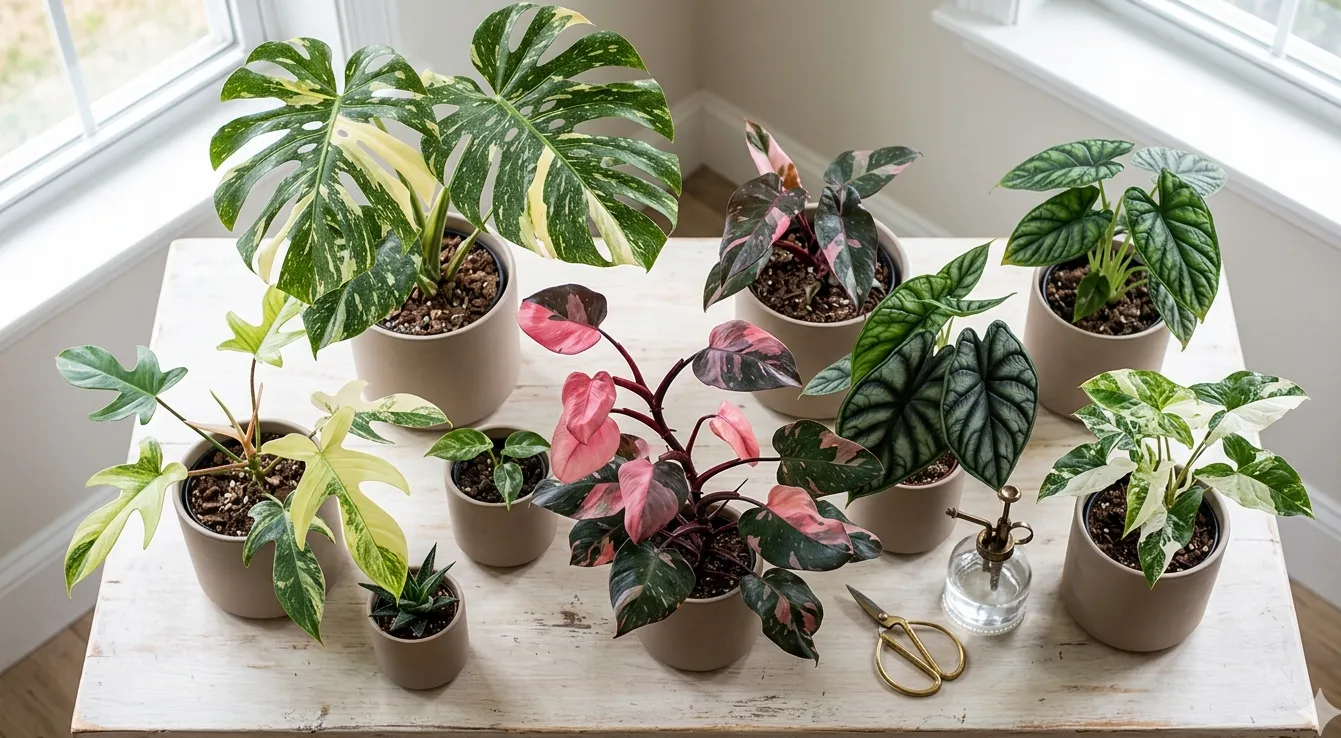
The absolute star of variegated plants. The Monstera Thai Constellation boasts large fenestrated leaves dotted with cream and white, like a constellation (hence the name). Unlike other variegated Monsteras, its variegation is genetically stable thanks to a tissue-culture mutation made in Thailand.
- Origin: Tissue-culture mutation, Thailand
- Difficulty: Moderate — it grows slower than a classic Monstera due to chlorophyll deficiency in white zones
- Price: €80-250 for a young plant, more for a mature well-fenestrated specimen
- Tip: Bright indirect light is mandatory to maintain variegation. Too little light = gradual revert to green
2. Philodendron Pink Princess
The Philodendron Pink Princess is probably the most “Instagrammable” plant of the moment. Its dark, almost black, green leaves are splashed with vivid pink — natural variegation caused by localised chlorophyll deficiency.
- Origin: Horticultural hybrid, likely from Philodendron erubescens
- Difficulty: Moderate — pink variegation is unstable and can disappear if conditions aren’t optimal
- Price: €40-150 depending on visible pink content
- Tip: Prune stems that revert fully green to encourage new variegated growth
3. Alocasia Dragon Scale
Among Alocasias, the Dragon Scale (Alocasia baginda) is the collectors’ centrepiece. Its thick, rigid leaves feature a fascinating scaled texture, with deeply etched veins evoking dragon skin. The underside is a striking purple.
- Origin: Tropical forests of Borneo
- Difficulty: Hard — demands high humidity (70 %+) and precise watering
- Price: €30-80 for a young plant
- Tip: A PON-style mineral substrate is ideal to prevent root rot while keeping moisture
4. Monstera Adansonii variegata
The variegated version of the “Swiss cheese plant” is one of the most sought-after and expensive plants in the plant world. Its small perforated leaves blend green, cream and white in always-unique proportions. Each leaf is a surprise.
- Origin: Rare natural mutation of Monstera Adansonii (Central and South America)
- Difficulty: Hard — very slow growth, unstable variegation, prone to rot
- Price: €200-800 for a rooted cutting — “half moon” specimens (half white, half green) reach the highest prices
- Tip: Avoid direct sun on white parts, which burn easily. Water propagation is possible but tricky
5. Philodendron Gloriosum
The Philodendron Gloriosum is a terrestrial creeper (it doesn’t climb) with heart-shaped leaves of deep velvety green, traversed by brilliant white veins. At maturity, leaves can exceed 50 cm in diameter — an absolute spectacle.
- Origin: Tropical forests of Colombia
- Difficulty: Moderate — needs horizontal space, not a pole
- Price: €40-120 depending on size
- Tip: Plant in a long shallow pot to respect its creeping growth. Substrate should be aerated and rich
6. Anthurium Clarinervium
The Anthurium Clarinervium is the king of structured foliage. Its heart-shaped leaves, deep dark green, are veined with silver-white in an almost geometric pattern. The texture is thick, almost cardboard-like — it looks like an art object.
- Origin: Mountain forests of Chiapas, Mexico
- Difficulty: Moderate to hard — needs high humidity and very free-draining substrate
- Price: €30-90
- Tip: A bark, perlite and sphagnum substrate works better than classic potting soil. The Anthurium Clarinervium is epiphytic — its roots need air
7. Hoya Kerrii variegata
The famous “heart plant” in its variegated version: each fleshy heart-shaped leaf is edged in cream and white. More than a Valentine’s Day gimmick, a true complete Hoya Kerrii variegata (with stem and node, not just a single leaf in a pot) is a climbing plant that can live for decades.
- Origin: Southeast Asia (Thailand, Laos, Cambodia)
- Difficulty: Easy to moderate — extremely slow growth, but resilient and undemanding
- Price: €20-60 for a stemmed plant (beware single leaves sold without a node — they’ll never grow)
- Tip: Let the substrate dry well between waterings. Hoyas are succulents and tolerate dryness better than excess water
8. Begonia Maculata
The Begonia Maculata (or polka-dot begonia) is recognisable instantly thanks to its elongated olive-green leaves dotted with silver spots, contrasting with a burgundy red underside. The most “design” plant in this selection.
- Origin: Atlantic forests of Brazil
- Difficulty: Moderate — doesn’t like sudden watering swings or air that’s too dry
- Price: €15-40 — one of the most accessible on this list
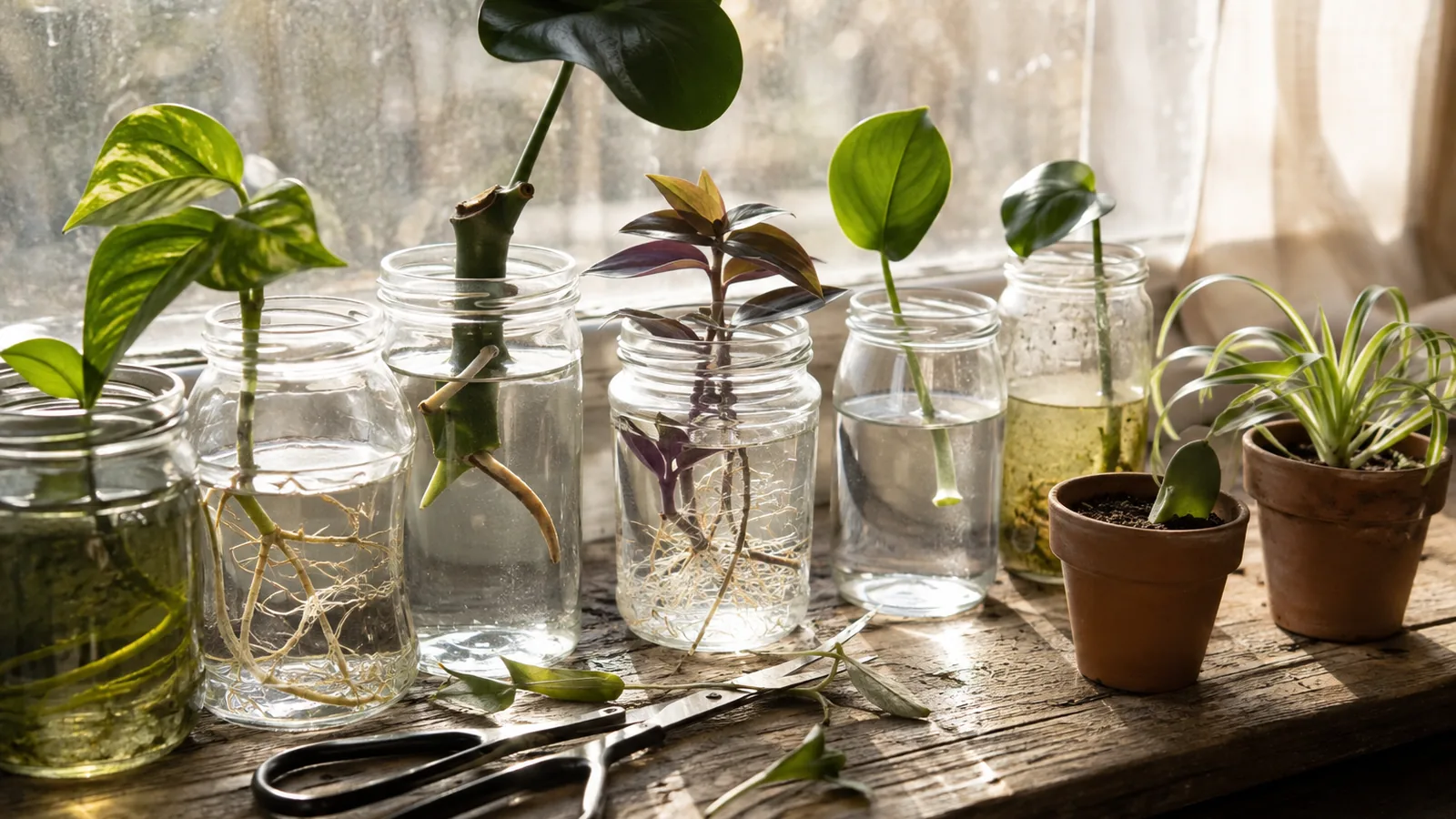
- Tip: It propagates very easily in water, making it an excellent gift to share between collectors
9. Scindapsus Treubii Moonlight
The Scindapsus Treubii Moonlight stands out with its thick leaves of iridescent silver-green, almost metallic. Less famous than the classic Pothos it vaguely resembles, it’s an elegant climber that draws the eye in any collection.
- Origin: Tropical Southeast Asia
- Difficulty: Easy — robust, tolerant, moderate growth
- Price: €15-35
- Tip: Give it a moss pole to encourage larger leaves. Medium to bright light
10. Philodendron Melanochrysum
The Philodendron Melanochrysum is the dark jewel of collectors. Its long velvety leaves of such deep green they appear almost black shimmer with a crystalline golden glint under the light. At maturity, they can reach 60-90 cm long — a breathtaking sight.
- Origin: Tropical forests of Colombia and Ecuador
- Difficulty: Hard — demands high humidity (70 %+) and good airflow to prevent fungal infections
- Price: €50-200 depending on size
- Tip: A moss pole is essential — it’s a climber that develops its most beautiful leaves with height
Comparison table
| Plant | Difficulty | Price | Light | Humidity | Growth |
|---|---|---|---|---|---|
| Monstera Thai Constellation | Moderate | €80-250 | Bright indirect | 50-70 % | Slow |
| Philodendron Pink Princess | Moderate | €40-150 | Bright indirect | 50-60 % | Moderate |
| Alocasia Dragon Scale | Hard | €30-80 | Bright indirect | 70 %+ | Slow |
| Monstera Adansonii variegata | Hard | €200-800 | Bright indirect | 60-80 % | Very slow |
| Philodendron Gloriosum | Moderate | €40-120 | Bright indirect | 60-70 % | Moderate |
| Anthurium Clarinervium | Moderate-Hard | €30-90 | Moderate | 60-80 % | Slow |
| Hoya Kerrii variegata | Easy-Moderate | €20-60 | Bright | 40-60 % | Very slow |
| Begonia Maculata | Moderate | €15-40 | Bright indirect | 50-70 % | Fast |
| Scindapsus Treubii Moonlight | Easy | €15-35 | Medium-bright | 40-60 % | Moderate |
| Philodendron Melanochrysum | Hard | €50-200 | Bright indirect | 70 %+ | Moderate |
Where to buy rare plants
Avoid classic large garden centres for the most sought-after varieties. Prioritise:
- Specialty nurseries — often run by collectors themselves, they guarantee healthy and well-identified plants
- Plant markets and exchange fairs — opportunity to find rarities and negotiate. Always check root condition before buying
- Facebook groups and forums — active communities where members sell or trade cuttings and plants. Always ask for recent photos and tracked shipping
- Specialty online shops — convenient but check reviews, shipping conditions (cold season = freezing risk) and refund policy
Beware of scams: be wary of prices too good to be true, stolen photos and sellers without history. A Monstera Adansonii variegata at €30 is a red flag.
SPRAIA tip: photograph your plant on arrival with SPRAIA to formally identify it and create its tracking sheet. The AI verifies the species and detects any signs of transport stress.
How to care for rare plants
Most rare plants on this list share a few fundamental needs:
Light
Variegated plants (Thai Constellation, Pink Princess, Adansonii variegata, Hoya Kerrii variegata) need more light than a green specimen — white or pink areas don’t photosynthesise. Bright indirect light, always. Never direct sun on depigmented parts.
Humidity
This is the most under-estimated factor. Forest tropicals (Alocasia, Philodendron, Anthurium) demand 60-80 % humidity. A humidifier is often essential in winter when heating dries the air. Group your plants to create a microclimate.
Substrate
Forget compact universal potting soil. Rare plants deserve a aerated free-draining substrate: bark, perlite, horticultural charcoal and sphagnum mix — or a PON-style mineral substrate for the species most sensitive to rot (Alocasias, Anthuriums).
Watering
No single rule, but a principle: better underwater than overwater. Rare plants are often more sensitive to excess water than to lack. Always check the substrate before watering.
Propagation
Many of these plants propagate via water cuttings or division. It’s an excellent way to safeguard your investment — if the mother plant has a problem, you have a backup. And it’s the best way to share your rarities with other enthusiasts.
SPRAIA tip: the app adapts its watering reminders and diagnoses to each species in your collection. An Alocasia Dragon Scale and a Hoya Kerrii don’t have the same needs — SPRAIA knows it and adjusts recommendations accordingly.
Conclusion
Collecting rare plants is a mix of patience, curiosity and passion. No need to start with the most expensive varieties: a Begonia Maculata or a Scindapsus Treubii Moonlight are accessible entry points that’ll give you a taste for the hunt. Over time, your collection will grow — and with it, your knowledge.
To not lose any of your protégés along the way, add each plant to SPRAIA on arrival. The app identifies the species, creates a personalised care programme and alerts you at the slightest sign of stress. Your collection deserves tracking worthy of its rarity.
Frequently asked questions about rare plants
Everything you wonder before investing in a rare plant or protecting a precious specimen.
- Several combined factors: a naturally infrequent mutation (stable variegations, albino forms), reproductive difficulty (slow growth, low rooting rate), demand outpacing supply, or restricted geographic origin. A plant can be rare one year and far less so the next if it propagates easily under industrial cultivation.
- Buy from reputable sellers (specialised nurseries, established collectors with verifiable history), ask for recent photos of the exact specimen, check the roots on arrival and the stability of variegations. Beware of "too good" prices on marketplaces: fake Monstera Albo or Pink Princess scams are common.
- Yes, generally. White or cream zones contain no chlorophyll and therefore produce no energy: the plant must photosynthesize only via green zones. Result: slower growth, stricter light needs (bright indirect, no harsh sun), and lower tolerance for watering mistakes.
- Depends on the species and demand. A well-tended Monstera Albo can produce 2-3 stable cuttings per year, sellable at €80-200 each — return on investment in 1-2 years. By contrast, a Philodendron Spiritus Sancti takes 5+ years before its first cutting. Fast propagation isn't the main goal — this is above all a hobby.
- Above a few thousand euros of value, yes: some all-risk home insurance contracts cover plants against theft and water damage (you must ask explicitly, it's rarely included by default). Document each specimen with dated photos, invoices and provenance. Some collectors even subscribe to insurance specific to collectible items.