Water Propagation: The Complete Guide to Multiplying Your Plants
Learn to propagate your plants in water step by step. Compatible plants, materials, mistakes to avoid and transition to soil.
By SPRAIA editorial team · Method: botanical sources, field feedback and editorial validation
Multiplying your plants for free, with no complicated equipment, watching the roots grow in real time: that’s the promise of water propagation. The technique appeals to beginners and seasoned collectors alike — and for good reason, it’s probably the most accessible propagation method that exists.
Why propagate in water
Aquatic propagation has three major advantages over soil:
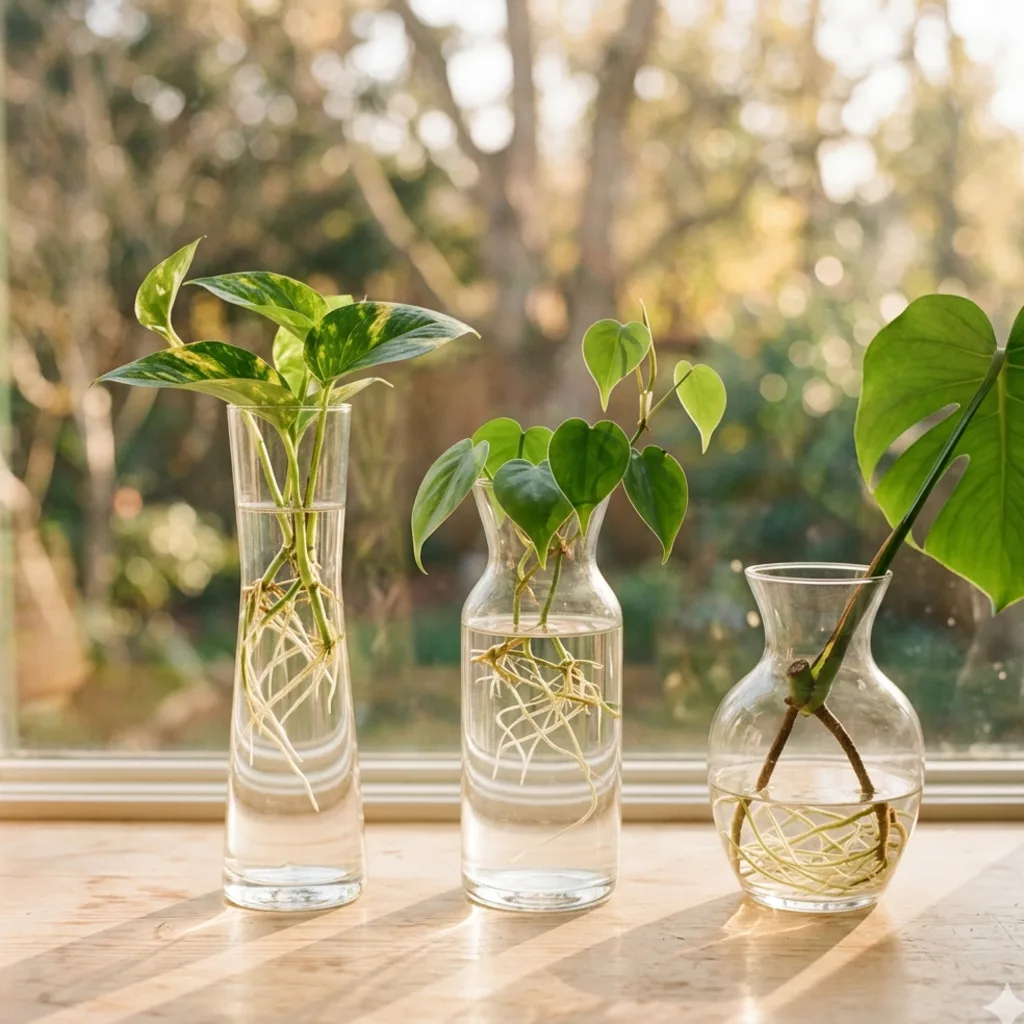
- Visible roots — you track progress day by day
- Simplicity — a glass, water, a stem. No rooting hormone or mini-greenhouse
- High success rate — water keeps constant hydration, reducing dry-out risk
It’s also a great way to save a broken stem or rejuvenate a leggy plant.
Which plants propagate in water
Not all plants take to aquatic propagation. The best candidates:
| Plant | Difficulty | First roots | Notes |
|---|---|---|---|
| Pothos | Very easy | 5-10 days | The propagation king |
| Philodendron | Very easy | 7-14 days | All cultivars work |
| Tradescantia | Very easy | 5-7 days | Spectacularly fast |
| Monstera | Easy | 14-21 days | Cut below an aerial-rooted node |
| Ivy (Hedera) | Easy | 10-14 days | Cut 10-15 cm stems |
| Begonia | Easy | 14-21 days | Even a single leaf can root |
| Syngonium | Easy | 7-14 days | Aerial roots = fast start |
Avoid: succulents, cacti and woody-stemmed plants (mature Ficus, shrubs) which rot easily in water or don’t form aquatic roots.
Required materials
No need to invest:
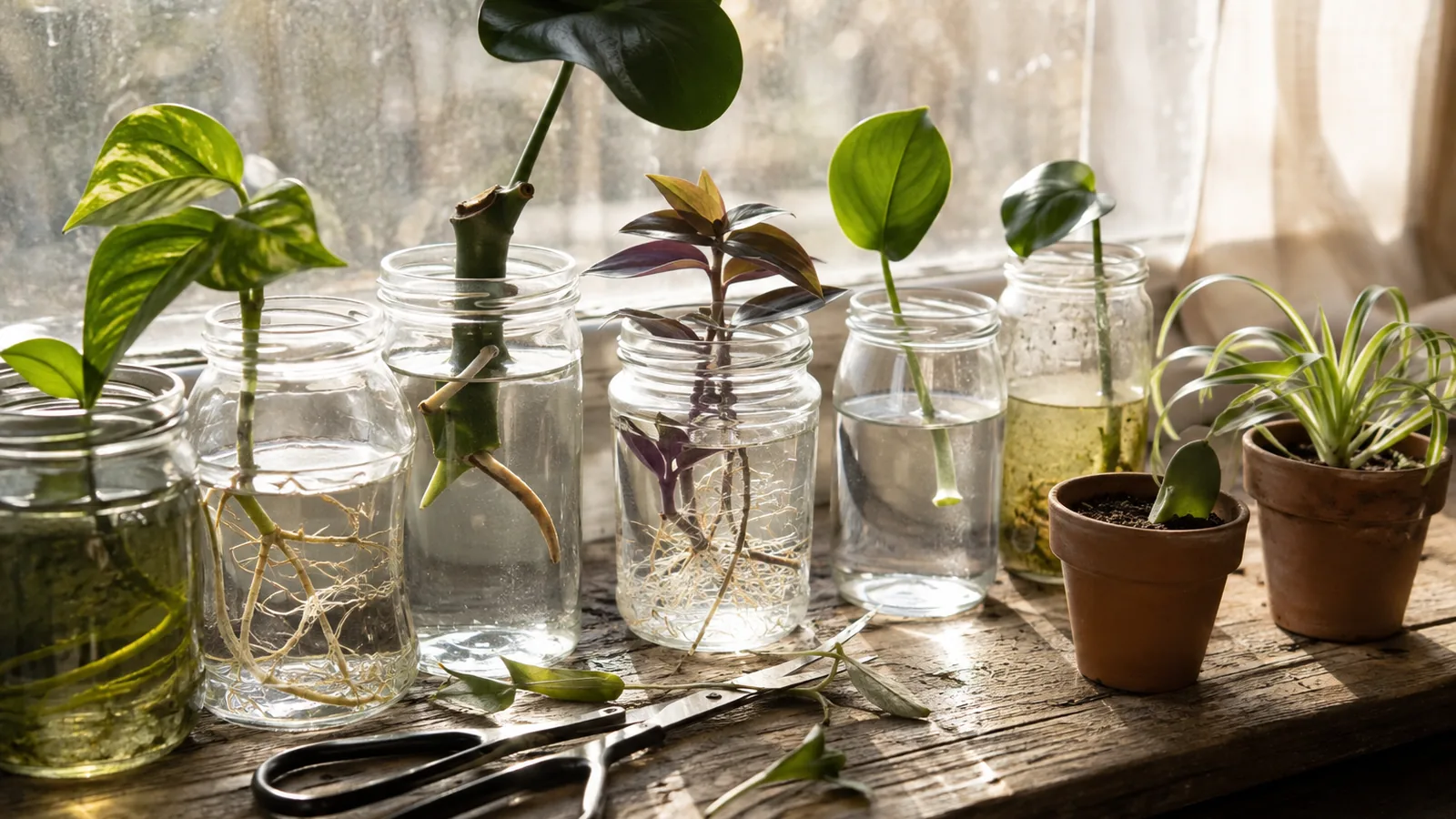
- Transparent glass container — glass, jar, vase
- Water — tap water rested 24 h or filtered
- Clean pruners — sterilised with alcohol
- Bright spot — bright indirect, never direct sun on the glass
Optional: a pinch of activated charcoal in the water to limit bacterial growth.
En pratique, étape par étape
Complete procedure to succeed with aquatic propagation on Pothos, Philodendron, Monstera and other tropicals.
-
Select a healthy stem
Choose a vigorous 10-15 cm stem with 2-3 leaves. Avoid sick, soft or too-young stems — they have less reserves to produce roots.
-
Cut below a node
Spot a node (the small bump where leaves or aerial roots emerge). Cut at a 45° angle, 1-2 cm below this node, with sterilised pruners. Without an immersed node, no roots.
-
Remove lower leaves
Take off any leaves that would sit in water. No leaf should soak, otherwise it rots and contaminates the container. Keep 2-3 leaves on top for photosynthesis.
-
Place in water
Submerge the cutting base until the node is covered. Leaves stay above water. Place in bright indirect light (never direct sun) at 18-25 °C.
-
Change water every 4-5 days
This is the golden rule. Stagnant water deprives roots of oxygen and encourages bacteria. Rinse the glass and cutting with clean water at each refresh.
-
Transfer to soil when roots reach 3-5 cm
Once roots are 3-5 cm and starting to branch, plant in light free-draining substrate (potting soil + perlite 70/30). Water generously the first 2 weeks to ease the transition.
Mistakes that fail propagations
- Cutting without a node — the stem can’t produce roots
- Forgetting water changes — green or cloudy water = bacteria = rot
- Too much direct sun — glass concentrates heat, water warms, young roots burn
- Leaves in water — they rot in days
- Cutting too small — a 3 cm stem has too few reserves. Aim 10 cm minimum
- Impatience — some plants take 3-4 weeks to show any root
When and how to transfer to soil
The classic trap: leaving roots in water too long. The longer aquatic roots grow, the harder the soil transition — these roots are water-adapted and must readjust.
Right time: roots 3-5 cm and starting to branch.
The method:
- Prepare a small pot with a light free-draining substrate — potting soil + perlite (70/30) works well
- Plant the cutting, burying all roots
- Water generously the first two weeks
- Gradually reduce watering frequency after 2-3 weeks
SPRAIA tip: add your cutting to your collection in the app at repotting. SPRAIA adapts watering reminders to a young rooting plant.
Frequently asked questions about water propagation
The classic questions for nailing your water cuttings the first time.
- Yes, every 4 to 7 days. The water depletes in oxygen and accumulates stem compounds: without refreshing it, bacteria multiply and cause base rot. At each change, gently rinse the glass too to remove the biofilm stuck to the walls. Adding a pinch of activated charcoal stretches the interval by a few days.
- Not really useful for water propagation. The hormone (auxin) is designed to stimulate root formation in a solid substrate. In water, it dilutes immediately and loses effectiveness. For easy-to-propagate plants (Pothos, Philodendron, Tradescantia), plain water is more than enough.
- Several possible causes: bad cut placement (not under a node), too thin or woody stem, cold water, lack of light, or a species that doesn't root in water. Also check the initial cutting's health: an already stressed stem roots very slowly. The ideal season is spring-summer, when the plant is actively growing.
- When the roots are 3-5 cm long and several branches are visible. The longer you wait, the more the plant develops specialized "water roots" that struggle to adapt to solid substrate. Conversely, roots that are too short (under 2 cm) won't survive the transition to soil.
- Yes, provided you fertilize regularly with diluted hydroponic fertilizer (once a month) and change the water every 1-2 weeks. Growth is slower than in soil, leaves stay smaller, but the plant remains healthy for years — particularly well-suited to Pothos, Philodendron scandens, Monstera and Tradescantia.
Conclusion
Water propagation is probably the most rewarding way to grow your collection. No expensive equipment, no complex technique — just a stem, a glass of water and a bit of patience. Start with a Pothos or Philodendron to gain confidence, then try more demanding species like a Monstera or Begonia.