Natural Fertilizers: Feeding Houseplants Without Chemicals
Complete guide to natural fertilizers for houseplants: homemade recipes, doses, calendar and mistakes to avoid for healthy nutrition.
By SPRAIA editorial team · Method: botanical sources, field feedback and editorial validation
Your plants are hungry. Not every day, nor in the same way, but they need nitrogen, phosphorus, potassium and a dozen trace elements to grow, flower and resist disease. The easy answer: a chemical fertilizer from the shop. But it’s neither the only one, nor always the best. Natural fertilizers, homemade or sourced from organic products, offer a healthy, economical and ecological alternative. Bonus: they enrich the soil sustainably instead of just “doping” the plant. Here’s everything you need to know to feed your plants without chemicals.
Why plants need fertilizer
A potted plant lives in a confined volume. After a few months, the original substrate is depleted: its nutrients have been absorbed by roots, leached by successive waterings, or transformed into non-assimilable forms. Without external input, the plant stalls, yellows, becomes pest-prone.
The 3 essential nutrients (NPK)
Every fertilizer shows three numbers (e.g. 7-3-5) corresponding to the percentage of:
- N — Nitrogen: leaf and stem growth. Deficiency = pale leaves, slow growth.
- P — Phosphorus: root development, flowering, fruiting. Deficiency = weak roots, few flowers.
- K — Potassium: robustness, disease resistance, flower and fruit quality. Deficiency = brown leaf edges, fragile plant.
Trace elements
Less famous but essential:
- Calcium (Ca): cell wall structure
- Magnesium (Mg): chlorophyll production
- Iron (Fe): green leaf pigmentation (deficiency = yellowing between veins)
- Sulphur, zinc, manganese, boron, copper…
Natural fertilizers have the advantage of providing these trace elements in balanced proportions, unlike many synthetic fertilizers focused on NPK only.
Recognising a deficiency
Before fertilizing, identify symptoms to target the right input:
| Symptom | Likely deficiency | Natural solution |
|---|---|---|
| Pale leaves, slow growth | Nitrogen (N) | Cooking water, coffee grounds, nettle |
| Brown leaf edges | Potassium (K) | Wood ash, banana peel |
| Few flowers/fruits | Phosphorus (P) | Eggshells, bone meal |
| Yellowing between veins | Iron or magnesium | Acidified water, Epsom salts |
| Weak stems, low resistance | Calcium | Eggshells, cooking water |
| Deformed leaves on new growth | Boron, zinc | Mature compost, balanced mix |
To go deeper, our yellow leaves diagnostic guide covers every possible cause, including deficiencies.
Essential natural fertilizers
1. Coffee grounds
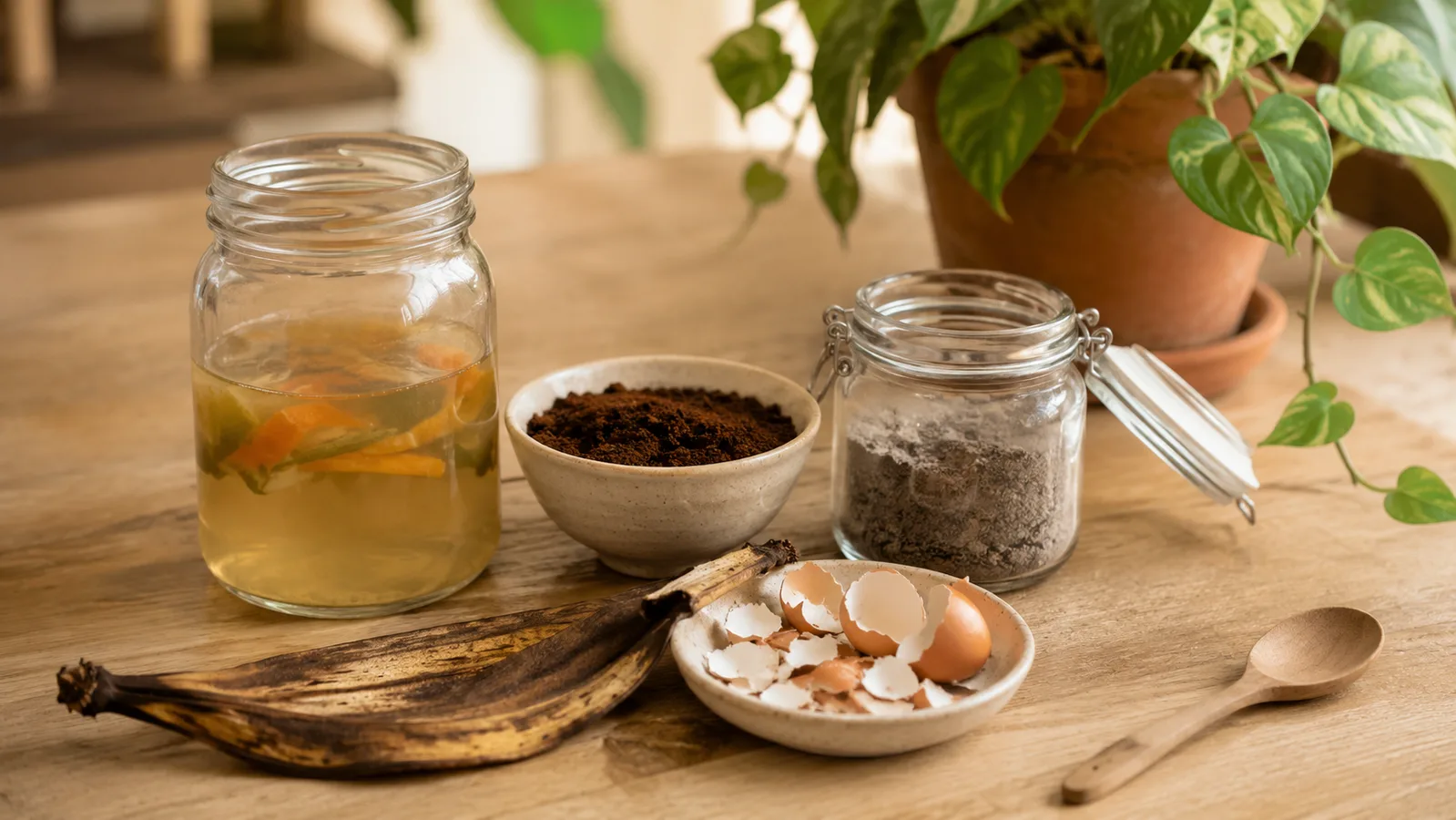
The best-known homemade fertilizer. Rich in nitrogen, it favours leaf growth. Also brings some potassium and phosphorus, plus trace elements.
How to use:
- Sprinkled on the surface: 1 tablespoon of dried grounds per pot, once a month
- As an infusion: 2 tbsp grounds in 1 L water, steep 24 h, filter, water normally
Cautions:
- Always dried before use (moist grounds mould on the surface)
- Slightly acidifying: ideal for Calathea, ferns, azaleas. Moderate for cacti and succulents.
- Maximum once a month to avoid excessive substrate acidification
2. Cooking water
The unsalted cooking water from vegetables contains minerals that migrated into the water (potassium, magnesium, calcium, trace elements).
Recipe:
- Cook your vegetables (potatoes, broccoli, green beans) without salt
- Let the water cool completely
- Water your plants instead of usual water
- Frequency: every 2-3 weeks
Ideal for: all green plants in active growth.
3. Banana peel
Very rich in potassium and phosphorus, perfect for flowering plants and dense foliage.
Methods:
- Maceration: 1 banana peel cut up in 1 L water for 48 h. Filter, dilute 50/50 with water, water. Use within the week.
- Sprinkling: peels dried in oven at low temperature, ground to powder. 1 tsp per pot every 6 weeks.
- Compost: add peels to your standard compost.
Avoid: fresh peels buried directly in the pot — they attract fungus gnats and mould.
4. Eggshells
Natural source of calcium and magnesium for sturdy plants and bright foliage.
Preparation:
- Wash and dry the shells
- Grind to fine powder in a mortar or blender
- Sprinkle 1 tsp per pot 2-3 times a year
- Or steep in watering water for 24 h
Particularly beneficial for: indoor tomatoes and flowers, plants with fleshy foliage (Crassula, Sedum).
5. Wood ash
Excellent supplier of potassium and trace elements. Caution: use sparingly.
Valid sources:
- Untreated wood ash only (no MDF panels, painted boards, charcoal)
- Hardwood preferred (oak, beech)
Application:
- 1 pinch per pot, mixed into substrate at repotting
- Or 1 tsp diluted in 1 L water, use once every 2 months
Caution: alkalizing. Avoid for acid-loving plants (azalea, camellia, fern, Calathea).
6. Nettle slurry
Nettle slurry is a powerful fertilizer and immune stimulant, used in organic farming.
Recipe:
- 1 kg fresh nettles in 10 L rainwater
- Ferment 1-2 weeks in a non-airtight container
- Filter, dilute 1:10 with water before use
- Water once a month in active growth
Note: strong smell. Make outdoors if possible. The slurry keeps several months in a sealed bottle.
7. Mature compost
Compost is the total fertilizer: NPK + trace elements + beneficial microorganisms. But it must be well matured.
Application:
- Top-dressing: 1-2 cm of mature compost on the pot surface, twice a year in spring and summer
- Mix at repotting: 10-15 % compost in the substrate blend
- Compost tea: 1 glass of compost in 1 L water, steep 24 h, filter, dilute 1:5
Cautions:
- Well-decomposed compost only (otherwise attracts gnats and mould)
- Avoid in winter (microorganisms are barely active)
8. Epsom salts (magnesium sulphate)
Provide magnesium and sulphur, essential for chlorophyll. Particularly effective on foliage yellowing between veins.
Recipe:
- 1 tsp Epsom salts in 4 L water
- Water normally with this solution every 4-6 weeks in active growth
- Foliar spray possible (same dilution) on spotted leaves
Epsom salts are sold at pharmacies or garden centres. Very economical.
Fertilization calendar
| Season | Frequency | Preferred fertilizers |
|---|---|---|
| Spring | Gradual resume: 1×/3 weeks | Compost, coffee grounds, cooking water |
| Summer | Active growth: 1×/2 weeks | All, alternating |
| Autumn | Reduce: 1×/4 weeks | Ash, Epsom salts |
| Winter | Full stop except winter-flowering plants | None |
Important: never fertilize a stressed plant (recently repotted, sick, recovering from root rot, or in light transition). Roots can’t absorb nutrients and risk burning.
Golden rules
1. Always on moist soil
Fertilizing on dry substrate burns the roots. Water first, wait 1 hour, then apply fertilizer.
2. Dilute more than the official dose
Houseplants tolerate overdoses poorly. For all fertilizers (even natural), start with half the recommended dose. Increase gradually if the plant responds well.
3. Vary your sources
No natural fertilizer covers every need. Alternate: coffee grounds (nitrogen) one time, banana peel (potassium) the next, cooking water (trace elements) the third. Your plants thus get a complete nutritional spectrum.
4. Respect winter rest
In winter, most houseplants slow or stop growth. Fertilizing then causes accumulation and burning. Hard stop November to February, except special cases (winter-flowering plants like Phalaenopsis orchids in re-bloom).
5. Observe more than you fertilize
The best strategy is observation: leaf colour, growth vigour, intervals between new shoots. If everything is fine, fertilizer may be unnecessary for months. To read plant signs well, our plant identification guide helps you understand each species’ specific needs.
Recipes by plant type
Leafy green plants (Pothos, Philodendron, Monstera)
Need: nitrogen-dominant, leaf growth Routine: coffee grounds 1×/3 weeks + cooking water 1×/3 weeks alternating, from spring to autumn.
Flowering plants (Anthurium, Spathiphyllum, orchids)
Need: phosphorus and potassium Routine: macerated banana peel 1×/3 weeks + crushed eggshells 1×/2 months.
Cacti and succulents
Need: minimal, balanced NPK, low nitrogen Routine: 1×/6 weeks in summer only. Very dilute wood ash or minimal mature compost. No fertilizer in winter.
Acid-loving plants (Calathea, ferns, azalea)
Need: slightly acidic substrate, available iron Routine: coffee grounds (acidifying) 1×/3 weeks + rainwater or filtered water. Avoid wood ash (alkalizing).
Cuttings rooting
Need: support root development Routine: no fertilizer until roots are firm (5-7 cm). Then half-dose diluted compost.
Common mistakes
- Over-fertilizing — leading cause of fertilizer death. More isn’t better.
- Fertilizing a stressed plant — fragile roots, burn guaranteed.
- Fertilizing in winter — toxic accumulation, burnt roots.
- Using fertilizer on dry substrate — excessive concentration, damaged roots.
- Confusing deficiency with another problem — yellow leaves ≠ always deficiency (often overwatering).
- Putting fresh coffee grounds on the substrate — moisture, mould, gnats.
- Ignoring pH — overly acidified substrate blocks absorption of some nutrients.
Frequently asked questions about natural fertilizers
The most-asked questions for feeding your plants without chemicals.
- Yes, but in moderation and dry. Sprinkle a thin layer (1 teaspoon max per medium pot) on the surface, once a month in spring-summer. In excess, coffee grounds compact the substrate, acidify the pH and attract fungus gnats. Prefer composted grounds or an infusion (1 tablespoon in 1 L of water, rest 24 h) for a more balanced supply.
- Once every 2 to 4 weeks from March to October, at half-dose. Full stop from November to February: without enough light, the plant can't take up nutrients and salts build up in the substrate, burning roots. Newly repotted plants in fresh substrate don't need fertilizer for 6-8 weeks.
- Yes, provided it's unsalted and cooled. Vegetable cooking water (no salt) contains potassium, magnesium and trace elements released by the vegetables. Use pure or diluted 50% for watering every 15 days during growth. Avoid waters too concentrated in glucose (potatoes) which can mold.
- Deficiency: pale leaves, slow growth, yellowing of old leaves, rare flowers. Excess: brown crispy tips, burned leaf edges, white crust on substrate surface, damaged roots at repotting. When in doubt, under-dose rather than over-dose — fixing a deficiency is easier than recovering a saturated substrate.
- Yes, but not by burying them whole. Dry them in the oven (1 h at 80 °C), grind to powder and sprinkle 1 teaspoon per pot every 2 months. Banana is rich in potassium, ideal for flowering. Infusion is another option: peel in 1 L of water for 48 h, then dilute and water.
Conclusion
Natural fertilizers offer everything your houseplants need, provided you use them wisely: observe deficiency signs, vary sources, dose sparingly and respect seasons. Coffee grounds for nitrogen, banana peel for potassium, eggshells for calcium, compost for complete nutrition, wood ash as a complement — that’s a whole nutritional ecosystem available in your kitchen, at near-zero cost and with no ecological impact.
With SPRAIA, identify your plants precisely, get fertilization recommendations matched to each species and season, photograph any deficiencies for instant diagnosis, and schedule your fertilizer routines in the care journal. Your plants deserve nutrition designed for them — not a generic chemical product. Kitchen and houseplants are the eco-conscious plant parent’s best allies.