Starting With Houseplants: Forget the Rules, Learn to Observe
Common myths debunked, vital signs to read, real factors that matter: the foundational guide to actually starting with houseplants without killing them.
By SPRAIA editorial team · Method: botanical sources, field feedback and editorial validation
“Water once a week.” “This one is an easy plant.” “Just put it near a window, it’ll be fine.” You’ve probably heard those sentences a thousand times — in a shop, on Instagram, in a garden centre leaflet. And yet, those phrases are part of why your last plant died.
The problem is neither your “green thumb” (which doesn’t exist) nor the plant itself. The problem is that you’ve been handed rules when what you actually needed was to learn how to read the signs. A plant isn’t a clock, and every home is a unique ecosystem. This article sets the record straight: we debunk the most stubborn myths, show you how to observe, and explain why we built SPRAIA to turn that intuition into real know-how.
Why generic “rules” fail
Picture two Monstera deliciosa bought on the same day from the same shop. One ends up in a south-facing London flat with dry electric heating, the other in a humid coastal home with east-facing light. Three months later, the first one rots from overwatering (“but I watered once a week, like they said!”), and the second thrives even though it only got water every three weeks.
Same species. Same advice. Opposite outcomes.
That’s because a plant doesn’t respond to a calendar — it responds to its current environment. Available light, air humidity, temperature, substrate type, pot size, drainage, season, drafts, its own growth stage… some twenty parameters come into play. Universal advice ignores all of them.
The good news: you don’t need a botany PhD. You just need to learn how to observe your plant and its context. That’s exactly what this article will teach you.
Myth #1: “Water once a week”
This is the single most dangerous sentence ever handed to a beginner. It kills more plants than all diseases combined.
A plant doesn’t get thirsty every seven days. It gets thirsty when its substrate dries down enough that it’s time to rewet it — without letting roots dehydrate. That moment depends on:
- the light it receives (more light = more evapotranspiration = drinks more)
- the ambient temperature (warm = drinks fast, cold = drinks slowly)
- the air humidity (dry air = drinks more, humid air = drinks little)
- the pot volume and substrate type (a small terracotta pot dries in 3 days, a big plastic pot in 15)
- the season (active growth in spring/summer, relative rest in winter)
- the plant’s own health
The result: the same plant may need water every 4 days in July and every 18 days in January. Watering by the calendar is watering blindfolded. Our complete watering guide covers all the techniques to adjust continuously.
Myth #2: “This plant is easy, that one is hard”
There’s no such thing as a “hard” plant in absolute terms. There are plants that fit or don’t fit your context.
A Calathea is reputedly “difficult” — unless you live in a bright bathroom at 65% humidity, where it feels right at home. Conversely, a cactus is “easy” — unless you place it 4 metres from a north-facing window, where it’ll rot in two months regardless of advice.
So the real question isn’t “is this plant easy?” but: “does my environment match its needs?”
That’s why we publish both our list of 15 easy plants for beginners and detailed guides for more demanding species — “difficulty” is always context-dependent.
Myth #3: “Near a window is enough light”
The human eye is a terrible photometer. Two metres from a window, our brain reads “pleasant brightness” — for a plant, that’s up to 80% less light than at 50 cm from the glass. Light decreases with the square of distance.
Worse: “near a window” means nothing on its own. A north-facing window delivers almost no direct light. A south window without a sheer curtain burns Calathea leaves. An east window gives 2-3 hours of gentle morning sun, perfect for many species. Needs vary drastically — see our complete light guide.
The only reliable way to know? Measure in lux or use a light meter (your smartphone works). It’s the very first thing we built into SPRAIA, because 90% of plant problems start with poorly diagnosed light.
Myth #4: “Yellow leaf = thirsty plant”
It’s the opposite, nine times out of ten. A yellow leaf on a houseplant is most often the symptom of overwatering — asphyxiated roots, early rot, saturated substrate.
Lack of water tends to produce soft, wrinkled, drooping leaves. Once watered, the plant perks up within hours. A yellow leaf never perks up — it eventually falls. Before watering a yellowing plant, read our complete yellow-leaf diagnosis first — you might just save it.
How to tell your plant is doing well
Instead of a calendar, learn to read five simple signs:
1. Turgor
Gently touch a healthy leaf: it’s firm, fleshy, springy. When it turns soft, wrinkled or crisp, something is off. That’s your first water-stress signal (either under OR over).
2. Foliage colour
A deep, uniform green = well-fed, well-lit plant. Pale green = not enough light or nitrogen. Very dark green with short internodes = light saturation. Brown spots = burn or hard-water buildup.
3. New growth
A healthy plant regularly produces new leaves during its growing season (spring-summer). No new leaf for 6 months at the peak of season? Something is blocking — light, cramped roots, deficiencies.
4. New-leaf size
If new leaves come out smaller than older ones, it’s almost always a light deficit. If they come out deformed, it’s often pests (thrips, mites) or shock.
5. Substrate and roots
A substrate that smells fresh and earthy = good. A sour, fermented, swampy smell = rot in progress. When repotting, white/cream firm roots = health; brown, mushy, smelly roots = rot (see our root rot rescue guide).
How to tell if it really needs water
Forget the calendar. Here are the four reliable methods, in increasing order of precision:
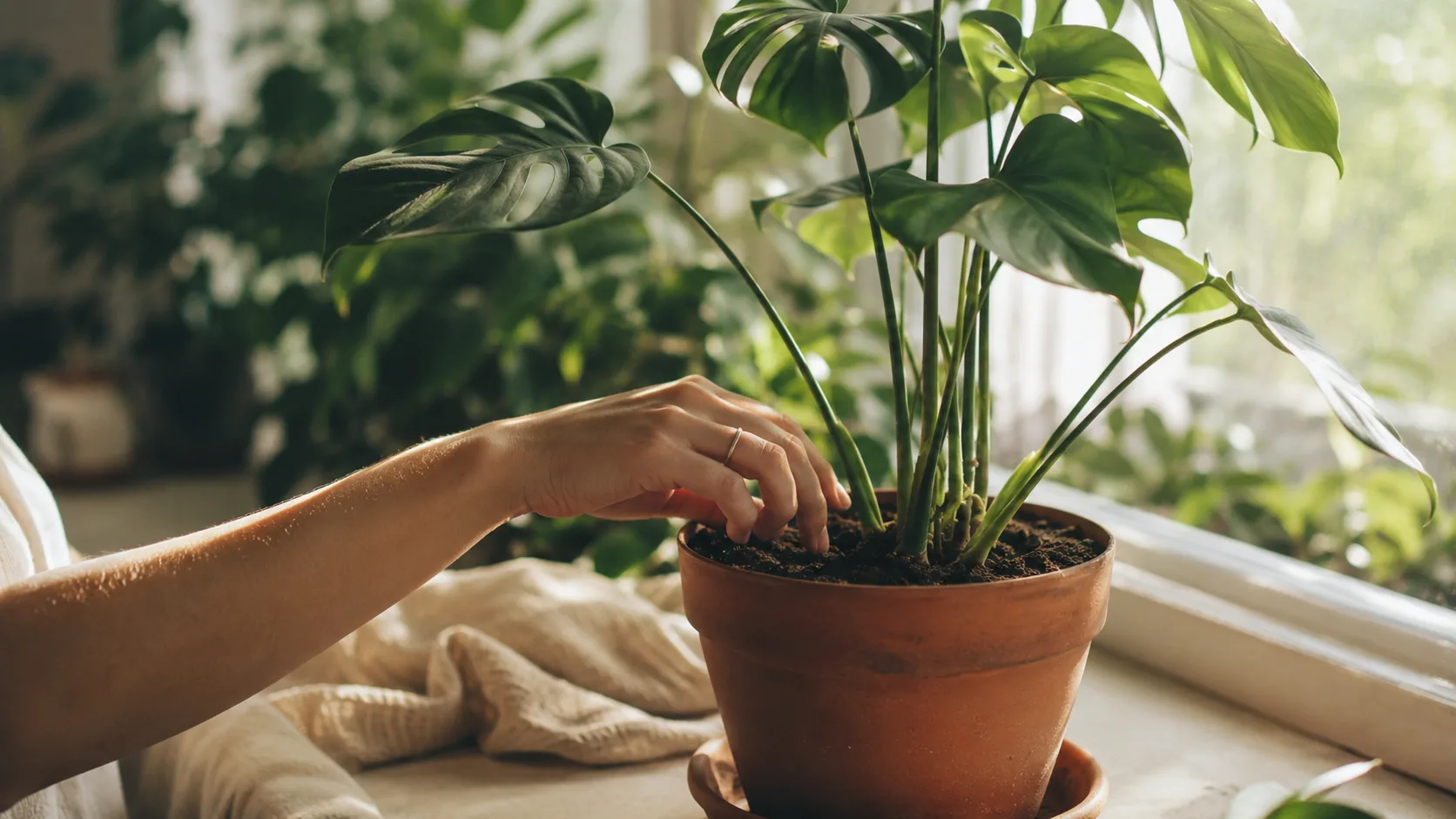
1. The finger test. Sink your index finger 3-5 cm into the substrate. Dry deep down = water it. Still moist = wait. Universal and free.
2. The weight test. Lift the pot right after watering to memorise its “full” weight. When it feels noticeably lighter, it’s time. With practice you’ll spot a 200 g difference blind.
3. A moisture probe. A probe ($6-15) plunged into the substrate shows a 1-to-10 level. Useful for opaque or deep pots, or plants you can’t easily touch (spiny ones).
4. Visual substrate check. With light mineral substrates (pon, lechuza) or transparent pots, you literally see condensation disappear. The most precise approach for modern setups — see our complete PON guide.
Avoid: cheap analog moisture meters from garden centres. They’re notoriously inaccurate (often biased toward “dry” or “wet”) and give a false sense of control.
The real factors that matter (and that nobody mentions)
If you take only one thing away: a plant’s needs don’t depend on its species, but on the interaction between its species and its environment. The main parameters to track:
Light (intensity and duration)
Measured in lux, it’s the #1 variable. A Sansevieria survives at 500 lux; a Calathea wants 800-1500 lux; a Ficus lyrata won’t grow under 2000 lux. On top of that, photoperiod (hours of light per day) varies by season and orientation.
Air humidity
Measured in %RH. Many tropicals struggle below 50%RH — common in winter with central heating. An $8 hygrometer is a game-changer.
Temperature (day AND night)
Most houseplants like 18-25°C in the day and not below 12-15°C at night. A windowsill in winter can drop to 8°C — guaranteed cold shock.
Drafts
A plant next to a door opened 20 times a day, or above a radiator, is under constant stress. Many unexplained leaf drops come from there.
Pot and drainage
A pot without a drainage hole is a slow death sentence for 95% of plants. The material (terracotta, plastic, glazed ceramic) also affects how fast the substrate dries.
Substrate
A cheap “universal” potting mix is usually too dense and holds too much water. Many plants (aroids, succulents) demand an aerated mix. A plant in good substrate, overwatered, often recovers — in bad substrate, almost never.
Season and age
In spring, a plant uses 3x more water than in December. A young growing plant doesn’t have the same needs as an established 5-year-old.
Why every plant is unique
Even within the same species, two specimens are different. Why?
- Plant history: where was it grown (Dutch greenhouse vs Costa Rica outdoors)? How long in the shop? Stressed during transport?
- Root-to-foliage ratio: a plant with lots of roots for its foliage drinks fast. A young cutting with few roots drinks slowly.
- Your home’s microclimate: impossible to reproduce from a generic guide. Your room has its own signature.
- Your routine: how you water (slow and deep? quick? tap or filtered water?) creates a unique partnership with your plant.
That’s why a generic Pinterest tip falls flat: it knows neither your plant, nor your home, nor you.
Why we built SPRAIA
We built SPRAIA on a simple realisation: nobody needs another generic gardening book. What you need is an assistant that knows your plant, in your home, with your routine.
Concretely, SPRAIA combines:
- Accurate photo identification — Snap any plant (yours, a friend’s, a leaf you found) and SPRAIA identifies it in seconds, with scientific name, baseline needs and common pitfalls. To go deeper, see our method to identify a plant in 30 seconds.
- Photo-based problem diagnosis — Leaf turning yellow, spot appearing, pest sighted? One photo is enough to get a clear diagnosis and an action plan, no guesswork.
- Built-in light meter — Point your phone at the spot where your plant lives, and SPRAIA measures available lux. You instantly know if the spot is suitable.
- Geolocation and climate — By combining your location, season and local weather, SPRAIA tunes its recommendations. The same Monstera doesn’t have the same needs in July in Marseille and January in Manchester.
- Full per-plant history — Every watering, every repotting, every growth photo is logged. After a few weeks, SPRAIA learns your rhythm and your plants — not a theoretical average.
- Smart reminders — Not a rigid calendar, but reminders that adjust to weather, season, and your plant’s actual history. Heatwave incoming? SPRAIA knows, and brings the reminder forward.
- Personalised advice — Where a paper guide says “lots of light”, SPRAIA says: “your Calathea is at 850 lux, it needs 1200, move it one metre toward the east window”.
This measured, learned contextual personalisation is what changes everything compared to apps that just display generic Wikipedia entries.
The SPRAIA method, in five steps
To recap — here’s the approach to adopt from now on:
- Observe before acting. Touch the leaves, lift the pot, check the colour, look at visible roots. 30 seconds of observation beat ten Pinterest tips.
- Identify the context before the plant. Light, humidity, temperature, drafts, pot type. Match the species to the place, not the other way around.
- Adjust continuously. A plant in July isn’t the same as in January. Your reference points must move with the season.
- Keep a history. Log waterings, repottings, changes (or let SPRAIA log them). Patterns emerge after 2-3 months.
- Trust your eyes and measured data. Not rules. Not calendars. The plant itself is always the source of truth.
With this approach you’ll stop killing your plants — and more importantly, you’ll understand why they thrive when they do. That’s what becoming a plant parent really means.
Frequently asked questions
- Choose a plant suited to your light, not a plant 'reputed to be easy'. For a dim room: Sansevieria, Zamioculcas, Pothos. For a bright room: Monstera, Pilea, Philodendron. The plant-to-place fit matters far more than the species' reputation.
- There's no universal frequency. Water when the substrate is dry 3 to 5 cm deep (finger test) or when the pot feels noticeably lighter (weight test). Frequency ranges from 3 days to 3 weeks depending on the plant, season and environment.
- In 9 out of 10 cases, yellowing is linked to overwatering, not underwatering. Other possible causes: lack of light, nutrient deficiency (nitrogen, iron), hard water, cold shock, natural end of an old leaf. Diagnosing by photo with SPRAIA helps pinpoint the exact cause.
- Yes — it's the most decisive variable and the one humans estimate worst. A spot that looks 'bright' to your eye can be 5 to 10 times too dim for a demanding plant. The SPRAIA light meter measures available lux in seconds and tells you if the spot works.
- Plan on 2 to 3 months of regular observation to start understanding your first plants' rhythms. The learning curve accelerates afterwards — each new plant becomes easier to read. Mistakes are inevitable at the start; losing 1 or 2 plants is how you really learn to observe.