Pothos: The Complete Guide for Spectacular Growth
Everything about the Pothos (Epipremnum aureum): cultivars, watering, propagation and tips for fast growth and dense foliage.
By SPRAIA editorial team · Method: botanical sources, field feedback and editorial validation
The Pothos (Epipremnum aureum) is often the first plant people bring home. And for good reason: it’s nearly indestructible, grows fast, propagates effortlessly and adapts to almost any condition. But behind this easy-plant reputation lies a growth potential even seasoned collectors love to exploit. Whether you’re a beginner or an enthusiast, this guide gives you every key to get the most from your Pothos.
🌿 Quick fact sheet: Pothos care summary on its dedicated page — light, watering, humidity, toxicity at a glance.
The most popular Pothos cultivars
The genus Epipremnum offers surprising foliage diversity. The cultivars you’ll most often encounter:
- Golden Pothos — the classic, vivid green leaves splashed gold. The hardiest and fastest. Ideal for beginners
- Marble Queen — heavy white-green marbling, like marble. Slightly slower than Golden due to less chlorophyll
- Neon — entirely chartreuse-green leaves, near-fluorescent. No variegation but instant visual impact
- N’Joy — small compact leaves with crisp white/dark green panels. Very graphic
- Manjula — irregular creamy variegation, slightly wavy leaves. Slower but each leaf is unique
- Cebu Blue — silver-blue arrow-shaped leaves. The only cultivar that develops fenestrations (holes) at maturity when climbing
- Global Green — recent cultivar with a gradient from dark green centre to light green edges. Compact and easy to care for
SPRAIA tip: add each cultivar individually in the app. SPRAIA adapts its advice based on the cultivar — a Marble Queen needs more light than a Golden to keep its variegation.
Light: the #1 growth factor
The Pothos is famous for tolerating low light, and that’s true — it’ll survive in a dim corner. But surviving and thriving are very different.
What the Pothos really prefers
- Bright indirect light — the sweet spot. Near an east or west window, or 1-2 m from a south-facing window with a sheer curtain. In these conditions, expect rapid growth with wide, well-coloured leaves
- Medium light — decent growth, slightly smaller leaves. Variegated cultivars (Marble Queen, N’Joy, Manjula) gradually lose variegation and revert to green
- Low light — the Pothos survives, but vines stretch with increasingly large gaps between leaves (this is etiolation). Growth slows considerably
Direct sun: caution
Avoid prolonged direct sun, especially in summer. Leaves burn (dry brown spots). A bit of soft morning sun (east window) is, however, beneficial.
Watering: less is more
The Pothos is a drought-tolerant plant thanks to its fleshy stems that store water. Overwatering is by far the most common mistake — and the most dangerous, leading directly to root rot.
The simple rule
- Let the substrate dry on the top 2-3 cm between waterings
- Push your finger into the soil: if still moist, wait
- In summer: about once a week
- In winter: every 10-14 days, sometimes less
- Water deeply until water flows through drainage holes, then empty the saucer
For a complete watering technique guide, see our article on when and how to water indoor plants.
Signs of incorrect watering
- Soft drooping leaves — the Pothos is thirsty. Water and it’ll perk up in hours
- Yellow soft leaves — too much water. Check roots and let dry. See our yellow leaves guide for full diagnosis
- Black stems at the base — advanced rot. Urgent intervention: cut healthy parts to propagate
The secret to large leaves: give it something to climb
Here’s what most Pothos owners don’t realise: in nature, Epipremnum aureum is a climbing vine that clings to tree trunks and produces leaves over 50 cm. The miniature Pothos in a hanging basket is just its juvenile form.
Moss pole vs trailing vines
How you grow your Pothos dramatically changes its morphology:
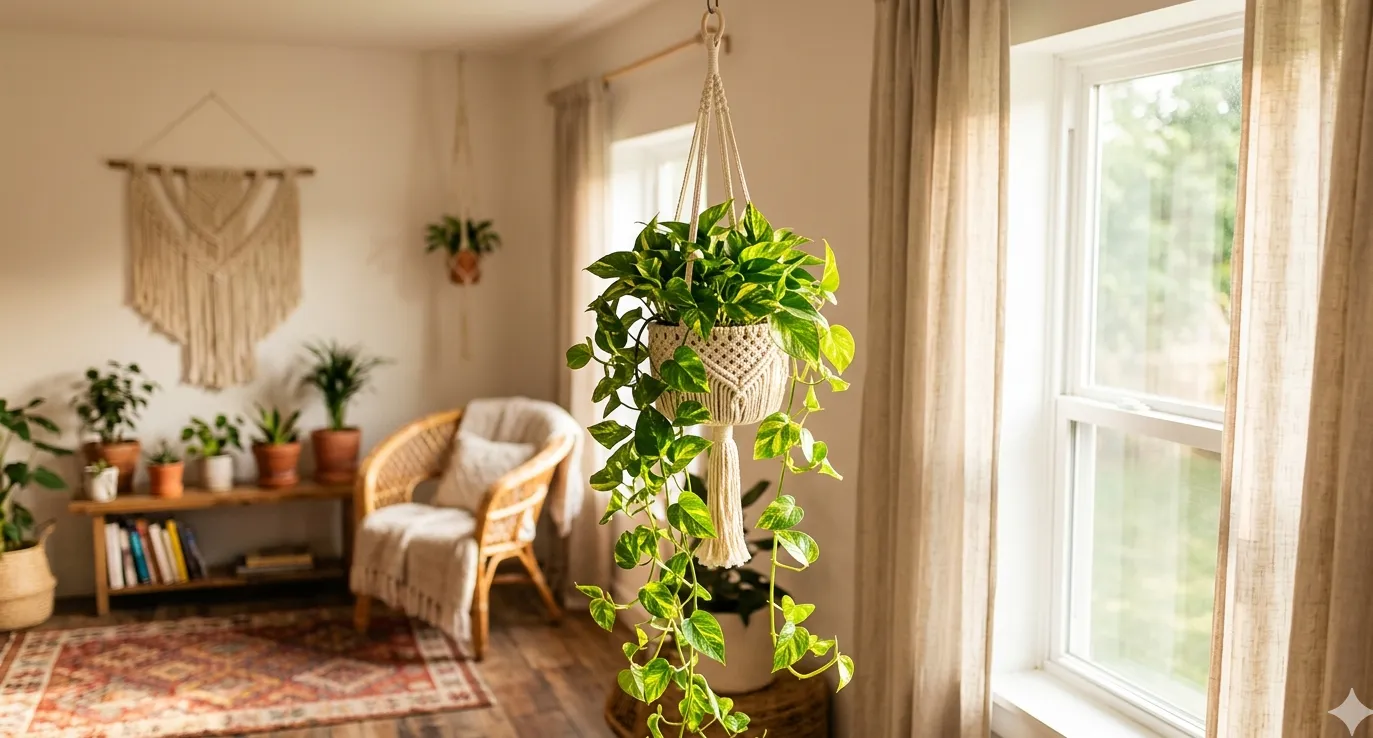
- In a hanging basket (trailing vines) — leaves stay small (5-10 cm), internodes elongate. Pretty and easy, but the Pothos will never reach its full potential
- On a moss pole (climbing) — the plant detects a vertical support, activates its aerial roots and starts producing increasingly large leaves. A Golden Pothos on a pole can reach 20-30 cm leaves indoors
How to install a moss pole
- Choose a sphagnum moss pole or coco pole at least 60 cm tall
- Plant it in the centre of the pot, well anchored
- Attach stems to the pole with soft ties (clips, foam ties)
- Keep the pole moist — mist it regularly to encourage aerial roots to attach
- Be patient: the transition to large leaves takes several months
SPRAIA tip: use the app’s photo tracking to document your Pothos’s evolution on a pole. You’ll be surprised by the difference comparing photos month by month.
Propagation: the easiest plant to multiply
The Pothos is the all-around water propagation champion. If you’ve never propagated a plant, start with this one.
The 4-step method
- Cut a stem 10-15 cm just below a node (the small bump where an aerial root or leaf emerges)
- Remove the bottom leaf so the node is exposed
- Place in water — a simple glass works. Change water every 4-5 days
- Repot when roots reach 3-5 cm — usually within 2 weeks
For a more detailed step-by-step guide, including mistakes to avoid and the soil transition, read our complete water propagation article.
Tip to bushen up a sparse Pothos
If your Pothos has bare stems at the base, cut healthy tips, propagate them and replant directly in the same pot. Within weeks, you’ll get a much fuller, denser pot.
Pothos vs Philodendron: how to tell them apart
Confusion is common because the two plants look very similar. Key differences:
| Criterion | Pothos (Epipremnum) | Philodendron (climbing) |
|---|---|---|
| Leaf texture | Slightly thick, waxy, with relief | Thin and smooth, more flexible |
| Leaf shape | Sharp pointed tip, slightly asymmetric | More symmetric, often heart-shaped |
| Petiole | Slightly grooved, with a furrow on top | Round and smooth |
| Aerial roots | Thick, one per node | Thinner, several per node |
| New leaves | Unfurl without protective sheath | Emerge from a cataphyll (sheath) that browns afterwards |
| Growth | Slightly slower | Often slightly faster |
The most reliable method: look at the petiole (the stem connecting leaf to vine). If you feel a furrow running your finger over it, it’s a Pothos.
Common problems and solutions
Yellow leaves
The most frequent issue. Main causes:
- Overwatering — by far cause #1. Substrate stays soaked too long and roots suffocate. Let dry and reduce frequency
- Lack of light — the oldest leaves (at the base) yellow and drop. Natural in small amounts, but if it accelerates, move closer to light
- Cold draft — the Pothos doesn’t like temperatures below 12 °C. Move away from windows in winter
- Pot too small — compressed roots limit water and nutrient absorption
For a detailed diagnosis, see our article on yellow leaves: causes and solutions.
Bare etiolated vines
Classic symptom of insufficient light. Internodes elongate and leaves become smaller and more spaced. The solution:
- Move to a brighter location
- Cut the bare portions (propagate the healthy tips)
- New growth will be more compact if light is sufficient
Root rot
Caused by constantly wet substrate, often combined with a pot lacking drainage. Signs: soft black stems at the base, unpleasant smell, leaves that yellow rapidly.
What to do:
- Unpot and remove all soil
- Cut brown and soft roots with clean pruners
- Let roots air-dry for a few hours
- Repot in fresh free-draining substrate with a drainage-hole pot
- Don’t water for a few days after repotting
If the base is too damaged, cut healthy stems above the rot and propagate them in water to save the plant.
Loss of variegation
Variegated cultivars (Marble Queen, N’Joy, Manjula) producing increasingly green leaves lack light. White or yellow parts contain no chlorophyll — the plant compensates by producing more green to capture more light. Move closer to a light source and variegation will return on new leaves.
Care summary table
| Parameter | Recommendation |
|---|---|
| Light | Bright indirect (tolerates low light) |
| Watering | Let dry 2-3 cm between waterings |
| Temperature | 18-30 °C (minimum 12 °C) |
| Humidity | 40-70 % (tolerates dry air) |
| Substrate | Potting soil + perlite (70/30), free-draining |
| Fertiliser | Balanced liquid fertiliser monthly in spring/summer |
| Repotting | Every 1-2 years, when roots come out of the pot |
| Propagation | In water, year-round (prefer spring/summer) |
| Toxicity | Toxic to cats, dogs and children (calcium oxalate) |
| Growth | 30-50 cm of new vine per month in optimal conditions |
SPRAIA tip: all this information is built into the app. Add your Pothos to your collection and SPRAIA sends the right reminders at the right time — watering, fertiliser, repotting — factoring in season and environment.
Frequently asked questions about Pothos
The questions plant parents ask most often about Epipremnum aureum.
- Almost always lack of light. Variegated varieties (Marble Queen, N'Joy, Manjula, Pearls and Jade) need bright indirect light to keep their white or cream zones. In a dark room, the plant produces more chlorophyll to photosynthesize and new leaves come out fully green. Move it closer to a bright window — without direct sun — and the next leaves will get their marbling back.
- In water, count 7 to 14 days to see the first roots, and 3 to 4 weeks for 3-5 cm roots sturdy enough to move to soil. In spring and summer it's faster; in winter, the process can take 6 weeks. Change the water every 5 days to avoid suffocation.
- Yes, in full hydroponics or semi-hydro. You then need regular dilute hydroponic fertilizer (once a month) and a water change every 10-15 days. Growth is slower than in soil, leaves stay smaller, but the plant can live for years that way — handy for a desk corner or a pot-free shelf.
- Three common causes: not enough light (first thing to check), erratic watering (either too much or too little), or roots cramped in a pot that's now too small. Check drainage, feel the substrate before each watering, and look at whether roots are sneaking out the pot's holes. A spring repot often kick-starts growth again.
- Yes, for cats, dogs and rabbits. Every part contains calcium oxalate crystals that cause intense oral irritation, drooling, vomiting and sometimes tongue swelling. Place it high, out of reach, or choose a non-toxic plant such as Chlorophytum or Pilea — see our [guide to toxic plants](/en/blog/toxic-plants-children-pets-guide/).
Conclusion
The Pothos is a plant of unmatched versatility. As a hanging plant, it dresses a room corner with long trailing vines. On a pole, it transforms into a tropical with impressive foliage. And when you want more, just cut a stem and put it in water. Whether you’re a beginner looking for an unkillable plant or a collector hunting for rare cultivars like Cebu Blue or Manjula, the Pothos always has something to offer.
Add yours to SPRAIA to track its growth, get personalised care reminders and document its evolution photo by photo. Because a well-cared Pothos is a Pothos that never stops growing.