Indoor Plant Light: The Complete Guide
Learn to assess light at home, choose the right plants for each exposure and spot signs of low or excess light.
By SPRAIA editorial team · Method: botanical sources, field feedback and editorial validation
Light is your plants’ #1 source of energy. Before watering, before fertilising, before substrate choice — light determines whether a plant will thrive or slowly fade in its corner. Yet it’s the most under-estimated factor by indoor plant owners.
In this guide, you’ll learn how to concretely assess the light available at home, choose plants suited to each situation, and recognise warning signs when something’s off.
Light types: vocabulary to master
When talking about light for plants, we distinguish four levels. Understanding these terms is essential — they appear consistently on every care sheet.
Direct light
The sun’s rays reach the foliage directly. Indoors, that means a south-facing window with no curtain, where the plant gets several hours of unfiltered sun. Few houseplants tolerate it — most burn.
Bright indirect light
The plant gets plenty of brightness, but never direct rays. Typically a position 1-2 m from a south-facing window, or directly facing east or west. This is the sweet spot for most tropical plants.
Moderate light (partial shade)
Bright enough to read comfortably without a lamp, but no direct sun or strong glare. Think a position 2-3 m from a window, or a clear north-facing window.
Low light (shade)
A corner far from windows, a hallway, a north-facing room with obstructed views. Few plants thrive here — most survive but barely grow.
SPRAIA tip: snap a photo of your space with SPRAIA for an instant light assessment and placement recommendations.
How to assess light at home
The phrase “bright indirect light” doesn’t speak to everyone. Here are concrete methods to evaluate your situation.
The shadow test
Hold your hand 30 cm above a white surface, where you’d like to place a plant:
- Sharp, well-defined shadow — direct or bright indirect light
- Visible but blurry shadow — moderate light
- Barely perceptible shadow — low light
- No shadow at all — too dark for most plants
Window orientation
Window orientation is the determining factor:
| Orientation | Light type | Intensity | Ideal for |
|---|---|---|---|
| South | Direct then bright | Maximum | Succulents, cacti, Ficus |
| East | Soft morning | Medium-high | Calatheas, ferns, Pothos |
| West | Warm afternoon | Medium-high | Monstera, Philodendrons |
| North | Diffuse all day | Low-moderate | Pothos, ZZ, Snake Plant |
Common pitfalls
- Curtains reduce light by 30-60 % depending on opacity
- Distance: light intensity drops dramatically — 2 m from a window, you only receive 25 % of the sill’s available light
- Season: in winter, duration and intensity drop sharply. A “sufficient” east window in June can become inadequate in December
- Obstructed views: a building across can block 50 % or more of light, even with good orientation
Which plant for which light?
Plants for bright to direct light
These plants love sun and tolerate a few hours of direct rays:
- Ficus elastica — a classic that loves light. See our complete Ficus elastica guide for every care detail
- Strelitzia (bird of paradise) — needs several hours of bright light to flower
- Succulents and cacti — built for full sun
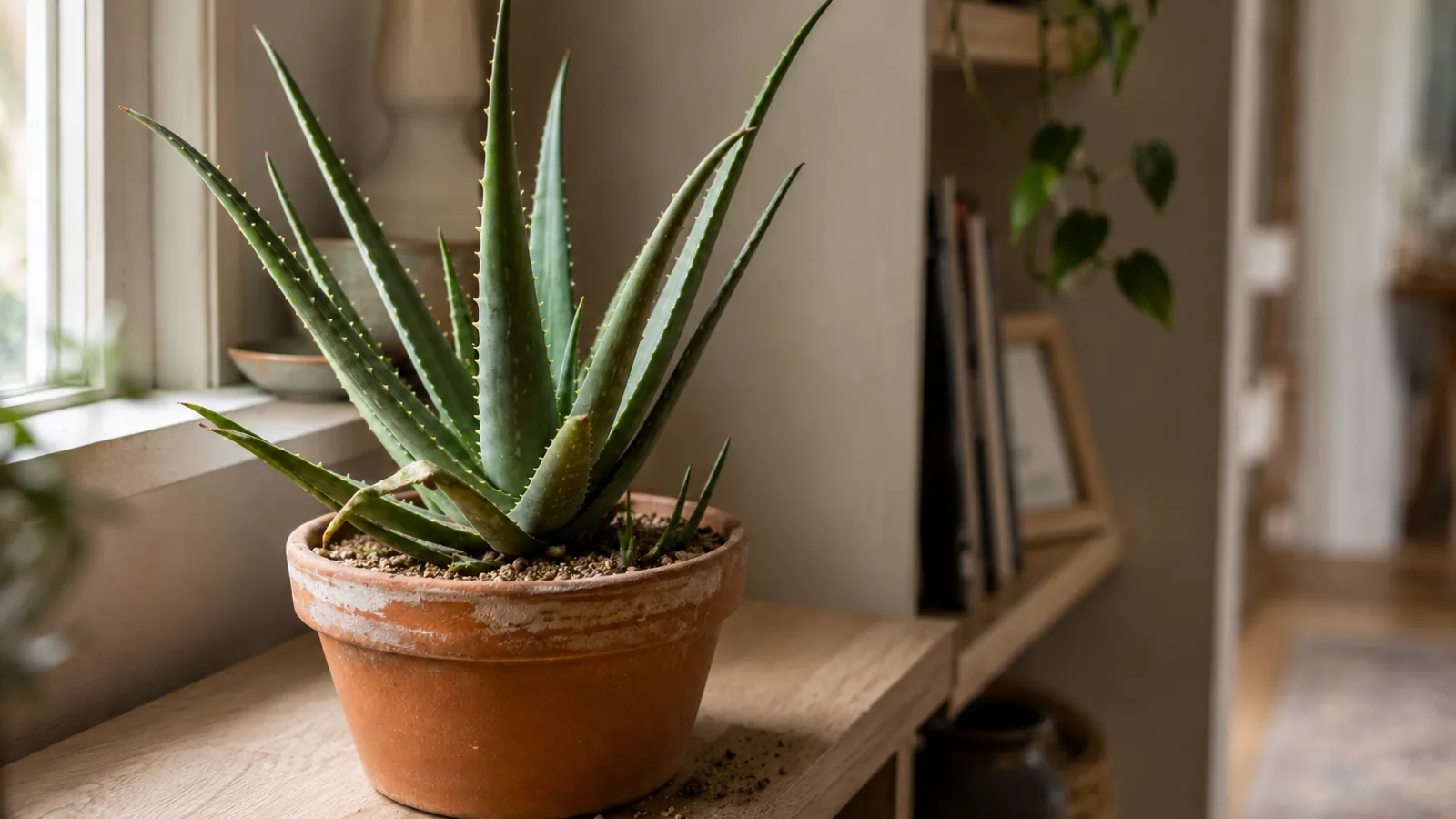
- Aloe vera — ideal on a south-facing window sill
Plants for bright indirect light
Most popular indoor plants fall in this category:
- Monstera deliciosa — this is the light it needs to develop its iconic fenestrations. Our Monstera guide details every optimal condition
- Philodendrons — most species thrive in bright indirect
- Alocasias — spectacular plants needing brightness without direct sun. See our dedicated Alocasia guide
- Calathea — bright but filtered to preserve patterns. All details in our Calathea guide
- Pilea peperomioides — the Chinese money plant that loves brightness. Our Pilea guide covers everything
Partial-shade tolerant plants
For dimmer rooms or recessed positions:
- Pothos — the king of adaptability, survives almost anywhere. Our complete Pothos guide helps you get the most from it
- Spathiphyllum (peace lily) — one of the rare plants that flowers in moderate light
- Aglaonema — decorative foliage even in partial shade
- Dracaena — robust and undemanding
Plants for low light
The shady corner survivors:
- Zamioculcas (ZZ) — nearly indestructible, tolerates the darkest nooks
- Snake Plant (Sansevieria) — slow but unbothered
- Aspidistra — nicknamed “cast-iron plant” for good reason
If you’re a beginner looking for easy plants for any condition, our easy beginner plants guide is an excellent starting point.
Recognising insufficient light
Your plants talk to you. The unmistakable signs:
Etiolation
The plant stretches abnormally toward the light source. Stems thin out, internodes space out, the habit becomes unbalanced. The most obvious sign.
Loss of colour and pattern
Leaves pale, going from dark green to washed-out green. Variegated plants (variegata) lose their variegation and turn fully green — the plant sacrifices aesthetics to maximise photosynthesis.
Slowed or stopped growth
No new leaves for months, especially during growing season (spring-summer)? Lack of light is often the cause.
Falling leaves
The lowest leaves — those getting the least light — yellow and drop. If your leaves are yellowing, light is one of the first causes to investigate.
Substrate stays moist too long
Less light = less photosynthesis = less water absorption. If your substrate takes more than a week to dry between waterings, the plant probably isn’t using enough water due to lack of light.
Recognising excess light
Excess is rarer indoors but does happen:
- Leaf burn — brown, dry, crispy patches, often on the most exposed leaves
- Curling leaves — the plant tries to reduce exposed surface
- Discolouration — leaves whitening or yellowing on the window side
- Soil drying too fast — if you have to water every 2-3 days, light (and associated heat) may be too intense
The solution is simple: move the plant 50 cm to 1 m back, or add a sheer curtain.
Optimising light at home
Play with distance
Remember: each metre of distance dramatically cuts received light. Before investing in artificial lighting, just try moving plants closer to the window.
Rotate your plants regularly
Quarter-turn your plants every two weeks. This ensures even growth and prevents one-sided etiolation.
Clean leaves
Dust on leaves can block up to 25 % of absorbed light. Wipe large leaves with a damp cloth once a month.
Light surfaces help
White walls and light surfaces reflect light and increase ambient brightness. A well-placed mirror can also redirect light to a darker corner.
Artificial lighting as a last resort
If you really don’t have enough natural light, horticultural LED lamps are a viable option. Choose full-spectrum bulbs and aim for 12-14 hours of lighting per day to compensate for low intensity.
Light and seasons: adapting your care
Light changes dramatically through the year:
- Spring-summer: long days, intense light. Active growth period. Your bright-light plants are in heaven
- Autumn-winter: short days, weak grazing light. Even a south-facing window loses considerable intensity
Implications:
- Move your plants in autumn — bring them closer to windows
- Reduce watering — less light = less water consumption. See our watering guide to adjust your frequencies
- Stop fertilising from November to February — without sufficient light, the plant can’t use nutrients
- Accept the slowdown — near-zero growth in winter is normal, not a sign of disease
Conclusion
Light is the most important — and most overlooked — parameter in indoor plant care. Before blaming watering or substrate when a plant declines, assess its light. Often, moving a plant 50 cm makes more difference than any fertiliser.
Take time to observe your home at different times of day, test with the shadow method, and don’t hesitate to reorganise plants based on their actual needs. Your plants will reward you with vigorous growth and radiant foliage.
Frequently asked questions about light
The questions that come up most when assessing and tuning the light your houseplants get.
- The shadow method is the simplest: at noon on a clear day, hold your hand between the window and a white wall. A sharp, dense shadow means bright light (3000+ lux), a blurry but visible shadow means medium light (500-2000 lux), and a barely perceptible shadow means low light (<500 lux). Several free smartphone apps (including lux meters) also give a useful estimate.
- A few very tolerant species (Sansevieria, Zamioculcas, Aspidistra) survive in a windowless room as long as artificial lighting of at least 1000-2000 lux runs 10-12 hours a day. With zero light at all, no plant grows long-term: photosynthesis stops and reserves run out within months.
- Count 12 to 14 hours per day for most green plants, either to supplement or fully replace daylight. Too short (under 8 h), the plant doesn't store enough energy; too long (over 16 h), it loses its day/night cycle and stresses out. Use a timer for a steady rhythm.
- Yes, ideally every 7 to 15 days by a quarter turn. Plants orient their growth toward the light source (phototropism): without rotation, they become asymmetrical and the side opposite the window thins out. Rotation ensures balanced development and an even shape.
- Yes, for many tolerant species — ferns, Calathea, Spathiphyllum, Pothos, Sansevieria. North windows give a soft, steady indirect light without harsh sun. On the other hand, forget cacti, succulents, demanding variegated plants and flowering plants: they need east, west or south exposure.