Philodendron: Species, Care and Mistakes to Avoid
Complete Philodendron guide: climbing or bushy varieties, light, watering, propagation and solutions to the most common problems.
By SPRAIA editorial team · Method: botanical sources, field feedback and editorial validation
If the Monstera has been the undisputed star of houseplants in recent years, its cousin the Philodendron deserves just as much spotlight. This vast genus includes over 480 species with surprisingly diverse forms: graceful vines, compact bushes, leaves shaped like hearts, fiddles, or cut like delicate lace. Adaptable, low-maintenance and easy to propagate, Philodendrons are perfect for beginners and seasoned collectors alike. Here is everything you need to know to choose them well and keep them in top form.
What exactly is a Philodendron?
The word Philodendron comes from the Greek philos (loving) and dendron (tree) — literally “tree-loving”. And for good reason: in nature, most Philodendrons are climbing epiphytes that wrap around tree trunks in the tropical forests of Central and South America, taking advantage of the light filtered through the canopy.
This adaptation to the dim understory is exactly why they tolerate our homes so well — homes that are often less bright than we imagine. They belong to the Araceae family, like Monstera, Pothos, or Anthurium — relatives you’ll often find side by side in plant shops (our guide to indoor plant families explores this large botanical family in detail).
Philodendron or Monstera? How to tell them apart
Many people confuse the two genera, and not by accident: they were long classified in the same group. A few easy signs:
- Foliage: Monstera develops fenestrated (perforated) leaves at maturity; Philodendrons generally keep entire leaves — except a few species like Philodendron bipinnatifidum.
- Aerial roots: very visible and thick on Monstera, finer and more discreet on Philodendron.
- Cataphylls: Philodendrons produce thin membranes that protect new leaves, which then dry up and fall off. Monsteras don’t.
If you hesitate at the garden centre, remember this: if the adult leaves have holes, it’s probably a Monstera. Otherwise, you likely have a Philodendron. For more depth on Monstera, check our complete Monstera care guide.
Must-have species
Here is a selection of the most popular Philodendrons indoors, from classic to rare.
Heart-shaped climbers
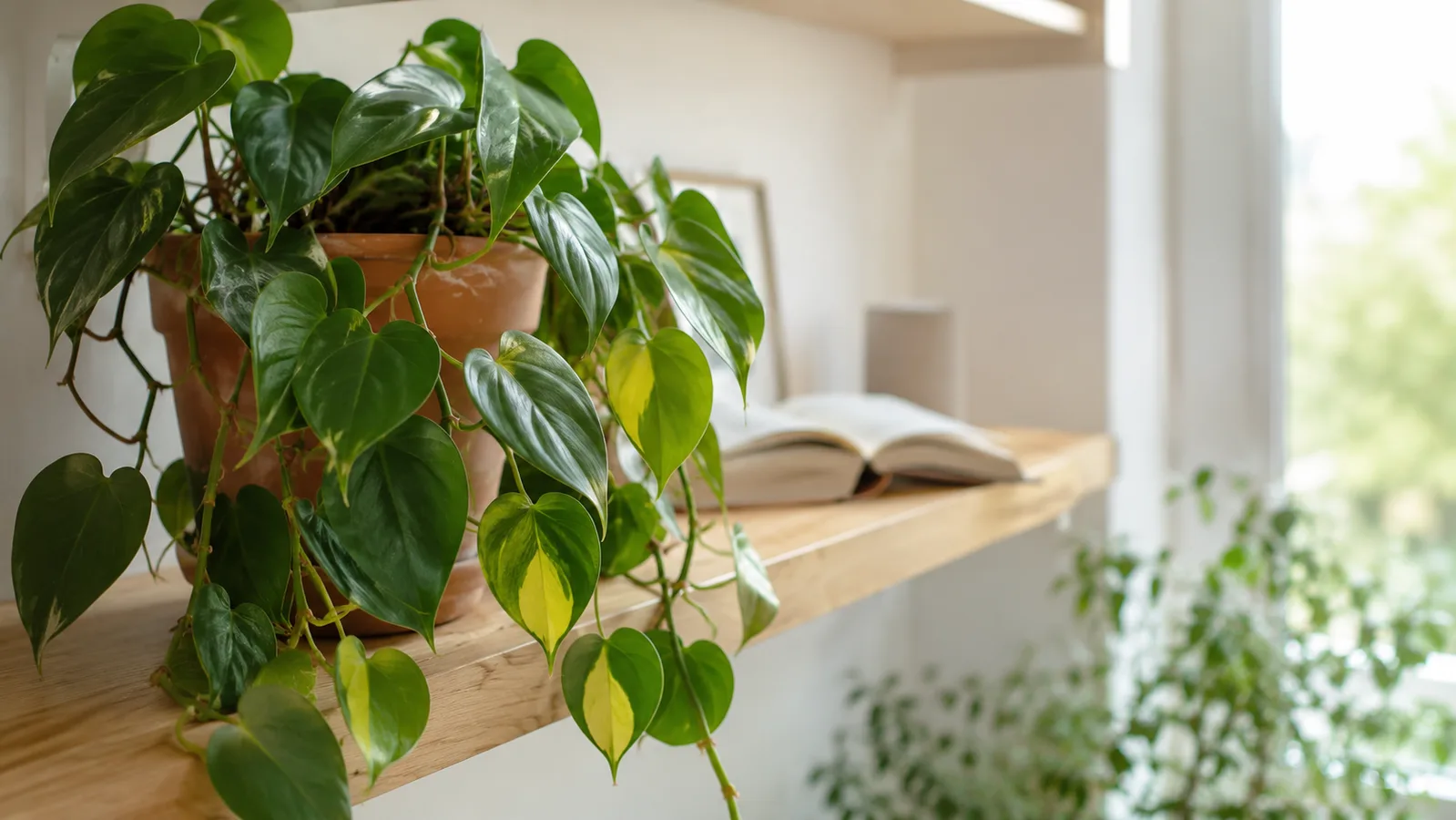
- Philodendron scandens (or hederaceum) — the quintessential Philodendron, with small, glossy heart-shaped leaves. Very tolerant, ideal hanging or on a trellis. Fast grower.
- Philodendron Brasil — variegated form of scandens, with bright yellow-green stripes down the centre of leaves. As easy as the classic.
- Philodendron Micans — close relative of scandens, but with velvety leaves and copper highlights. A “luxe” version of the classic climber.
- Philodendron Lemon Lime — electric yellow-green leaves. Perfect to brighten up a darker corner.
Spectacular bushy types
- Philodendron Birkin — compact habit, dark green leaves with white pinstripes. A modern hybrid, very on-trend.
- Philodendron White Wizard / White Princess / White Knight — varieties with pure white variegation, ultra sought-after by collectors (with a price tag to match).
- Philodendron Pink Princess — the queen of pink variegation. Demanding but stunning. Needs lots of light to keep its colour.
- Philodendron Bipinnatifidum (formerly selloum) — large size, deeply lobed leaves vaguely reminiscent of palms. Needs space.
Rarer for collectors
- Philodendron Gloriosum — huge heart-shaped leaves, velvet green with silver veins. A creeper, not a climber.
- Philodendron Verrucosum — velvety leaves with bronze tones, red and hairy petioles. A tropical beauty demanding in humidity.
- Philodendron Melanochrysum — long arrow-shaped leaves, almost black with golden highlights. More on these rare gems in our rare plants for collectors guide.
Essential needs
The greatest strength of the Philodendron is its forgiving nature. It tolerates forgotten waterings, moves and imperfect conditions. Here are the parameters to respect for a thriving plant.
Light: medium to bright indirect
Philodendrons love filtered bright light. An exposure 1–2 m from an east- or west-facing window is ideal. Avoid prolonged direct sun — it scorches leaves, especially on variegated varieties.
Green varieties (scandens, micans) tolerate lower light, but their growth slows. Conversely, variegated varieties (Pink Princess, White Princess, Brasil) need more light to keep their colours: without enough brightness, they progressively revert to plain green.
To learn how to evaluate light in your home, see our complete light guide for indoor plants.
Watering: moderate, never soggy
The most common mistake with Philodendrons? Overwatering. These plants tolerate slight dryness infinitely better than excess water.
Simple rule: let the top 2–3 cm of substrate dry out between waterings. When in doubt, wait another two or three days.
Indicative frequency:
- Spring–summer: about once a week
- Autumn–winter: every 10 to 14 days
But forget fixed schedules: the actual cadence depends on light, temperature, humidity and pot size. Our complete watering guide explains in detail how to read your plant’s true signals.
Humidity: appreciated but not essential
Most Philodendrons cope with normal household humidity (40–50 %). However, velvety species (Micans, Verrucosum, Gloriosum) thrive in higher humidity (60–70 %): their foliage becomes shinier and more vigorous.
To boost humidity locally:
- Group your plants together (microclimate)
- Place the pot on a tray of moist clay pebbles
- Invest in a humidifier if several plants benefit from it
Avoid spraying velvety leaves directly: standing water encourages spotting and fungal disease.
Temperature: 18 to 27 °C
Philodendrons are tropical: they love warmth and fear the cold. Keep them between 18 and 27 °C. Below 13 °C their growth halts and leaves can yellow. Above 30 °C with dry air they suffer fast.
Avoid:
- Cold drafts near windows in winter
- Thermal shock (placing on a balcony in shoulder seasons)
- Standing right next to radiators or air-conditioning vents
Ideal substrate
Philodendrons need a light, well-draining substrate, rich in organic matter. A compacted potting mix retains water and ends up suffocating the roots.
Balanced homemade recipe:
- 50 % quality houseplant potting mix
- 25 % pine bark (or coco coir)
- 15 % perlite (or pumice)
- 10 % vermiculite or mature compost
This airy composition mirrors the Philodendron’s epiphytic origin, where in the wild it often grows in pockets of humus accumulated on tree trunks. For a more modern approach, some hobbyists grow their Philodendrons in PON mineral substrate — a system offering ultra-precise control over root moisture.
Staking a climbing Philodendron
Climbing species develop much larger and more mature leaves when allowed to climb a support. Without a stake, they’ll keep producing small juvenile foliage and stay in a creeping habit.
Staking options
- Sphagnum moss pole — the great classic. The moss retains moisture and invites aerial roots to attach. Keep moist for best results.
- Coconut fibre pole — a more eco-friendly and durable alternative. Also requires regular moistening.
- Trellis or wood panel — for a more decorative effect. Tie stems with soft ties (raffia, silicone elastic).
- Wall or beam — for ambitious enthusiasts: a Philodendron freely climbing an indoor wall can reach spectacular dimensions.
How to install a stake
- Choose a stake about 30 to 50 cm taller than the current plant to anticipate growth
- Plant it in the centre of the pot, as deep as possible, ideally at repotting time to avoid damaging roots
- Tie main stems gently without squeezing
- Mist the stake regularly (sprayer or water syringe)
- Be patient: the first aerial roots will take 2 to 4 weeks to attach
Propagating a Philodendron: near-guaranteed success
Philodendrons are among the easiest plants to propagate. A single stem can produce several new plants in just a few weeks.
Method 1: water propagation
The most visual and accessible method:
- Find a node on the stem (the small bump where leaves and aerial roots emerge)
- Cut just below the node with clean shears, keeping 1–2 leaves on the cutting
- Dip the cutting in a glass of water, node submerged, leaves above water
- Place in bright indirect light
- Change the water every 3–5 days
- First roots appear in 2 to 4 weeks
- Pot up in soil when roots are 5–7 cm long
For a step-by-step method, our complete water propagation guide covers all advanced techniques.
Method 2: direct soil propagation
Faster transition, but less fun to watch:
- Prepare the cutting as above
- Dip the node in rooting hormone powder (optional)
- Plant directly in moist potting-mix-and-perlite blend
- Cover with a clear plastic bag (greenhouse effect)
- Air daily to prevent mould
- Roots in 3–5 weeks, sign: visible new growth
Method 3: air layering (for rare varieties)
Reserved for hard-to-propagate or precious species (Pink Princess, Verrucosum):
- Identify a node on a mature stem
- Wrap it with a ball of moist sphagnum moss
- Cover with clear plastic film and secure both ends
- Keep the moss moist for 4 to 8 weeks
- When healthy roots are visible through the plastic, cut and pot up
Most common problems
Yellow leaves
The classic. Several possible causes:
- Overwatering (cause #1) — substrate stays soggy, roots suffocate
- Natural ageing — a lower leaf turning slowly yellow is normal
- Light deficiency — the plant sacrifices its oldest leaves
- Nitrogen deficiency (rare indoors if the plant is repotted regularly)
Our yellow leaves diagnostic guide covers each cause and the right solution.
Brown, dry leaf tips
Typical symptom of air too dry or inconsistent watering. Solutions:
- Increase ambient humidity
- Regularize watering (same intervals, same volumes)
- Check water quality (overly hard or chlorinated tap water leaves deposits)
Long pale petioles, few leaves
Your Philodendron is light-starved. It stretches to find light. Move it closer to a window, remove curtains or add supplemental grow lighting.
Mealybugs
Philodendrons, like most tropical houseplants, are sensitive to mealybugs. These small white cotton-like clusters appear at leaf axils and along stems. Our complete guide to identifying and removing mealybugs walks you through how to deal with them without harsh products.
New growth that warps or aborts
Often linked to:
- Inconsistent watering at the time the new leaf was unfurling
- Lack of humidity at a critical moment
- Nutrient deficiency (overdue repotting)
Annual care calendar
| Season | Watering | Light | Fertilizing | Specific action |
|---|---|---|---|---|
| Spring | Gradual resume, 1×/week | Maximum available | Restart (1×/month balanced NPK) | Repot if needed |
| Summer | 1×/week, sometimes more | Bright indirect, no direct sun | 1×/15 days | Mist for velvety species |
| Autumn | Stretch (10–12 days) | Maximum available | Reduce (1×/month) | Pest inspection before winter |
| Winter | Every 12–15 days | Bright indirect | Stop | Move away from dry heat sources |
Common mistakes to avoid
- Watering too often — slight dryness is a thousand times less harmful than waterlogging
- Choosing a pot too large — promotes water retention and root rot
- Forgetting the stake on climbing varieties — limits leaf maturation
- Misting velvety leaves — they don’t like standing surface water
- Placing too far from light — especially variegated varieties, which revert
- Routinely cutting aerial roots — they help the plant attach and absorb humidity better
- Skipping repotting — a root-bound Philodendron slows its growth dramatically
Frequently asked questions about Philodendron
Everything you wonder when you adopt your first Philodendron — or your tenth.
- Both belong to the Araceae family and look very similar, but they are two distinct genera. The Monstera develops fenestrations (holes and splits) as it matures; Philodendrons usually keep entire leaves, heart-shaped or lobed. Care-wise, their needs are nearly identical: bright indirect light, moderate watering, free-draining substrate.
- It's called guttation — a natural process, not a disease. When ambient humidity is high and the plant has absorbed a lot of water, it releases the excess through specialised pores (hydathodes) at the leaf tips. It's harmless, but if it happens often, space out watering: your plant is drinking more than it needs.
- Once a month from March to October, with a balanced liquid fertilizer (NPK 10-10-10 or 20-20-20) diluted to half the recommended dose. Full stop from November to February: without enough light, the plant can't take up nutrients and salts build up in the substrate, burning the roots.
- Place a sphagnum moss pole in the pot at repotting time. Keep it moist with regular misting or by pouring a little water at the top. Gently tie the stems to the pole with soft ties, pointing the aerial roots toward the moss — they'll latch on by themselves within a few weeks. The leaves produced afterwards will be significantly larger.
- Yes, all of them, no exception. Like other Araceae (Monstera, Pothos, Anthurium), they contain calcium oxalate crystals that irritate pets' mouths and oesophagi. Place them out of reach, or pick non-toxic alternatives (see our [guide to toxic plants for children and pets](/en/blog/toxic-plants-children-pets-guide/)).
Conclusion
Philodendron ticks every box: aesthetic, forgiving, easy to multiply, available in an endless variety of species and variegations. Whether you start with a humble scandens at €10 or splurge on a Pink Princess at €200, the basics stay the same: bright indirect light, moderate watering once the substrate dries, free-draining substrate, and a touch of attention when growth slows.
With SPRAIA, instantly identify your Philodendron variety, get personalized reminders matching each species’ specific needs, and track its growth in a visual journal that captures every new leaf. Your collection deserves that level of care — and your plants will reward you with spectacular foliage.