Monstera obliqua
Monstera obliqua
The mythical monstera with paper-thin leaves that are almost all holes: rare, demanding, for experts only. Complete care guide.
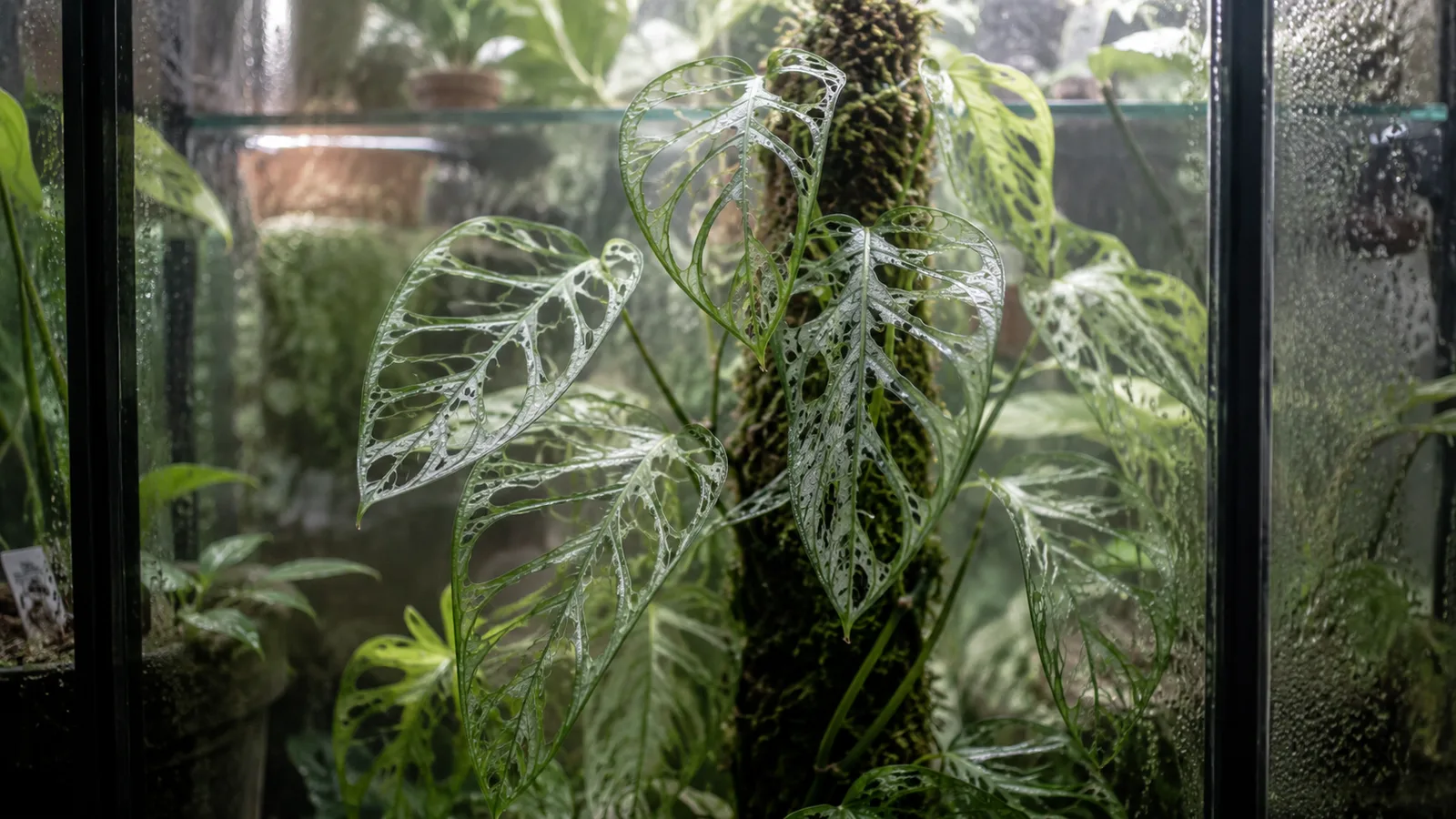
The Monstera obliqua is arguably the most mythical Monstera — and the hardest. Its leaves are so thin, almost translucent like paper, and so perforated that they can be up to 90 % holes. Extremely rare and expensive, it’s very often confused (deliberately or not) with the far more common adansonii. Reserve it for experienced growers or terrarium keepers.
What you really need to know
The obliqua demands conditions close to its habitat: very high humidity, constant warmth, a substrate kept slightly moist. In an ordinary flat it wastes away; in a cabinet or paludarium it thrives. It naturally spreads by stolons (long underground runners).
Light
Soft bright indirect light. Its paper leaves instantly burn under the slightest direct ray. Filtered, constant light suits it best — for example horticultural lighting in a cabinet.
Watering
The substrate must stay constantly and lightly moist, never soggy or dry: water every 4 to 7 days depending on evaporation. Its very fine roots rot fast in standing water but tolerate no drying out. Sphagnum and perlite make a good mix.
Humidity and temperature
Extreme conditions: 80-95 % humidity and 20-28 °C. Outside a cabinet or terrarium, reaching such humidity is very hard, hence its reputation as a fussy plant.
Mistakes to avoid
- Growing it in open flat air — crispy edges, rapid decline
- Direct sun — immediate burning of the translucent leaves
- Confusing it with an adansonii at purchase — check the extreme thinness of the blade
- Dry or soggy substrate — its fine roots forgive neither
Toxicity
⚠️ Toxic to cats, dogs and children: calcium oxalate crystals throughout. Keep out of reach.
Propagation
The obliqua puts out stolons: let these runners root in a moist substrate, then separate them. Node cuttings also work in very stable humid conditions. See our complete water propagation guide.
Varieties and common confusions
- Monstera adansonii: the #1 confusion — the adansonii has far thicker, less perforated leaves. See our Monstera adansonii sheet.
- There are several geographic forms of obliqua (Peru, Bolivia…), all rare.
- For a more accessible introduction to the genus, see the Monstera deliciosa.
Frequently asked questions
How often should I water this plant?
Water Monstera obliqua every 4-7 days, adjusting for season, pot size and available light. Always check that the top of the substrate has started to dry before watering.
Is this plant toxic to cats and dogs?
Monstera obliqua is classified as "toxic". As a precaution, keep it away from pets that chew leaves and contact a vet if ingestion causes symptoms.
Why are its leaves turning yellow?
Yellow leaves on Monstera obliqua most often come from overwatering, low light or recent stress. First check substrate moisture, root condition and placement.
Where should I place it at home?
Monstera obliqua prefers bright indirect light. Place it near a bright window without harsh direct sun, then adjust if leaves fade, brown or growth slows.
Is it beginner-friendly?
Monstera obliqua needs some observation: it is manageable, but less forgiving of overwatering and poor placement.
Sources and method
This fact sheet is based on public botanical references, recognized horticultural recommendations and the SPRAIA editorial method.
- Royal Botanic Gardens, Kew
- Missouri Botanical Garden
- Royal Horticultural Society
- GBIF
Diagnose and track this plant
SPRAIA is in private beta. Join the list to test plant identification, visual diagnosis and reminders tailored to each plant.
Join the private beta