Monstera: 10 Varieties to Know and How to Care for Them
Complete Monstera guide: deliciosa, adansonii, Thai Constellation, Albo, siltepecana… Recognise each variety, care for it and choose the right one.
By SPRAIA editorial team · Method: botanical sources, field feedback and editorial validation
The Monstera is probably the most iconic houseplant genus of the past decade. Everyone knows the deliciosa and its huge holey leaves — but behind that Instagram star lies a far richer family: vines riddled with holes, white- or cream-variegated cultivars, silvery foliage, forms that press flat against walls or split like fronds. This guide reviews the 10 essential Monsteras, helps you recognise them, care for them and choose the one that suits you.
What exactly is a Monstera?
The genus Monstera groups around fifty species of epiphytic vines in the Araceae family, native to the humid tropical forests of Central and South America. In the wild, they germinate on the ground then climb tree trunks using sturdy aerial roots, reaching for the light filtered through the canopy.
Their signature is fenestration: the holes and splits that appear in mature leaves. Two hypotheses explain it — letting light reach lower leaves, and withstanding heavy tropical rain without tearing. One key detail: these holes only appear at maturity, and only if the plant climbs a support. A young Monstera, or one grown without a pole, keeps entire leaves.
Like all aroids (Pothos, Philodendron, Anthurium…), Monsteras contain calcium oxalate crystals that make them toxic if ingested. To place this genus among its cousins, our guide to indoor plant families is a great starting point.
The 10 Monsteras to know
Here’s our selection, from the most accessible to the most advanced. Each name links to its detailed care sheet in our catalogue.
The easy classics
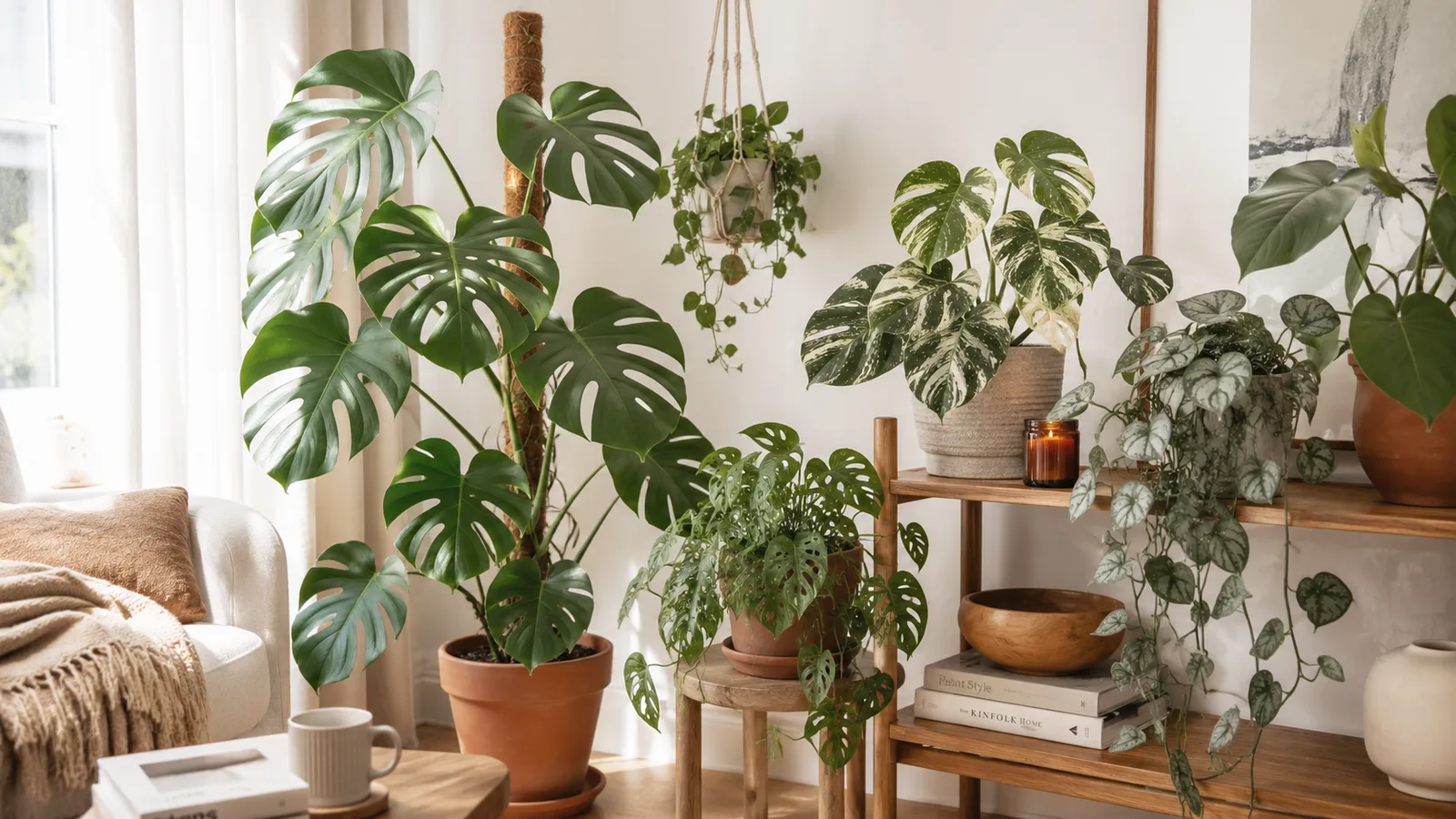
- Monstera deliciosa — the absolute reference, huge fenestrated leaves on a pole. Fast-growing, ideal to start. (See also our complete Monstera deliciosa care guide.)
- Monstera adansonii — the “monkey mask”, small leaves riddled with oval holes, perfect hanging.
- Monstera siltepecana — silvery-green juvenile leaves, vigorous and drought-tolerant.
- Monstera Peru — thick, puckered, ultra-glossy leaves; never fenestrates but forgives everything.
- Monstera standleyana — the “cobra philodendron”, elongated glossy leaves, sometimes cream-speckled.
The sought-after variegated
- Monstera Thai Constellation — stable starry cream variegation, from tissue culture.
- Monstera Albo Variegata — large pure-white sectors, unstable variegation: the collector’s grail.
The collector forms
- Monstera dubia — the “shingle plant” that presses its silver leaves flat against its support.
- Monstera pinnatipartita — spectacular metamorphosis: entire leaves when young, then deeply comb-split.
- Monstera obliqua — the mythical one with paper-thin leaves, almost more holes than leaf. Rare and demanding.
You’ll find these ten sheets gathered, with filters and identity cards, on our dedicated Monstera hub.
Variegated: understanding “stable” vs “unstable”
This is the big question that drives prices up. Two variegated Monsteras dominate the market, and they’re worlds apart in care:
- The Thai Constellation was created in a lab by tissue culture. Its speckled cream variegation is stable: it doesn’t disappear or “revert” to green. It’s the most reliable.
- The Albo Variegata results from an unstable mutation. Every leaf is a lottery: large white sectors, half-white half-green, even a fully white stem (which eventually dies, lacking chlorophyll). It needs regular pruning to keep a green/white balance.
In both cases, the pale zones don’t photosynthesise: they need more light than a green Monstera, but never direct sun, which instantly burns the white parts.
The care common to all Monsteras
Good news: despite their diversity, Monsteras share the same broad principles.
Light
Bright indirect light for all. Near an east- or west-facing window, or 1-2 m from a sheer-curtained south one. Too much shade = small, holeless leaves; direct sun = scorching. Variegated and silvery forms want the brightest light (without direct sun). To understand it all, see our complete light guide.
Watering
The golden rule: water only when the top 3-4 cm of substrate are dry. Overwatering is the leading killer of Monsteras. Reckon on every 7 days in summer, every 12-14 days in winter — but always check rather than water on a fixed schedule. Thin-leaved species (adansonii, obliqua) dry faster; thick-leaved ones (Peru) forgive a lapse.
Humidity, substrate and support
Monsteras like 50-80 % humidity (more for dubia and obliqua). Give them a very free-draining, airy substrate — a PON-type mineral substrate suits them perfectly. Finally, a moss pole is essential to trigger fenestrations and grow large adult leaves.
Which Monstera should you choose?
- Beginner? Start with a deliciosa, an adansonii or a Peru: hardy and forgiving.
- Small space / hanging? The adansonii and siltepecana cascade beautifully.
- Want variegation? The Thai Constellation for ease, the Albo if you love a challenge.
- Collector chasing rarity? The dubia, pinnatipartita or obliqua — bearing in mind the obliqua demands terrarium conditions.
Propagation: child’s play (almost)
Most Monsteras root very easily in water. Cut 1-2 cm below a node, ideally with an aerial root, place the cutting in a jar and change the water every 5 days. Pot up when roots reach 8-10 cm. For variegated ones, always choose a section with both green AND white. Our complete water propagation guide details every step.
Frequently asked questions about Monsteras
The questions that come up most often among Monstera lovers.
- Fenestrations only appear at maturity and only if the plant climbs. A young Monstera, or one grown without a pole, keeps entire leaves. Install a moss pole, provide bright indirect light and be patient: the following leaves will gradually develop holes. Light that's too low also blocks fenestration.
- They're the two most confused 'holey' Monsteras. The adansonii is common, hardy, with relatively thick leaves and oval holes. The obliqua is rare, very difficult, with paper-thin leaves made of up to 90 % holes. If the plant is affordable and vigorous, it's almost certainly an adansonii.
- No, and that's the whole point: its cream variegation is stable because it comes from lab tissue culture. Unlike the Albo Variegata (an unstable mutation that can revert to green), the Thai keeps its speckling. Simply give it plenty of bright indirect light to compensate for its chlorophyll-free zones.
- Yes, every species in the genus. Like other aroids, they contain calcium oxalate crystals that irritate the mouth and esophagus of cats, dogs and children if ingested. Keep them out of reach. For safe alternatives, see our guide to toxic plants for children and pets.
- No. Aerial roots let the plant cling to its support and absorb moisture and nutrients. Cutting them for looks weakens the plant. You can guide them towards the moss pole or, if they really bother you, gently coil them — but avoid removing them.
Conclusion
From the €15 deliciosa to the three-figure Albo, the Monstera genus offers fascinating diversity — yet remarkably consistent needs: bright indirect light, watering only when the substrate dries, a free-draining mix and a good pole. Master these fundamentals and you can collect every variety with confidence.
With SPRAIA, identify your Monstera instantly, get watering reminders tailored to the species, diagnose any issue and track each new fenestrated leaf in a photo journal. Your Monsteras deserve this level of attention — and they’ll repay you with spectacular foliage. Explore our complete Monstera catalogue now.