Monstera Albo Variegata
Monstera deliciosa 'Albo Variegata'
The most sought-after white-variegated monstera: unstable, sectoral variegation to balance by pruning. Complete care guide.
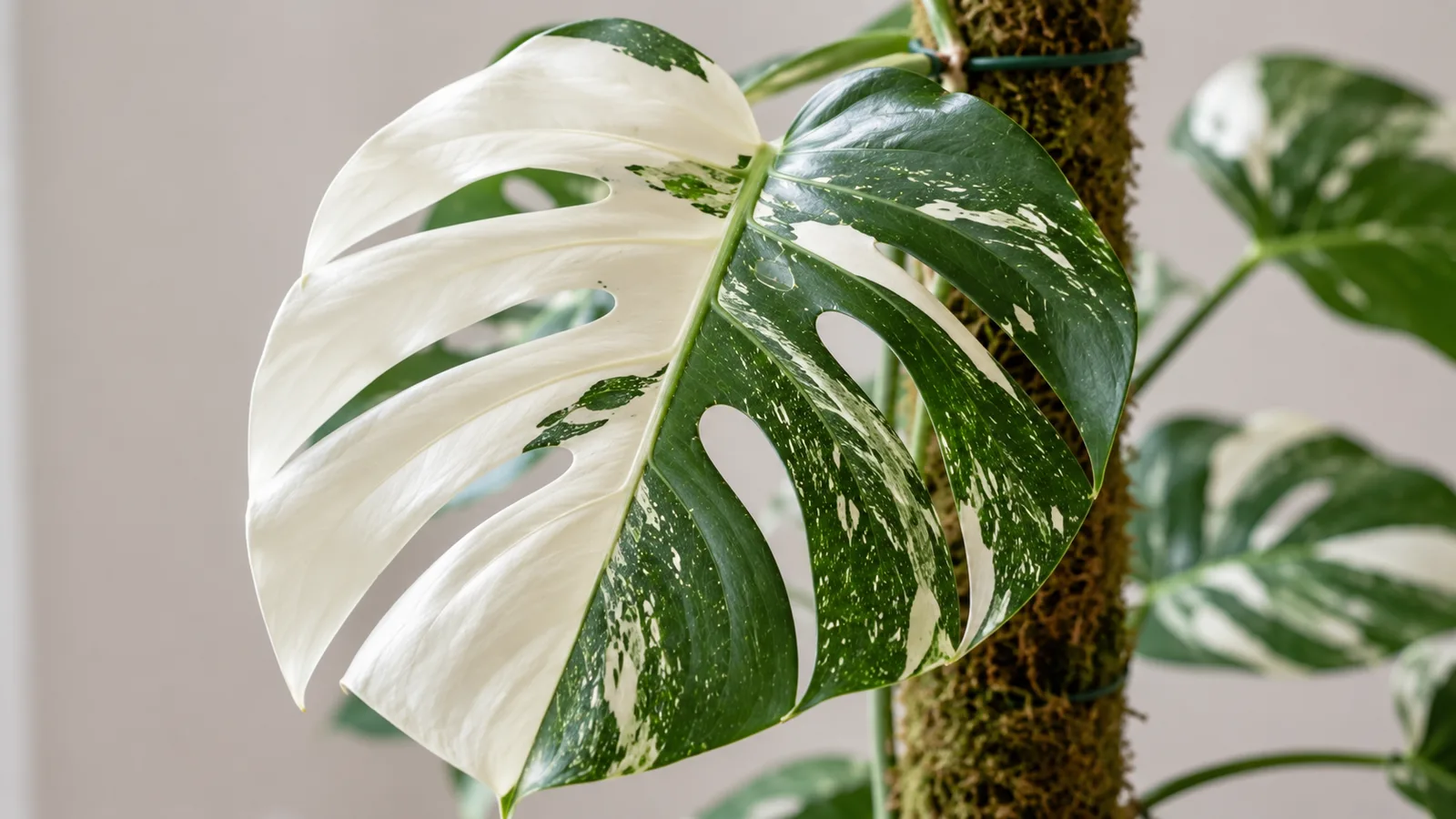
The Monstera Albo Variegata is the collector’s holy grail: a deliciosa whose genetic mutation produces large pure-white sectors on the foliage. Unlike the Thai Constellation, its variegation is unstable and sectoral — every leaf is a lottery. That unpredictability, and the risk of losing it, is exactly what makes it so rare and expensive.
What you really need to know
The Albo demands more attention than any other Monstera. White tissue has no chlorophyll and doesn’t photosynthesise: you must keep a green/white balance on every stem, or the plant starves (a 100 % white stem) or loses its variegation (reverting to green). Pruning and cutting selection are everything.
Light
Plenty of bright indirect light. As with any variegated plant, lots of light compensates for the chlorophyll deficit — but never direct sun, which instantly burns the white sectors. Too little light pushes the plant to produce greener leaves to survive.
Watering
Water when the top 3-4 cm dry out: every 7 days in summer, up to 12 in winter. White zones transpire little and rot fast: excess water browns the pale sectors before the rest. A very free-draining substrate and measured watering are essential.
Humidity and temperature
Ideal between 60-80 % humidity and 18-26 °C. The edges of white sectors brown first in dry air or under stress. Stability and high humidity limit this “browning”.
Mistakes to avoid
- Direct sun — immediate, irreversible burning of white zones
- Letting a 100 % white stem grow — it can’t feed the plant and eventually dies: prune it
- Propagating a section with no green — the cutting won’t survive
- Overwatering — white sectors rot first
Toxicity
⚠️ Toxic to cats, dogs and children: calcium oxalate crystals throughout. Keep out of reach.
Propagation
Always propagate a section with both green and white, just below a node with an aerial root, in water. A too-white cutting rots; a too-green one loses the variegation. Rooting is slow. See our complete water propagation guide.
Varieties and common confusions
- Monstera Thai Constellation: stable cream variegation from the lab, far easier — see our Monstera Thai Constellation sheet.
- “Albo” vs “Aurea”: the Aurea variegates golden-yellow rather than white.
- For the plain green version, see the Monstera deliciosa.
Frequently asked questions
How often should I water this plant?
Water Monstera Albo Variegata every 7-12 days, adjusting for season, pot size and available light. Always check that the top of the substrate has started to dry before watering.
Is this plant toxic to cats and dogs?
Monstera Albo Variegata is classified as "toxic". As a precaution, keep it away from pets that chew leaves and contact a vet if ingestion causes symptoms.
Why are its leaves turning yellow?
Yellow leaves on Monstera Albo Variegata most often come from overwatering, low light or recent stress. First check substrate moisture, root condition and placement.
Where should I place it at home?
Monstera Albo Variegata prefers bright indirect light. Place it near a bright window without harsh direct sun, then adjust if leaves fade, brown or growth slows.
Is it beginner-friendly?
Monstera Albo Variegata needs some observation: it is manageable, but less forgiving of overwatering and poor placement.
Sources and method
This fact sheet is based on public botanical references, recognized horticultural recommendations and the SPRAIA editorial method.
- Royal Botanic Gardens, Kew
- Missouri Botanical Garden
- Royal Horticultural Society
- GBIF
Diagnose and track this plant
SPRAIA is in private beta. Join the list to test plant identification, visual diagnosis and reminders tailored to each plant.
Join the private beta