Peace Lily (Spathiphyllum): Care and Flowering
Complete peace lily guide: light, watering, humidity, rebloom and common mistakes. Learn how to make your Spathiphyllum flower again.
By SPRAIA editorial team · Method: botanical sources, field feedback and editorial validation
The peace lily, or Spathiphyllum to use its botanical name, is probably the most expressive houseplant in the plant world. When it’s thirsty, it droops dramatically as if in despair — then bounces back upright in less than an hour after you water it. It really “talks” to its plant parents. It’s also one of the few foliage plants that truly blooms indoors, with elegant white spathes that last several weeks.
Yet many peace lilies lose their bloom within their first year and gradually decline. This guide gives you all the keys: its origin, ideal light, signature watering, humidity needs, what it takes to rebloom, and the mistakes to avoid so you can keep it beautiful for years.
Origin and botany: what you think is a flower isn’t one
The peace lily comes from the humid tropical forests of Central and South America (Colombia, Venezuela) and a few Pacific islands. In its natural habitat, it grows in the understorey, at the foot of large trees, enjoying soft light filtered by the canopy and constant atmospheric humidity of 70-90%.
Spathe and spadix: the real flower is elsewhere
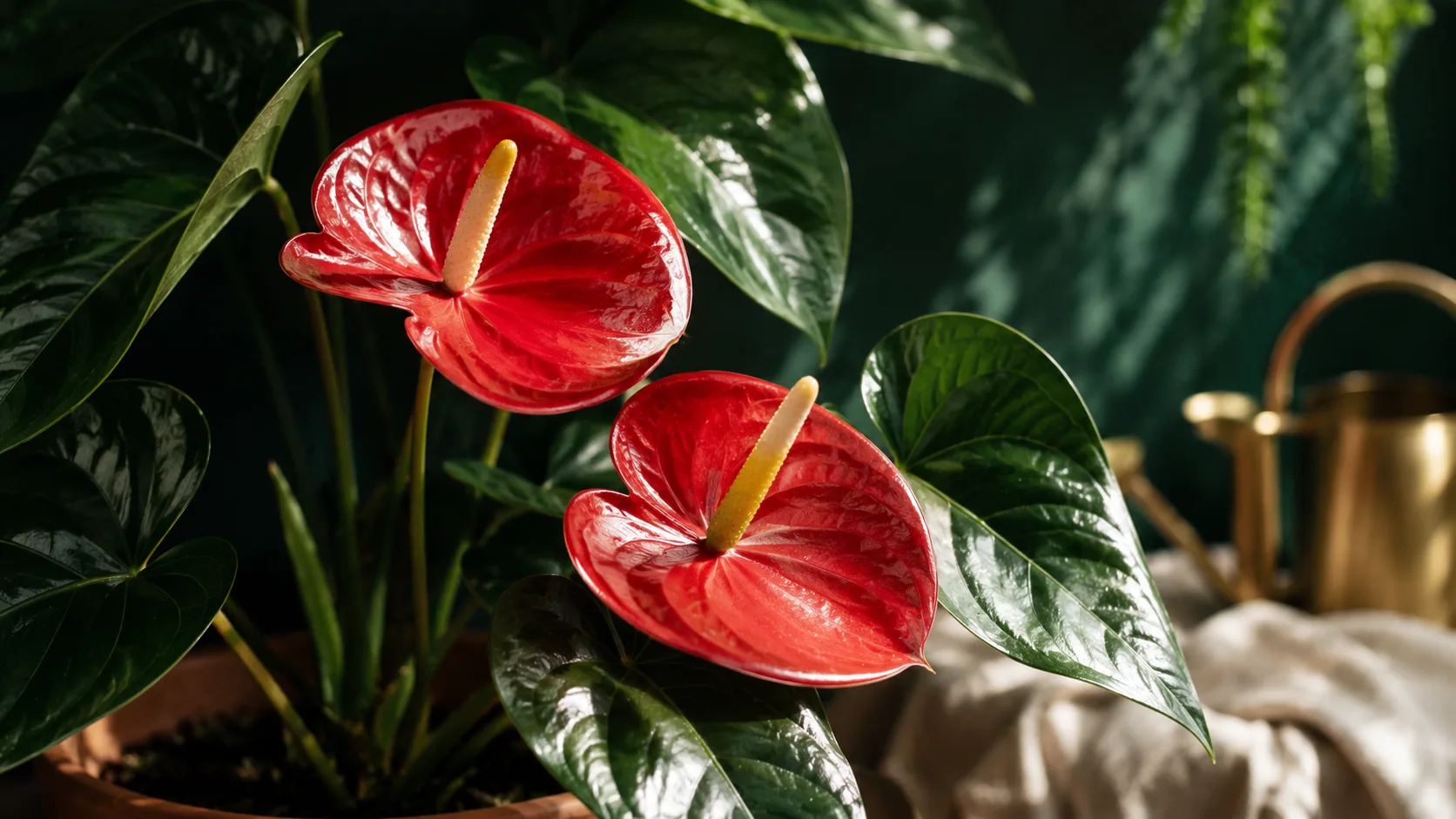
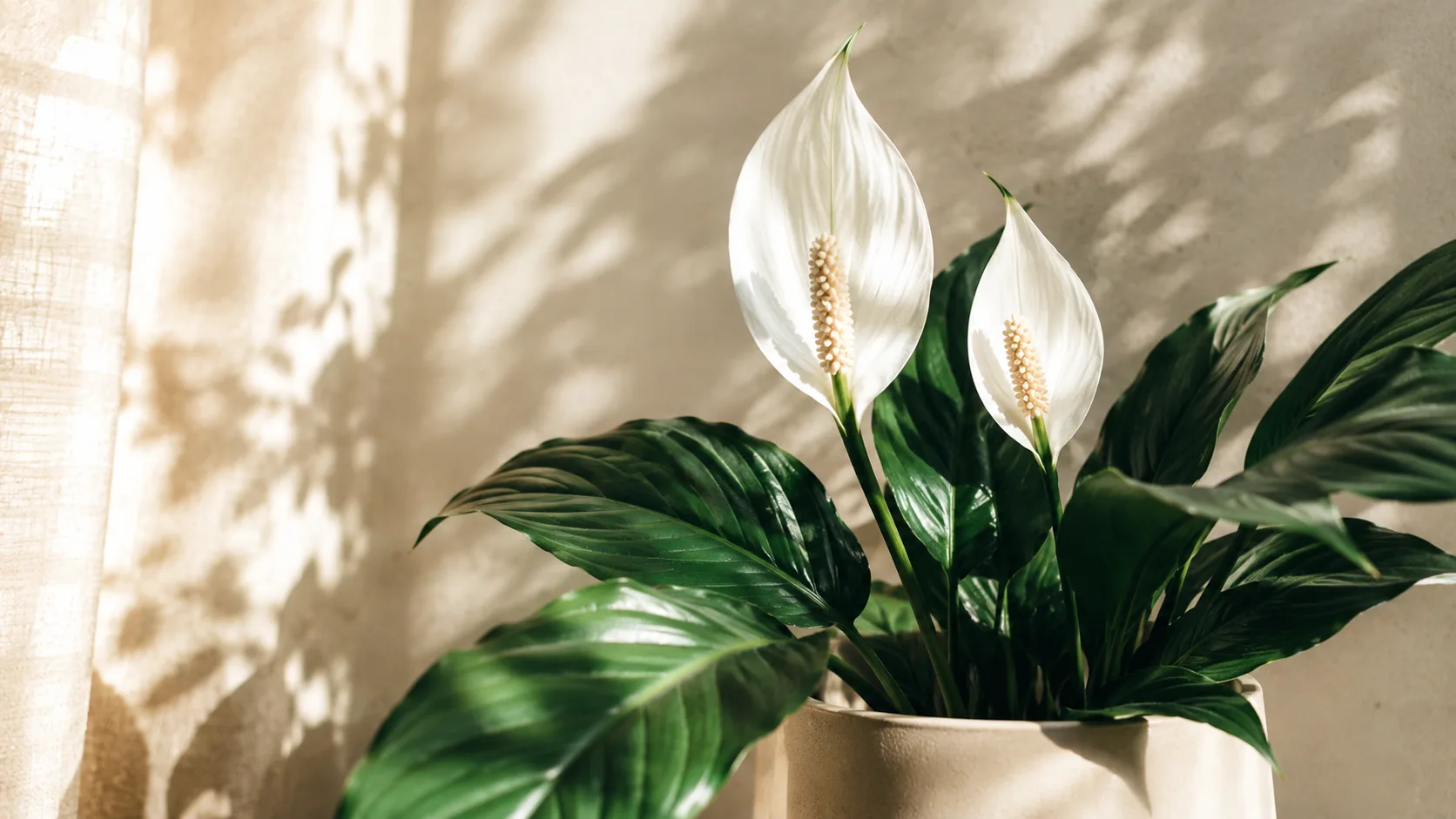
What looks like a “white flower” is in fact a spathe, a modified leaf that acts as a protective sheath. The real flowers are the tiny organs clustered on the spadix, the cream cylinder rising at the centre of the spathe. All aroids (Spathiphyllum, Anthurium, Monstera, Philodendron) share this anatomy.
The white spathe can last 3 to 6 weeks. It gradually turns green near the end of its life — this is normal, not a disease. Simply cut the flower stalk at its base when the time comes.
The most common varieties
- Spathiphyllum wallisii — the most widespread, compact (40-50 cm)
- Spathiphyllum ‘Mauna Loa’ — a larger variety with bigger spathes
- Spathiphyllum ‘Sensation’ — a giant cultivar that can reach 1.5 m
- Spathiphyllum ‘Picasso’ — white-cream variegated foliage, rare and slow-growing
Light: the number one condition for reblooming
Peace lilies have a reputation as plants that “grow in the dark”. That’s half true: they survive in low light, but they will never bloom in those conditions.
What it actually wants
- Bright indirect light — the absolute ideal. Near an east window, or 1-2 metres from a south window behind a sheer curtain. This is where it produces spathes in abundance
- Medium light — the plant stays attractive, foliage is healthy, but blooms are rare or absent
- Low light — pure survival: smaller leaves, long stretched stems, no blooms. The plant declines in 12-18 months
Direct sun: danger
Prolonged direct sun is fatal. After a single day of spring sun exposure, leaves develop dry brown scorch marks at the centre. Move it back at least 50 cm if you see such marks appearing. To better understand its light needs, see our complete light guide.
Watering: the queen of signals
This is where the peace lily becomes fascinating. No other plant communicates its water needs so clearly.
The peace lily language
- Leaves upright and firm: all is well, substrate is correctly moist
- Leaves beginning to lean: time to water, you have 24-48 hours
- Leaves completely collapsed, drooping: emergency, water now
- One hour after watering: the plant bounces back upright, as if by magic
This ability to signal thirst makes the peace lily the ideal plant for learning to water by feel. But beware: if you systematically wait for extreme drooping, you exhaust the plant in the long run and encourage brown leaf tips. The ideal is to water at the first signs of slight drooping.
The practical method
- Water thoroughly until water drains from the bottom
- Empty the saucer after 10 minutes (never leave standing water)
- Let the top 2 cm of substrate dry before the next watering
- Average rhythm: once a week in summer, every 10-12 days in winter
For broader watering techniques, read our article on when and how to water houseplants.
Tap water and brown tips
Peace lilies are sensitive to hard water and chlorine. If your tap water is hard, you’ll progressively see leaf tips brown and dry out. Solutions:
- Use rainwater or filtered water (Brita-style jug)
- Let tap water rest for 24 hours in an open container (chlorine evaporates)
- Avoid softened water (high in sodium, toxic long-term)
Substrate, repotting and humidity
The right substrate
Peace lilies enjoy a light, airy substrate that holds moisture without becoming waterlogged:
- 60% quality foliage plant potting soil
- 20% perlite (drainage)
- 20% fine pine bark or coco coir (aeration)
Repotting: every 2 years
Repot every 2 years in spring, using a pot 2 cm larger in diameter. The peace lily likes being a little cramped — too large a pot causes moisture to linger in the substrate core. If you see roots emerging from drainage holes or circling at the surface, that’s your signal. Our detailed guide on repotting houseplants covers every step.
Atmospheric humidity: aim for 50% minimum
Coming from tropical forest, the peace lily thrives in at least 50% humidity, ideally 60-70%. In heated apartments in winter, humidity often drops to 25-30%, which causes:
- Brown, dry leaf tips
- Smaller leaves
- Rare or aborted blooms
Solutions: a humidifier (most effective), grouping plants (microclimate effect), a tray of damp clay pebbles under the pot, a bright bathroom.
Misting alone is barely effective: the effect fades within 30 minutes.
The peace lily as an air-purifying plant (with a scientific caveat)
The famous NASA study led by B.C. Wolverton in 1989 ranked the peace lily among the best air-purifying plants: it filters formaldehyde, benzene, trichloroethylene, ammonia and xylene found in indoor air.
The important nuance
These results were obtained in a small sealed laboratory chamber with high pollutant concentrations. In a real, ventilated apartment, the purifying effect is much more modest — you’d need around a dozen plants to measurably alter air quality in a living room.
That said, the psychological effect and natural humidification (through evapotranspiration) are very real. A peace lily at home is still an excellent choice.
Toxicity: caution with cats, dogs and children
The peace lily is toxic to cats, dogs and humans if ingested. It contains calcium oxalate crystals (raphides) in every part — leaves, stems, spathe.
Symptoms after ingestion
- Excessive drooling, irritated mouth and lips
- Vomiting, refusal to eat
- Difficulty swallowing in severe cases
Symptoms are rarely fatal but unpleasant. Keep the plant out of reach of cats and small children. Our guide to toxic houseplants lists species to avoid in homes with pets.
Getting it to rebloom: full protocol
This is the big question. Here are the conditions to restart flowering.
The four critical factors
- Bright indirect light — by far the number one factor. Without sufficient light, no blooms. Near an east or west window
- Regular fertilising — fertilise every 4 to 6 weeks from April to September with a flowering plant fertiliser (NPK rich in phosphorus and potassium, like 5-10-10). Dilute to half-strength to avoid over-feeding
- Maturity — a young peace lily (under 2 years old) blooms reluctantly. Patience
- Avoid recent repotting stress — a freshly repotted peace lily often takes 4-6 months to rebloom. If you want flowers, hold off on repotting
The “banana tea” trick (DIY method)
Banana peels are rich in potassium, the key element for flowering. To make homemade banana tea:
- Cut 2-3 banana peels into small pieces
- Steep in 1 litre of water for 48 hours
- Then dilute 1:5 with water (1 part tea to 5 parts water)
- Water your peace lily with this mix every 3 weeks in spring
It’s a gentle, natural method that complements fertiliser without risk of root burn. Our piece on natural fertilisers for houseplants details more recipes.
The pro’s trick in production
Commercial growers use gibberellic acid (GA3), a plant hormone that forces flowering on demand. That’s why every peace lily in a shop is in bloom. At home, we don’t have access to GA3, so we rely on light + potassium + patience.
Common mistakes and solutions
- Brown leaf tips: hard tap water or low atmospheric humidity. Solution: filtered water + humidifier
- Yellow leaves: chronic overwatering most often. Check drainage, space out waterings. See our guide on yellow leaves
- No blooms for a year: lack of light + lack of fertiliser. Move closer to a window, fertilise regularly
- Green spathes instead of white: too much nitrogen-heavy fertiliser (20-5-5 type). Switch to a flowering plant fertiliser (5-10-10)
- Curled leaves: dry air or a plant that’s been thirsty for too long
- Brown spots in the middle of leaves: sun scorch. Move the plant 50 cm back from the window
Seasonal tips
- Spring (March-May): active growth resumes, repot if needed, start fertilising, watch for the first blooms
- Summer (June-August): peak growth, weekly watering, avoid heat waves (above 30°C the plant suffers)
- Autumn (Sept-Nov): gradually reduce fertilising, humidity will drop with heating
- Winter (Dec-Feb): relative rest, spaced watering (every 10-14 days), no fertiliser, keep at 18-22°C minimum, watch for heating-related brown tips
Frequently asked questions
The most common questions about peace lily care.
- In 90% of cases, it's a lack of light. The plant survives in low light but won't bloom. Move it closer to an east or west window (no direct sun), and fertilise every 4-6 weeks from April to September with a flowering plant fertiliser rich in phosphorus and potassium. Blooms usually return within 2-3 months.
- Two main causes. 1) Hard or chlorinated tap water: switch to filtered water or let it rest for 24h. 2) Low atmospheric humidity, especially in winter with heating: use a humidifier or group your plants. Trim brown tips with clean scissors following the leaf shape — they won't turn green again.
- At the end of the flower's life (after 3-6 weeks), it's completely normal: the spathe turns green before fading. If, however, spathes come out green from the start, it's often excess nitrogen. Switch to a flowering plant fertiliser (5-10-10 type) which encourages true white spathes.
- That's worrying. Check the roots: if they're brown and mushy, you have root rot (caused by chronic overwatering). Unpot, cut damaged roots, repot in fresh well-draining substrate. Otherwise, it could be cold shock, a draught, or shock from being moved.
- Yes, moderately toxic. It contains calcium oxalate crystals that cause excessive drooling, mouth irritation and vomiting if chewed. Rarely fatal but unpleasant. Keep the plant out of reach of curious cats: on a high shelf, in a closed room, or hanging.