Hoya (Wax Plant): Care Guide and Flowering Secrets
Everything about Hoyas: must-have species, reflowering tips, watering, drainage, and propagation. The complete guide to making your wax plant bloom.
By SPRAIA editorial team · Method: botanical sources, field feedback and editorial validation
You’ve been staring at your Hoyas for months, maybe years, and still no flowers? You’re not alone. The wax plant is one of the most rewarding houseplants once you crack its code, but it can feel temperamental until you understand its quirks. The good news: behind its “collector” reputation, the Hoya is remarkably tough. With the right habits — bright light, ultra-draining substrate, snug pot, and above all patience — you’ll eventually get those famous fragrant umbels that look carved from porcelain. Here’s everything you need to know to turn your Hoya into a spectacular flowering plant.
Meet the Hoya family
Hoyas belong to the Apocynaceae family, the same as oleanders and frangipanis. Native to Southeast Asia, Australia, and the Pacific Islands, they are epiphytic or semi-epiphytic plants that grow clinging to tree branches in the tropical canopy. This origin explains everything: thick waxy leaves that store water, aerial roots that capture ambient moisture, and remarkable tolerance to temporary drought.
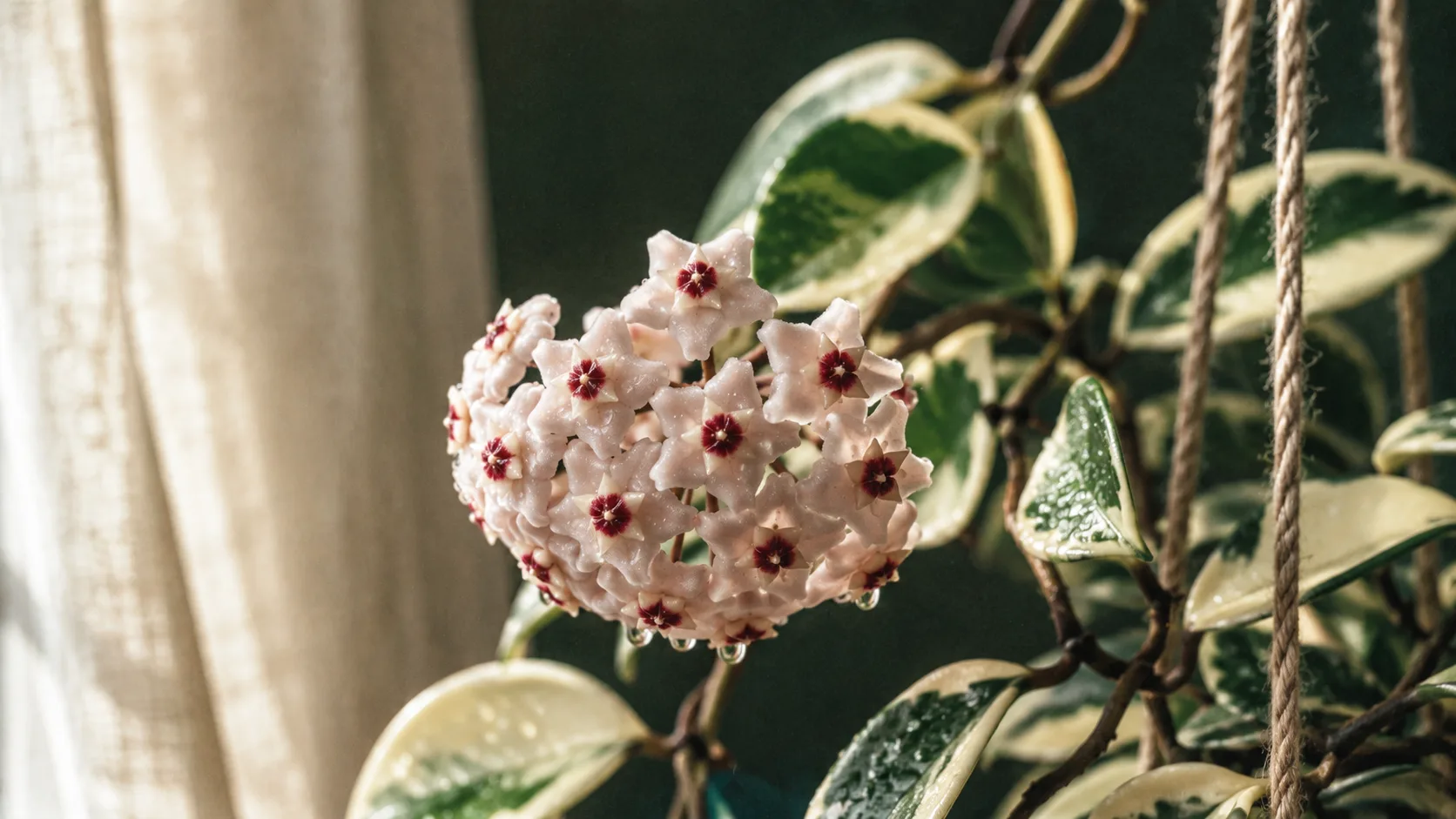
The name “wax plant” comes from the incredible texture of the flowers, which look sculpted from porcelain or beeswax. Each umbel can hold around twenty small five-petal stars, and many species release a sweet, intoxicating fragrance, often stronger in the evening.
A semi-succulent — and what that changes
Realising your Hoya is semi-succulent radically changes how you water it. Its fleshy leaves store water, meaning it would much rather be forgotten than overwatered. That’s also why it forgives distracted gardeners and is perfect for frequent travellers.
Hoya species worth knowing
More than 500 Hoya species are documented, and the list grows every year. Here are the varieties that deserve a spot in your collection:
- Hoya carnosa: the classic, indestructible, green or variegated leaves (“Krimson Queen” cream edges, “Krimson Princess” cream centre, “Tricolor” pink-green-white).
- Hoya kerrii: the famous “heart plant”, sold as a single-leaf cutting around Valentine’s Day. Patience: it takes years to develop stems.
- Hoya australis: round glossy leaves, generous blooms with a very sweet fragrance.
- Hoya linearis: thread-like leaves cascading in curtains, perfect in hanging baskets.
- Hoya retusa: needle-like foliage, unique flowers scented like white chocolate.
- Hoya multiflora: the “shooting star”, spectacular umbels with swept-back petals.
- Hoya pubicalyx: fast-growing, with near-black flowers on some cultivars.
This diversity makes Hoyas an accessible collector’s genus: you start with a $15 carnosa and quickly climb toward rarer specimens at $80 or more.
Light: the absolute key to flowering
If you want your Hoyas to flower, don’t compromise on light. A plant tucked into a dim corner will survive but never bloom. The ideal setup: bright indirect light for several hours a day, possibly some gentle morning or late-afternoon direct sun.
An east, west, or filtered south exposure is perfect. Harsh midday summer sun, on the other hand, can scorch the thick leaves and leave permanent white patches. If your home is light-poor, know that a Hoya moved from shade to a bright window may take 6 to 12 months before producing its first umbels — it needs time to build energy reserves.
To measure your plant’s light precisely, check out our complete houseplant light guide. This factor is so critical that it deserves careful attention.
Watering: less is more
The golden rule for Hoyas: let the substrate dry out across the top two-thirds before watering again. In practice, that means:
- Summer (active growth): roughly every 7 to 10 days.
- Winter (rest): every 2 to 3 weeks is plenty.
The foolproof sign: push your finger 4-5 cm into the soil. If it’s dry, water. If it’s still damp, wait. Slightly softened leaves are also an excellent thirst indicator.
For a deeper dive into reading water needs, see our houseplant watering guide. Tap water left to stand for 24 hours (to release chlorine) works perfectly, as long as it’s at room temperature — never icy.
Mild water stress: a collector’s trick
Many experienced growers trigger a mild water stress in spring (stretching watering intervals for 4 to 6 weeks) to kick-start flowering. Combined with bright light, this technique works very often. Worth trying if your Hoya stubbornly refuses to bloom despite good conditions.
The perfect substrate: drainage first
A Hoya potted in regular houseplant mix will rot within a few months. These epiphytes need an airy blend that dries quickly and lets air circulate around the roots.
The ideal mix:
- 40% fine pine bark (orchid grade)
- 30% perlite or pumice
- 20% light potting mix
- 10% sphagnum moss or coco fibre
Some collectors push drainage to the extreme by using 100% mineral substrate like pon. It’s a very interesting approach for Hoyas, which appreciate maximum aeration and controlled moisture retention. Our complete pon substrate guide walks through the transition and benefits.
NEVER cut the flower spurs
This is the rookie’s fatal mistake. After bloom, the flowers drop but the peduncle (the small stalk that carried them) stays attached to the plant. Many cut it off for aesthetics. This is a disaster: those persistent peduncles are exactly what will produce future blooms, year after year, sometimes for a decade on the same spur.
The more spurs your Hoya keeps, the more abundantly it will flower. Mature plants eventually produce dozens of peduncles, turning each summer into a fragrant show. Treat every spur like a treasure.
Triggering reflowering
Beyond light and mild water stress, here are the conditions that genuinely encourage blooming:
A snug pot
Hoyas flower when they feel slightly cramped. Only repot every 3 to 4 years, and choose a pot barely larger (2 cm of additional diameter, max). A too-spacious pot pushes the plant to grow foliage instead of flowers.
A cool winter rest
Drop the temperature to 14-17 °C for 6 to 8 weeks in winter while sharply reducing watering. This rest signals the plant to prepare for the next bloom cycle. An unheated conservatory or a little-used room works perfectly.
A nutritional boost
A phosphorus-rich fertiliser (orchid or bloom-booster formula) at quarter strength every 3 weeks from March to September supports future spurs. Avoid high-nitrogen feeds, which encourage leaves at the expense of flowers.
Easy water propagation
Good news: Hoyas root with embarrassing ease. Take a 10-15 cm stem cutting with at least two nodes and 2-3 leaves, strip the lower leaves, and place the cutting in a glass of water. White roots appear within 3 to 6 weeks.
Our complete water propagation guide covers technique and success-rate tips. Once roots reach 3-4 cm, transplant into a draining mix.
Hoya enemies
Mealybugs: enemy number one
Hoya’s waxy leaves attract mealybugs like a magnet. Inspect the leaf undersides and stem axils regularly for small white cottony clusters. At the first sign, intervene immediately with a cotton swab soaked in 70% alcohol, then apply diluted insecticidal soap.
Our mealybug guide covers the most effective control methods. A neglected infestation can weaken your plant for months.
Other common issues
- Wrinkled leaves: prolonged underwatering, slightly increase frequency.
- Yellowing and dropping leaves: overwatering, check drainage.
- Stalled growth: not enough light or pot-bound beyond repair.
- No bloom after 3 years: almost always a light deficit.
Hoya, an accessible collector plant
The Hoya craze has made them the new obsession for seasoned hobbyists, on par with rare Philodendrons or velvet Anthuriums. Our rare plants for collectors round-up includes several spectacular Hoyas. The beauty of this genus is that it offers gems at every price: you can start with a basic carnosa and grow your collection over the years without breaking the bank.
Conclusion: patience and light
Getting a Hoya to bloom is above all a matter of patience and consistency. Give it bright light, ultra-draining substrate, a snug pot, a cool winter rest, and most importantly, never cut the flower spurs. The first umbels can take 2 to 3 years on a young plant, but once the cycle begins, blooming becomes an unforgettable annual ritual. Let’s be honest: few houseplants offer this mix of sculptural foliage, intoxicating fragrance, and otherworldly flowers.
Frequently asked questions
- The three main causes are insufficient light (the most common), too large a pot, and a plant that's still too young. A Hoya often needs 2 to 3 years before its first bloom. Also check that you haven't cut the old flower spurs: they're essential for future flowers.
- No, it's not necessary. The waxy, thick leaves retain humidity very well, and excessive misting can encourage fungal issues. If your home is very dry in winter due to heating, a humidifier or a tray of damp clay pebbles is more than enough.
- Only every 3 to 4 years, and always into a pot barely larger (2 cm of extra diameter maximum). Hoyas flower better when they feel slightly cramped. Use the repot to refresh the draining substrate.
- The Hoya is generally considered non-toxic to cats and dogs, unlike many other houseplants. That makes it an excellent choice for pet households, although massive ingestion can cause mild digestive upset.
- Each umbel typically lasts between 5 and 15 days depending on the species and conditions. Some Hoyas rebloom several times in a season on the same spur, and a well-settled mature plant can produce blooms spread from May to October.