Calathea: Understanding and Mastering This Diva's Care
Complete Calathea guide: watering, light, humidity, popular species and mistakes to avoid for this demanding plant.
By SPRAIA editorial team · Method: botanical sources, field feedback and editorial validation
If you’ve ever seen a Calathea at a garden centre, you’ve probably swooned over its hand-painted-looking leaves. If you own one, you’ve probably also faced the frustration of browning edges, curling leaves or fading patterns. The Calathea has a well-earned reputation as a diva plant — demanding, capricious, sometimes discouraging. But this hides a more nuanced truth: the Calathea isn’t difficult, it’s simply precise in its needs. Understand them, and you’ll be rewarded with one of the most beautiful indoor plants in existence.
🌿 Quick fact sheet: Calathea Orbifolia care summary on its dedicated page — light, water, humidity, toxicity.
Why the Calathea fascinates: nyctinasty
Before talking care, let’s discuss what makes Calatheas truly unique. They are prayer plants. Each evening, their leaves rise vertically, like joined hands. Each morning, they reopen horizontally to capture light.
This movement, called nyctinasty, is controlled by a small swelling at the base of each petiole (the pulvinus) that inflates and deflates on a circadian rhythm. It’s not a touch reaction — it’s a true internal biological clock.
Watching this daily movement creates a special bond with the plant. When your Calathea moves vigorously, it’s well. When movement fades, it’s often the first sign something’s off.
SPRAIA tip: the SPRAIA app helps you monitor your Calathea’s behaviour over time. By logging regular photos, the AI detects subtle changes in posture and colour before they become visible problems.
The most popular species
Calatheas (now botanically reclassified under the genus Goeppertia, but no one uses that name) belong to the Marantaceae family. Here are the species you’ll most often encounter.
Calathea orbifolia
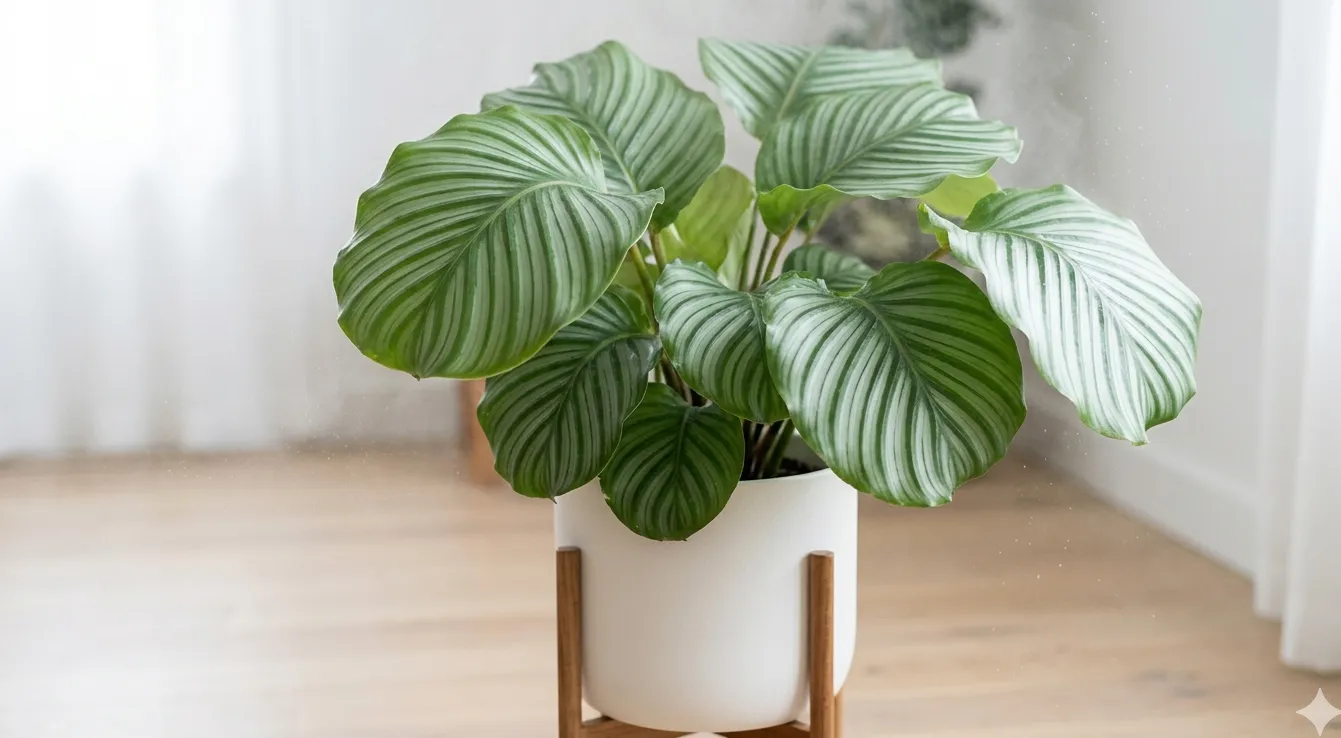
The undisputed star. Large round leaves (up to 30 cm wide) with silvery-green stripes of rare elegance. Hardier than many other Calatheas, an excellent choice to start. Can reach 60-80 cm tall.
Calathea Medallion (roseopicta)
Oval leaves with a dark green top adorned with pink-purple patterns and a deep purple underside. Very popular, fairly demanding on humidity. The contrast between top and underside is striking during the prayer movement.
Calathea lancifolia (rattlesnake)
Long narrow leaves with dark green spots on light green background, recalling rattlesnake skin. Purple underside. One of the hardiest in the genus — it tolerates a missed watering or moderate humidity better.
Calathea White Fusion
Considered by many to be the most beautiful but also the most demanding. Leaves marbled in white, green and lilac. The slightest watering or humidity slip translates to brown edges. Reserved for enthusiasts willing to invest in a humidifier.
Calathea makoyana (Peacock Plant)
Translucent pale green leaves with peacock-feather patterns in dark green. When light passes through the leaves, the effect is luminous and delicate. Medium difficulty within the genus.
Calathea roseopicta ‘Dottie’
Almost black leaves with a vivid pink feather-shaped border drawn on top. A dramatic, contemporary look. Good resilience if humidity is maintained.
Light: the art of chiaroscuro
Calatheas naturally grow under the canopy of South American tropical forests. They never see direct sun — and that’s crucial information for placement at home.
What they want
- Medium to low indirect light: a bright room without direct rays
- North-facing window: often the best choice, or set back from an east window
- East-facing window: gentle morning light (before 10 am) is tolerated
- South or west window: only with a sheer curtain or 2-3 m back
What they reject
Direct sun burns leaves and irreversibly bleaches patterns. Even 30 minutes of summer afternoon sun can leave marks. If you see your Calathea’s colours fading, it might be too much light.
Conversely, a too dark spot drastically slows growth and new patterns will be less contrasted.
Watering: water quality makes all the difference
This is where Calatheas stand apart from most indoor plants. They are extremely sensitive to water quality. To master watering basics first, see our when and how to water guide.
Filtered or demineralised water: non-negotiable
Chlorine, fluoride and dissolved minerals in tap water cause leaf-edge browning. It’s the #1 cause of cosmetic problems with Calatheas.
Your options, from best to most practical:
- Rainwater: ideal and free
- Filtered water (Brita-style filter pitcher): removes some chlorine and limescale
- Demineralised water: perfect but costly at scale
- Tap water rested 24 h: chlorine evaporates but limescale remains — an acceptable compromise in soft-water regions
Frequency and method
The substrate must remain slightly moist at all times, never soaked:
- Water when the top centimetre is dry to the touch
- In summer, this can be every 3-4 days; in winter, every 7-10 days
- Water deeply until water flows through drainage holes
- Always empty the saucer after 15 minutes
SPRAIA tip: the app calculates personalised watering reminders based on species, season and your home conditions. No more guessing — SPRAIA tells you exactly when to water.
Humidity: the decisive factor
If you remember just one thing from this article, it’s this: humidity is the absolute key to success with a Calathea. Below 50 %, problems are guaranteed. The ideal sits between 60 % and 80 %.
How to raise humidity
- Humidifier: most effective and reliable solution. An ultrasonic model in the same room changes everything. The #1 investment if you want to collect Calatheas
- Group plants: collective transpiration creates a more humid microclimate. Combine your Calatheas with Alocasias and other tropicals
- Pebble tray: place the pot on clay pebbles in a saucer filled with water (the pot bottom must not touch the water). Evaporation raises local humidity
- Bright bathroom: if you have a windowed bathroom, it’s often the dream spot
What doesn’t work (or not enough)
Misting is often recommended, but it raises humidity for only 15-30 minutes. Worse, stagnant water on leaves can encourage fungal disease. It’s not a lasting solution.
Temperature: stability above all
Calatheas are tropical plants that love warmth, but mostly consistency.
- Ideal range: 18-25 °C
- Absolute minimum: 15 °C (below, damage is often irreversible)
- Enemies: cold drafts, proximity to single-glazed windows in winter, direct AC, radiator within 50 cm
A Calathea near a regularly opening winter front door will suffer. Even brief thermal shock (going from 22 °C to 12 °C while ventilating) can trigger leaf curling.
Substrate and repotting
The substrate must be aerated, free-draining and able to retain some moisture without staying soaked. A good mix:
- 50 % quality potting soil
- 25 % perlite for drainage
- 25 % fine bark for aeration
Repot every 1-2 years in spring, in a pot only 1-2 cm wider than the previous one. A pot too large holds too much water and increases root rot risk.
Common problems and solutions
If you see yellow leaves or other signs of distress, here are the most common causes for Calatheas.
Brown crispy leaf edges
This is the classic problem. Causes by frequency:
- Tap water too mineralised or chlorinated — switch to filtered
- Humidity too low — aim 60 %+
- Insufficient watering — substrate dried out too long
- Air too dry from winter heating
Leaves curling on themselves
Sign of water stress: the Calathea reduces its evaporation surface.
- Check if the substrate is too dry
- Check if the air is too dry
- Check there’s no hot (radiator) or cold draft
Fading patterns
- Too much light: colours wash out under intense light
- Not enough light: new leaves emerge with less marked patterns
- Nutrient deficiencies: fertilise lightly in spring/summer (liquid fertiliser diluted by half, every 2-3 weeks)
Soft leaves and drooping stems
Often the sign of overwatering or root rot. Remove the plant from the pot, inspect the roots (healthy roots are white and firm, rotten ones are brown and soft), cut affected parts and repot in fresh substrate.
SPRAIA tip: photograph a damaged leaf with SPRAIA and the AI identifies the problem in seconds — brown edges, spots, discolouration, pests. You get a precise diagnosis and species-adapted solutions.
Care summary table
| Parameter | Ideal | Avoid |
|---|---|---|
| Light | Medium to low indirect | Direct sun |
| Temperature | 18-25 °C | Below 15 °C, drafts |
| Humidity | 60-80 % | Below 50 % |
| Watering | Slightly moist soil at all times | Soaked or fully dry soil |
| Water | Filtered, rain or demineralised | Hard tap water |
| Substrate | Aerated, free-draining, humus-rich | Compact heavy potting soil |
| Fertiliser | Diluted ×2, every 2-3 weeks (spring/summer) | Over-fertilising, winter feed |
| Repotting | Every 1-2 years, in spring | Pot too large, too frequent |
Which species to start with?
If you’ve never had a Calathea, don’t start with a White Fusion. Difficulty ranking:
- Easy: Calathea lancifolia (rattlesnake), Calathea rufibarba — the most tolerant
- Moderate: Calathea orbifolia, Calathea makoyana, Calathea roseopicta ‘Dottie’
- Expert: Calathea White Fusion, Calathea musaica — beautiful but unforgiving
Whatever your level, investing in a humidifier is the best advice we can give. It transforms the Calathea experience.
Calatheas vs Alocasias: which challenge to take on?
If you’re hesitating between the two star tropical families, see our complete Alocasia guide. Calatheas tolerate less light but demand more humidity and quality water. Alocasias accept standard water but want more light. In both cases, warmth and humidity are your best allies.
Conclusion
The Calathea isn’t a plant you place in a corner and forget. It’s a plant that demands attention — to the water you use, your home humidity, the light through your windows. In exchange, it offers a daily spectacle of painted foliage and hypnotic movements.
The key is not seeking perfection right away. A few brown edges don’t mean failure — they mean you’re learning. Adjust, observe, adapt. And if you want a hand, SPRAIA analyses your plants in real time and guides you step by step to create ideal conditions. Even divas eventually cooperate when you understand their language.
Frequently asked questions about Calathea
The questions plant parents ask most often about this demanding but stunning plant.
- It's almost always a sign of dry air or hard water. The Calathea is native to tropical understoreys where humidity stays above 70%. In a flat, especially in winter with the heating on, air drops below 30%. Boost humidity (humidifier, plant grouping), water with filtered or rainwater, and trim dry tips along the natural shape of the leaf with scissors.
- It's called nyctinasty, a natural phenomenon shared by all Marantaceae. Leaves rise in the evening and lower in the morning thanks to motor cells at the base of the petiole (the pulvinus). It's a sign of good health: a plant that no longer "prays" is often stressed, poorly lit or suffering from root issues.
- Avoid hard or chlorinated tap water. Prefer rainwater, distilled water or filtered water. If you must use tap, let it sit 24-48 h in an open container to off-gas the chlorine. Water should be at room temperature: cold water shocks the Calathea's tropical roots.
- Not enough light. Although the Calathea hates direct sun, it needs bright indirect light to keep its variegations. In a dim corner, the plant produces more chlorophyll and patterns fade. Move it closer to a window (east or bright north) and add a sheer curtain if the light is direct.
- About every 2 years, in spring, into a pot just 1 to 2 cm wider. The Calathea dislikes oversized pots (water retention). It's also the perfect moment to divide it if several clumps have formed — division is the most reliable propagation method for this plant.