Indoor Cactus Care: The Complete Guide to Not Killing Them
Desert vs forest cacti, maximum light, soak-and-dry watering, dry cold winter rest, gritty mix, terracotta pots, repotting, propagation and flowering.
By SPRAIA editorial team · Method: botanical sources, field feedback and editorial validation
A cactus never dies, right? That is exactly what we all believe — and precisely why so many of them end up in the bin. We picture them as indestructible, park them on a shelf far from the window, water them “whenever we remember” (which means too often), and six months later the base turns to brown mush while the top stretches sadly toward the light. An indoor cactus is not a difficult plant: it is a misunderstood one. Its needs are perfectly clear once you grasp one essential fact — a cactus comes from places where water is scarce and light is abundant. Recreate those two conditions and you will have a plant that may well outlive you. Here is the guide that spares you the fatal mistake.
Desert cacti or forest cacti: two plants, two rulebooks
The first thing to understand before you buy or water anything: not all cacti live in the desert. The Cactaceae family splits into two broad groups with almost opposite needs, and mixing them up is the first step toward failure.
Desert cacti
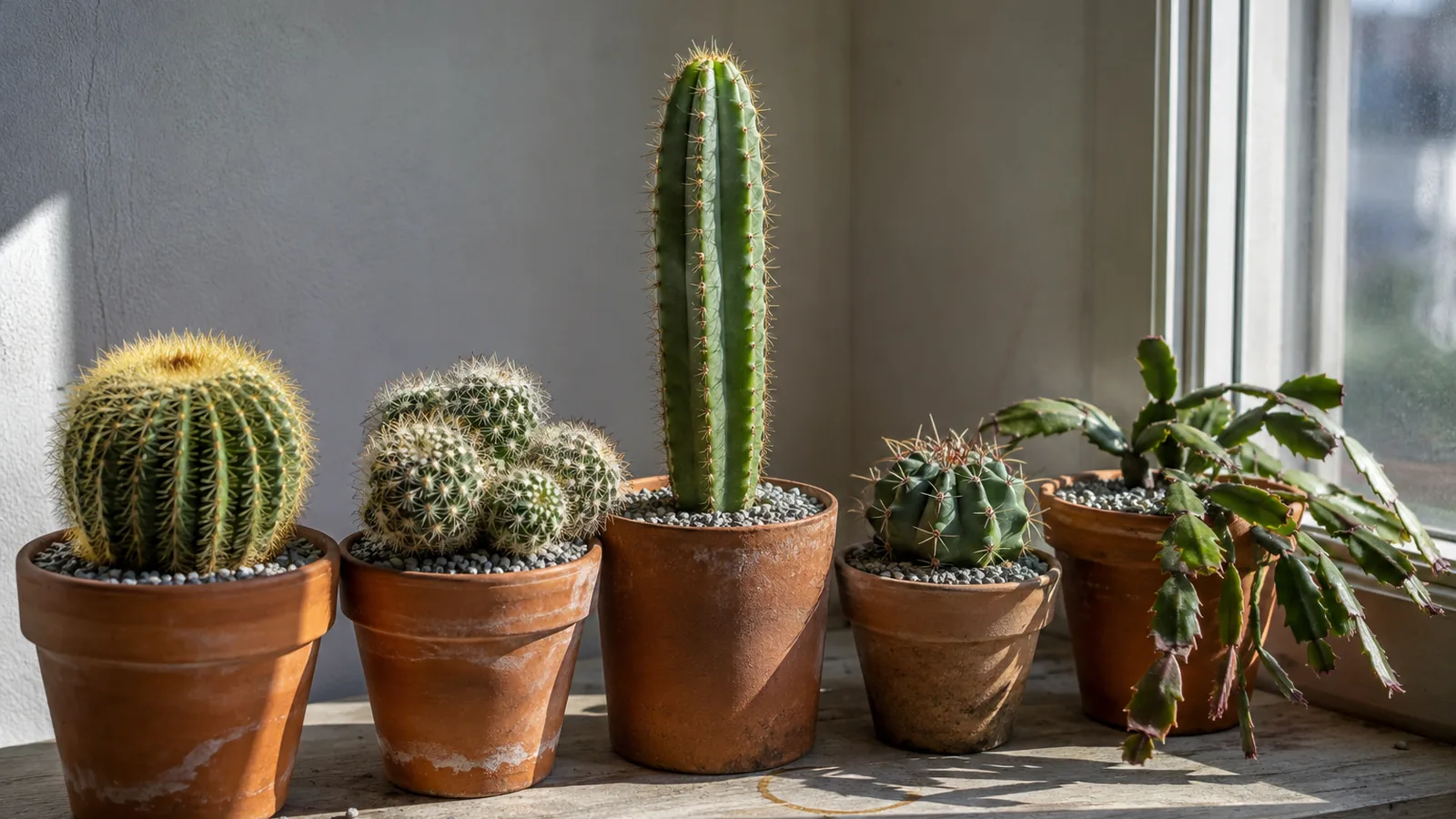
These are the “classic” cacti: Echinocactus (golden barrel), Mammillaria, Opuntia (prickly pear), Cereus, Ferocactus. They come from the arid zones of the Americas — Mexican deserts, Andean plateaus, the semi-deserts of the American Southwest. Their code:
- Maximum light, several hours of direct sun.
- Rare watering in summer, almost none in winter.
- A cold, dry winter rest that is essential for flowering.
- Globular or columnar shape, prominent spines, clearly visible areoles.
Forest cacti (epiphytes)
This is where everyone goes wrong. The Christmas cactus (Schlumbergera), the Easter cactus (Rhipsalidopsis), the Epiphyllum (large-flowered orchid cacti) and the Rhipsalis do not live in sand: they are tropical forest epiphytes, clinging to branches in dappled light and steady humidity. Their code is almost the reverse:
- Bright but indirect light, never scorching sun.
- More regular watering — they tolerate total drought poorly.
- A slightly richer mix that holds a little moisture.
- Flattened, segmented, often trailing stems — no real spines.
If you have no idea which camp your plant belongs to, SPRAIA’s photo identification gives you the species in seconds, and therefore the right protocol. That is the very first step: treating a Schlumbergera like an Echinocactus is a guaranteed death sentence.
Light: your absolute priority
If there is only one thing to remember about desert cacti, it is this: they need an enormous amount of light. Far more than a “bright” living room provides.
How much light, concretely?
- Desert cacti: the maximum possible. Ideally a south- or west-facing window with no sheer curtain and 4 to 6 hours of direct sun per day. A full-sun windowsill is perfect.
- Forest cacti: bright but filtered light. An east-facing window, or a metre back from a south window behind a sheer curtain. Harsh midday sun scorches their stems.
The classic trap: “the room is very bright, it’ll be fine.” No. Light drops off dramatically the moment you move away from the glass. Two metres from a window, a desert cactus gets a fraction of what it needs. To truly master this idea, read our complete guide to indoor plant light — it is the single most underestimated factor.
The signs of too little light: etiolation
A desert cactus starved of light will etiolate: it grows abnormally tall, thins out, pales, and loses its characteristic squat shape. A globular cactus “growing a point” at the top is screaming light famine at you. Unlike a soft stem, this deformation is irreversible: the etiolated portion stays thin forever. All you can do is correct the exposure for future growth.
To find out whether your spot is genuinely bright enough, SPRAIA’s built-in light meter measures the actual light in lux at the exact place you set the pot — far more reliable than the eye, which adapts and consistently overestimates indoor brightness.
Watering: the soak-and-dry method
This is where 90% of your cacti’s survival is decided. Overwatering kills far more cacti than thirst does. A cactus can go weeks without water and not flinch; it will not survive roots that sit and stew.
The soak-and-dry protocol
It is the only reliable method:
- Wait until the mix is completely dry all the way through (check with a wooden skewer that comes out clean and dry).
- Then water generously: soak until water runs out of the drainage hole, or dunk the pot in a basin for 10 minutes.
- Let it drain completely. Never leave standing water in the saucer.
- Do not water again until the next full dry-out.
This “a lot, then nothing” cycle mimics the episodic rain of arid habitats. The opposite — “a little, often” — keeps a permanent moisture that suffocates and rots the roots. Our general guide to when and how to water explains the pot-weight test, which is very handy for cacti.
Indicative frequencies
- Desert cacti, spring–summer: every 10 to 20 days depending on heat and light.
- Desert cacti, autumn–winter: almost none — see the winter rest section.
- Forest cacti: more regular, every 7 to 10 days in growth, reduced without ever drying out completely.
Overwatering: spotting rot in time
The most serious sign: the base of the cactus turning soft, brown or black, sometimes with an odour. That is rot, it climbs fast, and you must act immediately — cut above the healthy tissue, let it callus over for several days, then re-root the healthy top. If your cactus shows these symptoms, rush to our guide to saving an overwatered, rotting plant: every day counts.
Substrate and pot: drainage, drainage, drainage
Cacti sold in garden centres almost always come in a standard mix that holds far too much water. Your first mission after buying: plan a repot into an appropriate substrate.
A good cactus mix
The goal: water should pass through in seconds. A recipe that works:
- 50% cactus or houseplant compost
- 30% fine pumice or lava rock
- 20% coarse horticultural sand (never beach sand — too salty)
For forest cacti, increase the organic share (60% compost) and lighten the mineral part, as they enjoy a little more moisture. Serious collectors often switch to a 100% mineral mix like pon: our complete guide to pon substrate explains why this blend all but eliminates rot risk.
The terracotta pot: your best ally
Two non-negotiable rules:
- Always a drainage hole. A decorative pot with no hole is a guaranteed rot factory.
- Favour unglazed terracotta: porous, it wicks moisture out through its walls and dries the mix faster — exactly what a cactus loves. Plastic holds water longer; save it for forest cacti.
Choose a pot just 1 to 2 cm wider than the plant. An oversized pot holds a mass of substrate that stays wet too long at the centre.
Temperature, winter rest and flowering
This is the chapter almost nobody applies — and it is precisely the key to flowering.
The dry, cold winter rest of desert cacti
In winter, a desert cactus must enter dormancy: growth stops, watering is almost nil, and above all it needs coolness. The golden rule:
- Winter temperature of 8 to 12 °C (unheated conservatory, cool room, windowsill shielded from heating).
- Almost no watering from November to February — once a month at the very most, or none at all for globular species.
This cold, dry winter rest triggers flower-bud formation in spring. A cactus kept warm (20 °C) and watered all winter will never flower and will etiolate from the lack of winter light. This is the number-one reason cacti “won’t bloom.”
The special case of forest cacti
The Christmas cactus flowers through a different mechanism: it needs long, cool nights in autumn (13 to 15 °C, total darkness at night, short days) for 6 to 8 weeks to set buds. A lamp switched on in the evening in the room can be enough to block its flowering. Do not move it once buds have formed: it drops them at the slightest stress.
Repotting, cuttings and propagation
Repotting without getting stabbed (those spines!)
Repot in spring, every 2 to 4 years depending on vigour, or as soon as the plant is cramped. Protocol:
- Wait until the mix is dry (the rootball comes out more easily and roots are less brittle).
- Protect your hands: thick leather gloves, or wrap the plant in several layers of newspaper or a strip of foam to handle it without getting pricked.
- Unpot, gently remove old substrate, inspect the roots (cut away anything dead or rotten).
- Repot in a gritty mix, in a pot only slightly larger.
- Do not water straight away: wait 5 to 7 days to let any root wounds callus over. Watering a freshly cut root is an open door to rot.
For the general technique and choosing a container, our guide to repotting is a solid starting point.
Propagating by cutting and by offset
Cacti propagate easily:
- By offset: many species (Mammillaria, Echinopsis) produce “pups” at their base. Detach them gently, let the cut dry for 3 to 7 days (callus formation), then set on dry substrate. Roots in 2 to 4 weeks.
- By segment cutting (forest cacti and Opuntia): take a healthy segment, let it callus for a few days, plant it, and wait for rooting before watering.
The absolute rule for cactus cuttings: let the wound dry before it touches the substrate. Unlike soft-stem cuttings you can put in water — see our complete guide to water propagation — a cactus placed in water or damp soil right away rots before it can root.
The fatal mistakes to stop making
To sum up, here is what most often kills indoor cacti:
- Too much water — the number-one cause of death. Soak and dry, never “a little often.”
- Pot with no drainage — guaranteed rot within months.
- A mix that holds too much water — repot into a gritty, mineral blend.
- Too little light — irreversible etiolation for desert cacti.
- Watering warm all winter — kills dormancy, and therefore flowering.
- Treating a forest cactus like a desert cactus (or vice versa) — two opposite protocols.
- Watering right after repotting or a cutting — the fresh wound rots.
- Moving a budding Christmas cactus — instant flower drop.
Conclusion
The cactus is not the “indestructible plant you forget on a shelf”: it is a plant of simple but strict demands. Plenty of light, rare but thorough watering, a mix that drains in seconds, a terracotta pot with a hole, and — for those dreaming of flowers — a genuine cold, dry winter rest. Respect these pillars and your cacti will live not months but decades, rewarding your patience with spectacular blooms.
If you enjoy these water-thrifty plants, keep the adventure going with our guide to indoor succulents, their cousins with very similar needs. And to never again get the species or the watering wrong, let SPRAIA identify your plants, measure their light and send you the right reminders at the right time.
Questions fréquentes
- Never by the calendar. Wait until the mix is completely dry all the way through, then water generously (the soak-and-dry method). In practice, a desert cactus is happy with a watering every 10 to 20 days in spring and summer, and almost none in winter. Forest cacti want a slightly more regular rhythm.
- Almost always for lack of a genuine winter rest. Desert cacti need a cold (8-12 °C) and nearly dry winter from November to February to set buds. Kept warm and watered, a cactus will not bloom. The Christmas cactus, for its part, requires long, cool nights in autumn.
- That is rot from overwatering, and it spreads fast. Cut above the affected area with a clean knife, let the wound callus for several days, then re-root the healthy top on dry substrate. Stop all watering and check the pot's drainage.
- A very free-draining mix (about 50% compost, 50% mineral such as pumice and coarse sand) and an unglazed terracotta pot with a drainage hole. Terracotta dries quickly thanks to its porosity, which limits rot risk. Choose a pot only slightly larger than the plant.
- Desert cacti (Mammillaria, Echinocactus) want maximum direct sun and marked dryness. Forest cacti (Christmas cactus, Epiphyllum) are tropical epiphytes that need bright but indirect light and more regular watering. Confusing the two often leads to failure.