Pilea Peperomioides: Care and Propagation
Complete guide to the Pilea Peperomioides (Chinese Money Plant): light, watering, propagating offsets and common problems.
By SPRAIA editorial team · Method: botanical sources, field feedback and editorial validation
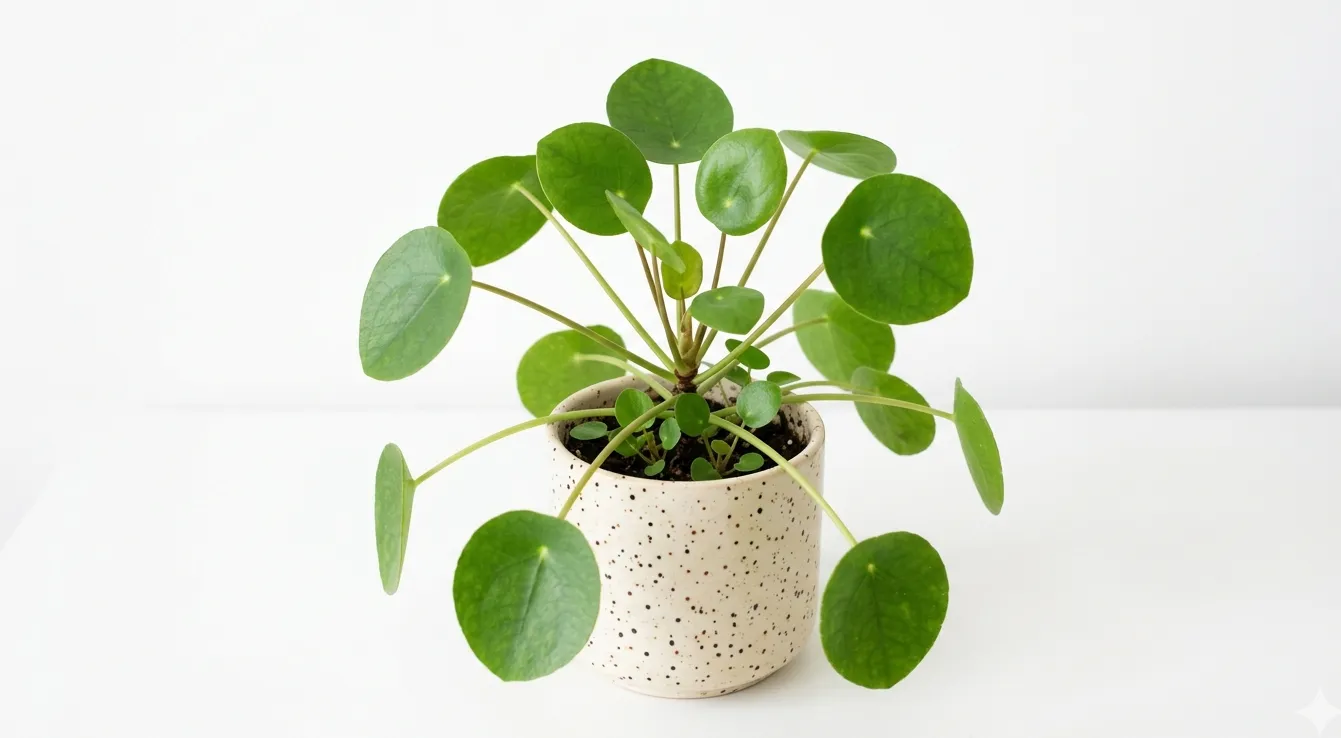
With its perfectly round leaves, graphic look and ease of propagation, the Pilea Peperomioides has become one of the most photographed plants on Instagram. Nicknamed Chinese money plant, missionary plant or friendship plant, it earns the last name from a simple tradition: it produces so many offsets that you always end up gifting some to friends. It’s also one of our best plants for beginners thanks to its accessible care and fast growth.
🌿 Quick fact sheet: Pilea peperomioides care summary on its dedicated page — light, watering, humidity, non-toxic.
The fascinating origins of the Pilea
The Pilea Peperomioides is native to Yunnan province in southwest China, where it grows naturally in the shade of limestone rocks at altitude (1,500-3,000 m). It was first collected by Scottish botanist George Forrest in 1906, but it was a Norwegian missionary, Agnar Espegren, who truly introduced it to Europe in the 1940s.
Espegren brought cuttings back to Norway, and the plant then spread hand to hand across Scandinavia, then the rest of Europe — only through cutting exchanges between individuals. For decades, it was nowhere to be found in nurseries. It wasn’t until the 2010s, with the rise of online plant communities, that the Pilea became a true global phenomenon.
This story explains its friendship plant nickname: it literally spread around the world thanks to its owners’ generosity.
Light: the secret to a symmetrical Pilea
The Pilea Peperomioides loves bright indirect light. It’s a plant that actively turns toward the light source — its round leaves orient like little solar panels.
- Place near an east- or west-facing window for optimal lighting
- Avoid prolonged direct sun (more than 2 h), especially in summer: leaves can burn and develop white or brown spots
- Tolerates partial shade, but growth will be slower and stems more elongated (etiolation)
The essential gesture: rotation
If you remember just one tip, it’s this: rotate your Pilea a quarter turn each week. Without rotation, the plant leans heavily toward the window and develops an asymmetric silhouette. A regular quarter turn ensures well-rounded balanced growth — exactly the look you want.
SPRAIA tip: add your Pilea to the app and enable a weekly rotation reminder. It’s a small gesture easily forgotten that makes all the difference long-term.
Watering: less is more
The Pilea is a semi-succulent — its fleshy thick stems store water. So it’s far more sensitive to overwatering than underwatering. When in doubt, wait one more day. To go deeper, see our complete watering guide.
- Let the top 2-3 cm of substrate dry before watering again
- In summer: about once a week (depending on heat and light)
- In winter: every 10-14 days — the plant slows and consumes less
- Use room-temperature water, ideally non-hard
- Always empty the saucer 30 minutes after watering to avoid root soaking
Yellow lower leaves are often the first sign of excess water. If leaves become soft and translucent at the base, immediately reduce watering frequency.
Substrate: light and free-draining
The Pilea hates having wet feet. Compact heavy substrate retains too much moisture and causes root rot. The ideal recipe:
- 60 % quality universal potting soil
- 20 % perlite for drainage and aeration
- 20 % fine pine bark to lighten the mix
A terracotta pot is recommended: its porosity lets the substrate dry more uniformly than a plastic pot. Make sure the pot has a drainage hole — non-negotiable.
Repotting
Repot in spring, about every 1-2 years, in a barely larger pot (2-3 cm extra diameter). The Pilea doesn’t have a huge root system and prefers fairly snug pots.
SPRAIA tip: the app sends you a repotting reminder when the season is ideal, based on the last repotting date you logged.
Propagation by offsets: the fun part
This is the Pilea’s great strength: it spontaneously produces offsets (“pups”) at the base of the main stem or directly from the roots. Some generous specimens produce 5-10 a year. Propagation is simple, rewarding, and the perfect occasion to gift plants to those around you.
Two types of offsets
- Basal offsets — they grow from the main stem, just above the soil. They already have their own little stem and a few leaves
- Root offsets — they emerge directly from the substrate, a few centimetres from the mother plant. They generally already have their own roots
Step by step
- Wait for the right moment — the offset should be at least 5-7 cm with at least 3-4 leaves. The bigger, the better its survival chances
- Prep your tools — a clean sharp knife (alcohol-sterilised), a small 7-8 cm pot, light free-draining substrate
- Clear the base — gently remove some soil around the offset to see exactly where it connects to the mother plant
- Cut cleanly — slice the offset at its junction with the main stem or root. For root offsets, try to keep maximum roots
- Plant immediately — place the offset in its new pot, bury the stem base 1-2 cm, lightly settle
- Water well — water generously after potting, then keep the substrate slightly moist (not soaked) for the first 2-3 weeks
- Place in soft light — avoid direct sun for 1-2 weeks while the offset adapts
The success rate is excellent: root offsets succeed almost 100 %, basal offsets about 90 % if sufficiently developed.
Propagation by water stem cutting
If your Pilea has lost its bottom leaves and looks like a small bare palm, you can give it a second life by stem cutting:
- Cut the main stem a few centimetres above the soil
- Place the cut part (with leaves) in a glass of water, node submerged
- Change water every 4-5 days
- Roots appear in 2-4 weeks
- Repot when roots are 3-5 cm
The remaining trunk in the pot will, in turn, produce new offsets from the base — so you get two plants instead of one.
For a detailed water propagation method, see our complete water propagation guide.
Common problems and solutions
Curling leaves
Curling is the most common Pilea problem. Edges fold inward or downward. Possible causes:
- Underwatering — the most common cause. Leaves curl to reduce evaporation surface. Water and they’ll unfurl in hours
- Excess direct light — leaves protect themselves from sun. Move the plant from the window
- Thermal stress — cold drafts or radiator proximity
Lower leaves dropping
Losing 1-2 lower leaves a month is normal — natural ageing. However, if the drop is massive:
- Check watering (excess or lack)
- Make sure the plant gets enough light
- Examine roots: brown soft roots indicate rot
See our article on yellow leaves for a deeper diagnosis.
Leaning or unbalanced plant
Not a disease, just a lack of rotation. The Pilea actively turns toward light. Resume weekly quarter turns and the plant will straighten gradually. If the trunk is really twisted, you can temporarily stake it with a small stick.
White floury spots on leaves
These are mineral deposits secreted by stomata — a natural Pilea phenomenon, especially if you water with hard water. Not a disease. Just wipe with a damp cloth.
Small brown spots
Often due to a sunburn or water droplets left on leaves in full sun (lens effect). Move the plant and avoid wetting the foliage.
Care recap
| Parameter | Recommendation |
|---|---|
| Light | Bright indirect — rotate 1/4 turn weekly |
| Watering | When top 2-3 cm are dry — about 1×/week summer, 1×/10-14 days winter |
| Substrate | Light and free-draining: potting soil 60 %, perlite 20 %, bark 20 % |
| Temperature | 15-25 °C — avoid cold drafts |
| Humidity | 40-60 % — tolerates dry indoor air |
| Fertiliser | Balanced liquid fertiliser monthly in spring/summer, none in winter |
| Repotting | Every 1-2 years in spring, barely larger pot |
| Propagation | Separate offsets once they reach 5-7 cm |
| Toxicity | Non-toxic — safe for cats, dogs and children |
SPRAIA tip: scan your Pilea with the app for an instant visual diagnosis. SPRAIA detects signs of overwatering, deficiencies and pests before they’re visible to the naked eye.
Frequently asked questions about Pilea Peperomioides
The questions plant parents ask about the Chinese money plant and its propagation.
- Three likely causes: plant still too young (offsets usually appear after 12-18 months), low light, or a pot too small that stresses the plant. To stimulate offsets: place the Pilea in bright indirect light, water regularly without excess, and fertilize lightly from March to September. Offsets emerge either from the soil or directly on the stem.
- Very domed leaves (cupped) are usually a sign of low light. The Pilea is trying to catch as much light as possible by increasing the exposed surface area. Move it closer to a bright window — without burning sun — and new leaves will flatten back to their regular shape.
- Wait until the offset is at least 5-7 cm tall with 3-4 leaves. Clear the soil around it, locate the rhizome connecting it to the mother, cut it cleanly with a sterilised knife while keeping as many roots as possible on the baby. Replant immediately in a small pot of free-draining soil and water moderately.
- No, it's one of the rare decorative plants that's completely non-toxic. It appears on the ASPCA reference list of pet-safe plants. Great choice for homes with cats, dogs or young children — see also our [guide to toxic plants](/en/blog/toxic-plants-children-pets-guide/) for more alternatives.
- A few lower leaves yellowing and dropping naturally with age is normal — the stem progressively clears, giving a miniature tree effect. If the drop is rapid, first check watering (excess = top cause), then light. You can top-cut to rejuvenate the plant when the trunk gets too bare.
Conclusion
The Pilea Peperomioides has it all: it’s beautiful, easy to care for and incredibly generous with offsets. The ideal plant to gift a friend just starting out — with a small pot and a few tips, the offset will quickly become a magnificent specimen that will produce its own babies in turn.
Whether you’re the proud owner of your first Pilea or you manage a small family of ten specimens, SPRAIA helps you keep an eye on each one: watering reminders, rotation reminders, growth tracking and instant diagnosis. Add your Chinese money plant to the app and share the next adventure with your loved ones.