Leaf Sunburn and Scorch: How to Spot, Prevent and Fix It
Pale brown patches, bleached leaves near the window? Learn to recognize leaf sunburn, tell it apart from other problems, and how to prevent and fix it.
By SPRAIA editorial team · Method: botanical sources, field feedback and editorial validation
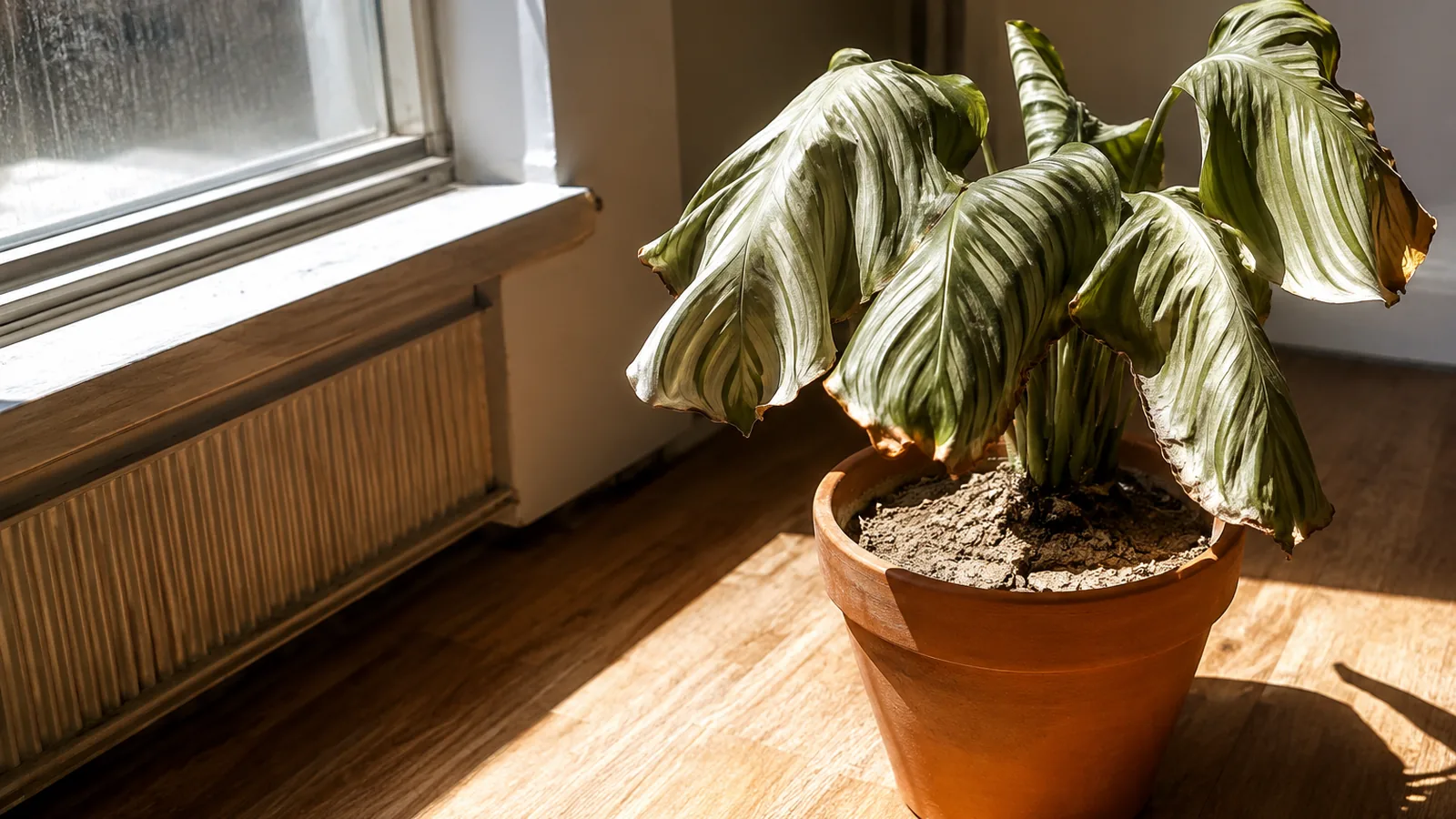
Summer arrives, you throw the curtains wide open, maybe move your plants out onto the balcony — and a few days later, pale brown, dry, bleached patches appear on the most exposed leaves. Don’t panic: in the vast majority of cases, this is neither a disease nor a pest, but sunburn. It’s the most common summer problem for indoor plants, and once you understand it, it’s easy to prevent.
The tricky part is that these patches look like other issues: fertilizer burn, underwatering, fungal disease. And you can only treat what you correctly identify. This guide teaches you to recognize sunburn at a glance, understand why it strikes mostly in summer, protect your sensitive plants, and know what to do with an already-scorched leaf. You’ll see: it’s simpler than it looks.
What leaf sunburn actually looks like
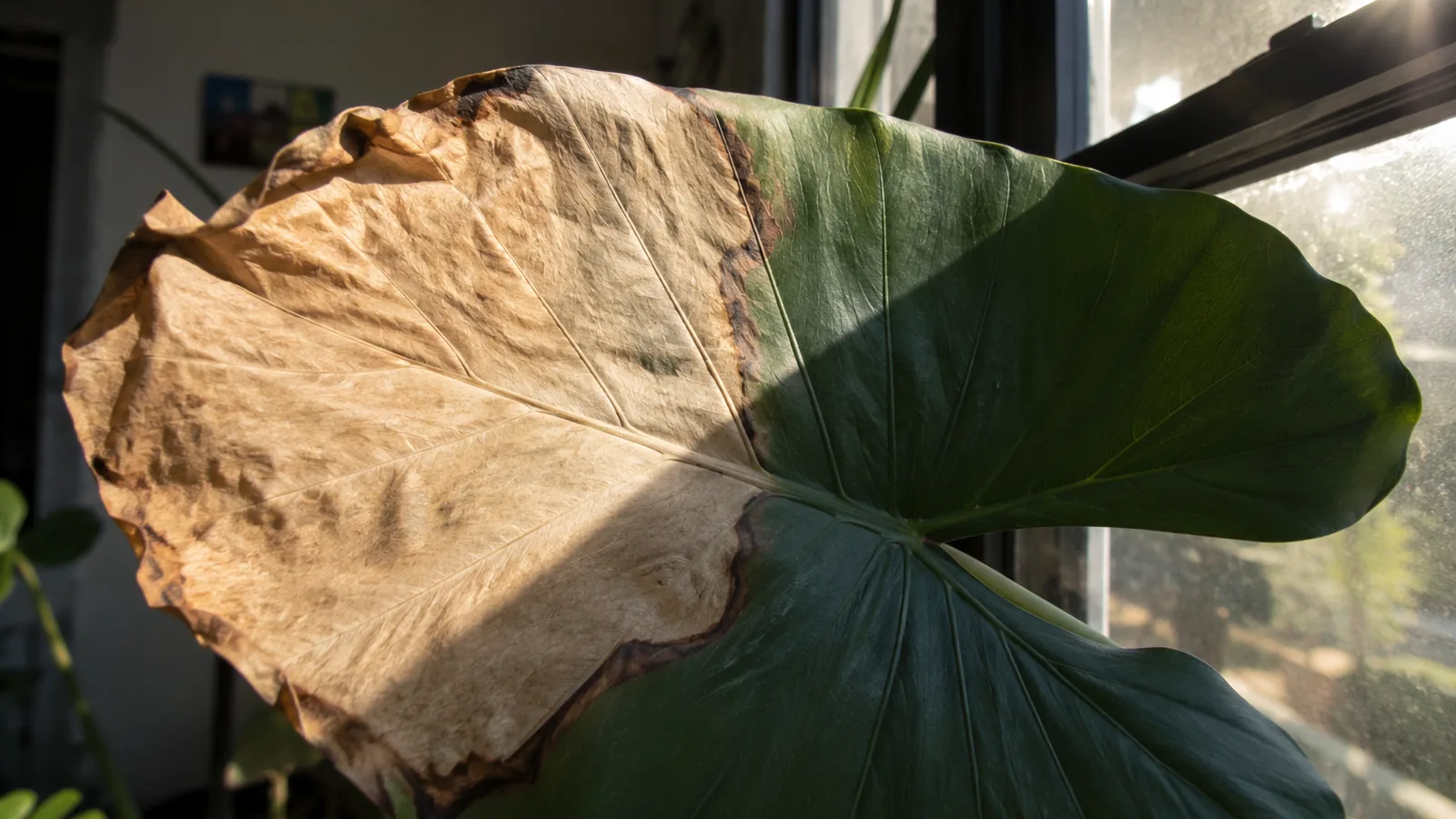
Sunburn (or leaf scorch) happens when a leaf receives more direct light than it can handle. The exposed cells overheat, dehydrate, and die locally. The result is very recognizable once you know where to look.
The unmistakable signs
- Pale brown, beige or bleached patches, sometimes almost colorless, never black and wet.
- Dry, brittle zones to the touch, like paper, often in the center of the leaf blade or on its most exposed part.
- Sharp patch edges, sometimes ringed with a yellow halo.
- Located on the window side: leaves facing the light source get hit, those in shade stay green.
- Fast onset (1 to 4 days) after a change: heatwave, moving the plant, cleaning the windows, taking it out on the balcony.
Another clue: sunburn does not spread once the cause is removed. The patch stays frozen, unlike a disease that gains ground day after day.
Why the leaf never recovers
A scorched zone means permanently dead cells. Unlike a deficiency, there is no possible “re-greening”: the destroyed tissue will not grow back. This matters right from the start, because it shapes how you react — the goal is never to save the damaged leaf, but to stop the cause to protect the rest of the plant.
Sunburn or something else? The differential diagnosis
This is where most mistakes happen. Here’s how to tell sunburn apart from its three most common look-alikes.
| Problem | Patch appearance | Location | Speed |
|---|---|---|---|
| Sunburn | Pale brown/bleached, dry, brittle | Window side, exposed leaves | Fast, then frozen |
| Fertilizer burn | Brown, dry tips and edges | Whole plant, uniform | After feeding |
| Underwatering | Curled edges, dry yellow-brown | Lower leaves first | Gradual, dry substrate |
| Fungal disease | Brown/black wet, soft, ringed patches | Random, often low and humid | Spreads, expands |
A few pointers to decide:
- Fertilizer burn: if you’ve fed recently (especially a strong dose or on dry substrate) and the tips and edges brown across the whole plant, it’s the fertilizer. Flush the substrate thoroughly with clean water.
- Underwatering: leaves curl, soften then dry starting from the bottom, and the substrate pulls away from the pot. Our guide to watering indoor plants covers the finger method so you never guess again.
- Disease: a sunburn patch is dry; a fungal or bacterial patch is wet, soft, oily, often haloed, and it grows. If your patches yellow before browning and multiply, check our yellow leaves diagnosis instead.
Why sunburn strikes mostly in summer
Three mechanisms combine in summer to multiply burns — and understanding each helps you avoid them.
Far more intense direct sun
In summer, the sun climbs high and sunlight can reach 80,000 to 100,000 lux at midday, versus 2,000 to 10,000 lux for comfortable bright indirect light. A plant used to 5,000 lux that suddenly gets a direct ray of tens of thousands of lux overheats within hours. The heat dries the leaf blade faster than the plant can transpire to cool itself.
The magnifying-glass effect of glass and water droplets
Two sneaky amplifiers:
- Window glass can concentrate radiation, especially through a curved pane, flawed glass, or when a leaf nearly touches the pane — heat builds up like a tiny greenhouse.
- Water droplets sitting on a leaf in the sun act like tiny magnifying glasses: they focus the rays and create small spot burns. That’s why you should never mist or water the foliage in full sun. Water early in the morning or in the evening.
The abrupt move
This is the number-one cause of summer disasters. A plant that has lived for months 2 meters from a window, or indoors, is suddenly moved out onto the balcony or pressed against the glass. It hasn’t had time to build up its defenses (protective layer, pigments). Result: burns within 24 to 48 hours. Light isn’t bad in itself — it’s the sudden change that harms. Our complete guide to indoor plant light explains how to measure and adjust exposure room by room.
Sensitive plants vs. tolerant ones
Not all plants react the same way. Knowing their origin helps a lot to anticipate — that’s also the value of learning to recognize the main indoor plant families.
The most sensitive to direct sun
These are mostly tropical understory plants, used to light filtered through the canopy:
- Calathea and Maranta: among the most fragile, they burn very fast at the slightest direct ray. See our Calathea care guide.
- Fittonia, some Ficus varieties, ferns.
- Alocasia, whose large leaves offer a wide exposed surface.
- Any variegated plant: the white or cream zones, with no chlorophyll, burn far more easily than green ones.
The tolerant, even sun-loving
- Succulents and cacti: adapted to full sun, but they too can burn if moved into direct sun too quickly without a transition (yes, even a cactus gets sunburned!).
- Sansevieria (Dracaena trifasciata), very tolerant.
- Aloe, agaves, some euphorbias.
General rule: the thicker, tougher or more fleshy the leaves, the more sun the plant takes. The thinner, softer and more variegated they are, the more vulnerable it is.
How to prevent sunburn
The good news: prevention is simple and costs almost nothing.
Filter direct light
- Hang a light sheer curtain or a pale fabric blind on south- and west-facing windows in summer. It cuts the harsh intensity while letting through lovely light.
- A distance of 50 cm to 1 m from the glass is often enough to turn a scorching ray into bearable bright light.
Acclimate gradually
This is the golden rule before any move outdoors or any move closer to a full-sun window:
- Days 1 to 3: expose to direct light for 1 to 2 hours in the morning only (gentle sun).
- Days 4 to 7: add 1 hour per day.
- Week 2: the plant can stay longer, avoiding the 12 pm–4 pm peak at first.
This ramp-up gives the plant time to build its protective pigments. It’s exactly the same logic as moving a plant toward more light indoors.
Good seasonal habits
- Keep leaves off the glass: no leaf should touch the hot pane.
- Water early morning or evening, never the foliage in full sun (droplet magnifying effect).
- During a heatwave, temporarily pull plants back 1 to 2 meters, or close the sheer curtain during the hottest hours.
- Rotate the pot a quarter turn each week to spread exposure.
- Watch especially plants recently repotted or moved: they’re more fragile.
What to do with an already-scorched leaf
Once the burn is there, the question is no longer “how do I heal it” (impossible) but “how do I manage it smartly.”
Should you cut the leaf?
- Lightly affected leaf (a small patch): keep it. The rest of the blade keeps photosynthesizing and feeding the plant. Cutting a still-useful leaf would weaken the plant for nothing.
- Badly damaged leaf (more than half burned, or hanging and dead): cut it at the base with clean shears. You can also trim only the dry zone, following the leaf shape, leaving a thin margin of dry tissue so you don’t reopen a live wound.
- Never cut all the leaves at once: that adds a major stress to an already-strained plant.
Support recovery
- Remove the cause immediately: move the plant to bright shade, draw the sheer curtain.
- Don’t fertilize a stressed plant: wait until it puts out new healthy leaves.
- Water normally, according to the substrate’s real needs (not more, not less out of “sympathy”).
- Watch the new growth: if it comes out green and healthy, the plant is saved. That’s the true sign of recovery.
Note the date and spot in a notebook — or in the SPRAIA growth journal — to map the risky zones of your home and avoid repeating the mistake next summer.
Sunburn or reversible light stress?
Be careful not to confuse it with temporary, reversible light stress. Some plants, exposed to too much light without an outright burn, react with:
- A general yellowing or paling of the leaves (they “bleach” to protect themselves).
- A reddening (common in succulents: this is “color stress,” often sought after).
- Leaves that fold up or reorient to reduce their exposed surface.
These reactions reverse if you reduce exposure — the leaves green up again, reopen. In contrast, a dry brown patch is permanent. Knowing the difference keeps you from panicking and cutting perfectly viable leaves.
In short: manage summer with confidence
Sunburn is the price of summer enthusiasm: we want to give our plants more light, and sometimes we go too fast. Remember the essentials:
- Sunburn = pale brown, dry patch, window side, fast onset then frozen. Tell it apart from fertilizer burn, underwatering, and wet diseases.
- Summer amplifies everything: intense sun, magnifying effect of glass and droplets, and above all abrupt moves.
- Prevent: sheer curtain, gradual acclimation over 10-14 days, keep off the glass, water outside full sun.
- Fix: impossible for the affected leaf, but removing the cause is enough to protect the rest. Only cut badly damaged leaves.
- Light stress (paling, reddening, folded leaves) is reversible; a dry burn is not.
With these markers, your plants will get through summer unharmed — and you’ll know how to act fast and right at the first sign. SPRAIA’s photo identification and light meter help you place each plant at the right light intensity, and clear up any doubt between a harmless sunburn and a real health problem.
Frequently Asked Questions — Leaf Sunburn
The most common questions about summer leaf scorch.
- No. The burned zone is permanently dead cells: the dry brown tissue never re-greens and won't grow back. The goal isn't to recover the damaged leaf but to stop the cause (remove it from direct sun) so new leaves grow healthy. Keep the leaf if it's lightly affected, cut it only if it's badly damaged.
- Sunburn gives pale brown, dry, brittle patches located on the window side, appearing fast then staying frozen. A fungal or bacterial disease gives wetter, softer patches, often ringed, scattered randomly, that expand day after day. The decisive test: dry and frozen = sun; wet and spreading = disease.
- Yes, but never abruptly. Acclimate them over 10 to 14 days: 1 to 2 hours of gentle morning sun the first days, then increase gradually. Avoid midday (12 pm-4 pm) for the first weeks and be wary of understory plants (Calathea, ferns, variegated plants) that burn even when acclimated.
- These are likely water droplets left on the foliage that, exposed to direct sun, acted as magnifying glasses and focused the rays into hot spots. Always water early in the morning or in the evening, never the foliage in full sun, and avoid misting during sunny hours.
- No, it's reversible light stress, often sought after by collectors: the plant makes protective pigments and colors up red, purple or orange. As long as there's no dry brown patch, it's a good sign. If you prefer the green color, simply reduce exposure and the hue will return.