Powdery Mildew on Houseplants: Causes and Remedies
A white powdery coating on your leaves? That's powdery mildew. Learn to recognise it, understand its causes and treat it naturally at home.
By SPRAIA editorial team · Method: botanical sources, field feedback and editorial validation
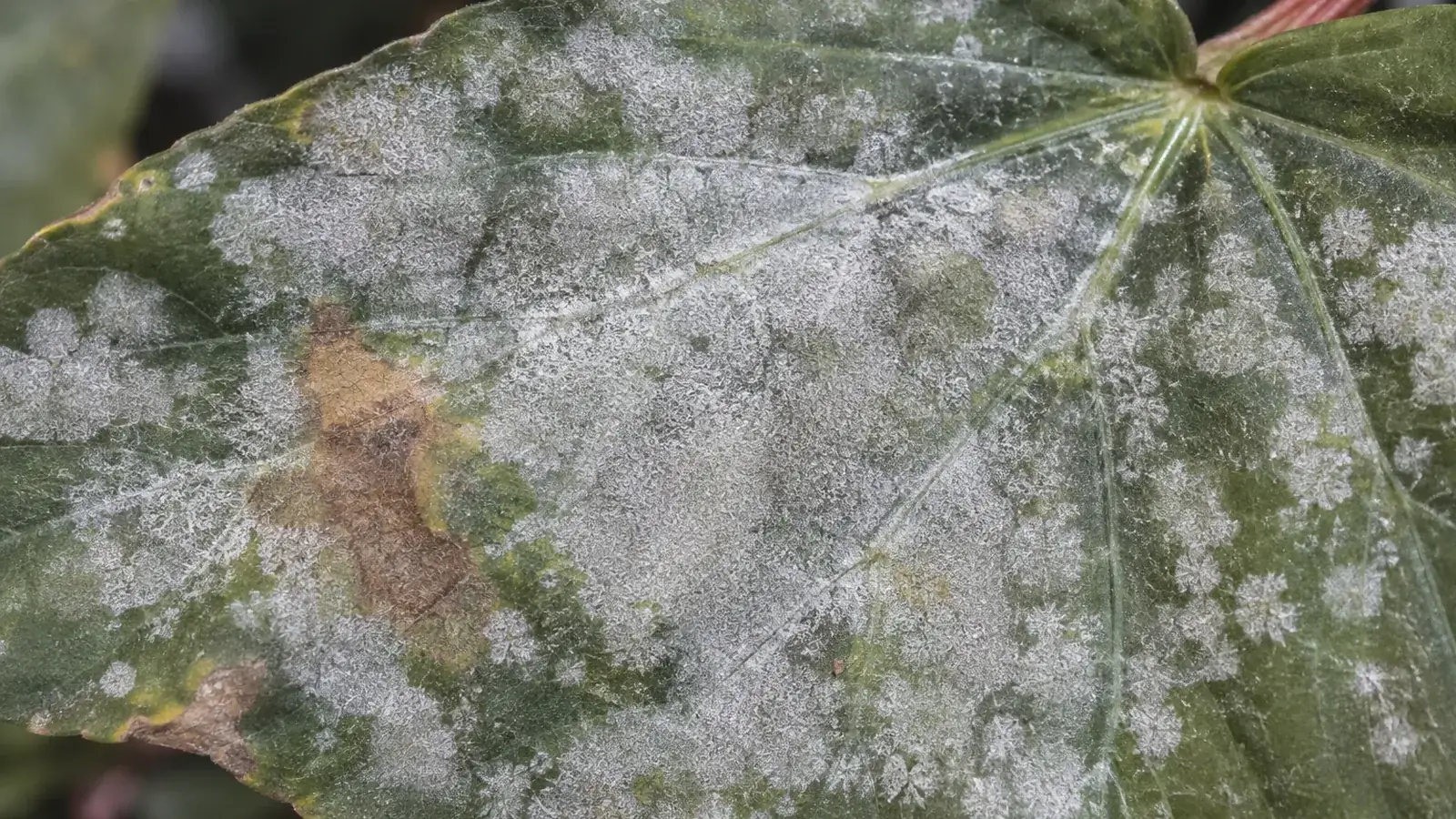
Have you noticed a white powdery coating on the leaves of your Begonia or Kalanchoe, as if someone had dusted them with flour? It isn’t dust and it isn’t limescale: it’s almost certainly powdery mildew, one of the most common fungal diseases on houseplants. The good news? Caught early, powdery mildew is easy to cure with a few kitchen remedies and some tweaks to your habits. Here’s how to recognise it, understand why it shows up, and — most importantly — get rid of it for good.
What exactly is powdery mildew?
Powdery mildew is caused by fungi in the Erysiphaceae family. Unlike many fungi that love standing water, powdery mildew has a quirk: it thrives in humid but stagnant air, without the leaves needing to be constantly wet.
The fungus colonises the leaf surface and forms a white felted mycelium. It draws nutrients straight from the plant cells using tiny feeding structures, which gradually weakens the plant: reduced photosynthesis, distorted leaves, yellowing, then drying out.
The trio of favourable conditions
Powdery mildew loves a very specific cocktail:
- High ambient humidity (above 70%), especially at night
- Stagnant air with no circulation around the foliage
- Sharp temperature swings between day and night, which cause condensation on the leaves
That’s why powdery mildew often flares up in autumn, when you close the windows and bring plants in from the balcony, or in summer in a poorly ventilated room where humidity climbs in the evening.
Recognising powdery mildew for sure
The symptom is fairly distinctive, but it can be confused with two other harmless phenomena. Learn to tell them apart.
Powdery mildew, dust or limescale?
- Powdery mildew forms white to grey patches, slightly powdery and felted, often starting as small rings that then spread. You’ll find it on the top AND underside of leaves, as well as on young stems and sometimes flower buds. Rub it gently and it partly comes off, but it comes back: it’s a living organism, not just a deposit.
- Dust is grey, uniform, settles mainly on the top of horizontal leaves, and comes off for good with a damp cloth.
- Limescale (white marks from misting with hard water) forms dry, crusty spots or rings, usually where droplets have dried. It doesn’t spread and disappears with a little diluted white vinegar.
When in doubt, here’s a trick: isolate the leaf and watch it for 48 hours. If the patch grows and spreads, it really is a living fungus.
SPRAIA tip: photograph the suspect leaf with the app. The AI photo diagnosis compares thousands of cases and distinguishes powdery mildew from a simple limescale deposit or another fungal disease in seconds. You avoid treating for nothing — or letting a real infection slip by.
The warning signs
- White felting that spreads from leaf to leaf
- Leaves that distort, buckle or curl
- Yellowing then drying of the worst-affected leaves (not to be confused with other causes — see our guide to yellow leaves and their causes)
- Slowed growth and flower buds that abort
- Premature drop of the lower leaves
The most susceptible houseplants
Not all plants are equal when it comes to powdery mildew. Some, with tender or fleshy leaves, are prime targets:
- Begonia — the star victim, especially rex Begonias with their thin leaves
- Kalanchoe — fleshy leaves hold surface moisture
- Poinsettia
- African violet (Saintpaulia) — whose downy leaves love stagnation
- Gerbera and other flowering houseplants
- Miniature roses grown in pots indoors
- Young seedlings and cuttings, still fragile
If you grow several of these plants crammed together, stay vigilant: powdery mildew spreads via light spores that travel on the slightest draught.
Why powdery mildew settles in at home
Understanding the causes is already half the treatment. Indoors, powdery mildew is almost always the symptom of an environmental problem, not bad luck.
1. Poor air circulation
This is the number one cause. In a corner with no ventilation, the air loads up with moisture and stagnates around the foliage. Spores settle quietly and germinate. A closed room, an overly dense cluster of plants, a shelf pushed against the wall: all breeding grounds for powdery mildew.
2. Wet leaves in the evening
Misting or watering late in the day is a classic mistake. At night, the temperature drops, the water doesn’t evaporate and sits on the leaves for hours — ideal conditions for spore germination. That’s why when you water matters as much as how much, a point we cover in our guide to when and how to water your plants.
3. Overcrowding
Too many plants in a small space creates a humid, confined microclimate. Every plant transpires, the air stops moving, and a single infected leaf can spread to the whole collection within days.
4. Too much nitrogen
Feeding that’s too rich in nitrogen produces tender, water-filled foliage that’s especially appetising to the fungus. Aim for balanced nutrition instead, as our guide to natural fertilizers for houseplants reminds you.
Treating powdery mildew: the remedies that work
Good news: powdery mildew is one of the easiest fungal diseases to treat at home. The strategy has two stages: remove what’s affected, then treat what remains.
Step 1: remove the affected leaves
Before any treatment, cut off the heavily colonised leaves with disinfected secateurs (wiped with 70% alcohol). Don’t compost them: bin them in a sealed bag to avoid scattering spores. This step immediately cuts the fungal load and gives your remedies a head start.
Step 2: baking soda + soap
The best-known home remedy, and rightly so. Baking soda changes the pH on the leaf surface, making it hostile to the fungus.
Recipe:
- 1 teaspoon of baking soda
- 3 to 4 drops of mild liquid soap (as a sticker and wetting agent)
- 1 litre of water
Spray the top and underside of the leaves, early in the morning. Repeat every 7 days until it clears, then every two weeks as a preventive. Test on one leaf first: too strong a dose can scorch the foliage.
Step 3: diluted milk
Surprising but effective, especially as a preventive and on early infections. Milk proteins, exposed to light, produce antifungal compounds.
Recipe: 1 part milk (semi-skimmed) to 9 parts water. Spray in the morning, in bright weather, once or twice a week.
Step 4: neem oil
Neem oil acts as both a fungicide and a repellent. Dilute 5 ml of pure neem oil in 1 litre of warm water with a few drops of soap (emulsifier). Spray in the evening (it degrades in direct light), once a week. Bonus: it also helps prevent certain pests.
Step 5: sulphur (stubborn cases)
For persistent infections, powdered or sprayable sulphur is a classic and effective fungicide. Save it for resistant cases, apply it at moderate temperatures (never above 28°C, to avoid scorching) and avoid it on sulphur-sensitive plants.
Preventing powdery mildew for good
Treating is good; preventing its return is better. Powdery mildew prevention rests on three simple pillars.
Ventilate and move the air
This is the most effective habit. Open the windows regularly, even for a few minutes a day in winter. In confined rooms, a small fan on a breeze setting for a few hours a day stirs the air and stops spores from settling. Moving air is powdery mildew’s sworn enemy.
Space out your plants
Don’t cram your plants against each other. Enough spacing lets air circulate between the foliage and limits contagion. As your collection grows, spread the plants out rather than grouping everything together — pests appreciate crowding too, as you’ll see with mealybugs to identify and eliminate or fungus gnats you need to get rid of.
Water at the base, in the morning
Two golden rules: water at the base of the plant rather than over the foliage, and do it in the morning so any residual moisture dries during the day. Avoid systematic evening misting, especially on susceptible plants. If you do mist, do it early and in a ventilated room.
Keep an eye on humidity and temperature
Aim for reasonable ambient humidity (40 to 60% for most plants) and limit abrupt temperature swings that create condensation. A cheap hygrometer helps you keep an eye on it.
SPRAIA tip: turn on watering and treatment reminders in the app, and keep a photo growth journal. By comparing your shots week after week, the AI spots suspicious felting long before it spreads — the best way to step in early, while a simple dusting of baking soda is still enough.
How long does it take to get rid of?
With regular treatment and a corrected environment, powdery mildew usually recedes within 1 to 3 weeks. The key isn’t a miracle remedy but consistency: treating every week without skipping an application, and above all fixing the root cause (ventilation, watering, spacing). A one-off treatment without changing the conditions almost always leads to a relapse.
If powdery mildew still lingers after a month, reassess the plant’s location: sometimes moving it to a brighter, better-ventilated spot is all it takes to close the chapter for good.
Frequently asked questions about powdery mildew
The questions that come up most often when facing this white felting on the leaves.
- Limescale (from misting with hard water) forms dry, crusty spots or rings that don't spread and disappear with a little diluted white vinegar. Powdery mildew is a slightly powdery white felting that gains ground day by day and comes back after rubbing, because it's a living fungus. When in doubt, isolate the leaf and watch it for 48 hours: if the patch grows, it's powdery mildew.
- Yes, very easily. Powdery mildew spreads via light spores that travel on the slightest draught. A single infected leaf can spread to a whole collection within days, especially if the plants are crammed together. Immediately isolate the affected plant, remove the worst leaves and space out the rest of your collection while you treat.
- Yes, it's one of the most reliable home remedies on early infections. Baking soda changes the pH on the leaf surface and makes it hostile to the fungus. Use 1 teaspoon per 1 litre of water with a few drops of liquid soap, sprayed every 7 days. Test on one leaf first: too strong a dose can scorch the foliage.
- Yes, remove the heavily colonised leaves before any treatment, using secateurs disinfected with alcohol. This immediately cuts the amount of spores and gives your remedies a head start. Don't compost these leaves: bin them in a sealed bag to avoid scattering spores around the room.
- Tackle the root causes: ventilate the room regularly, space out your plants so air can circulate, water at the base and in the morning rather than over the foliage in the evening, and avoid excess nitrogen that makes leaves too tender. A small fan on a breeze setting for a few hours a day is remarkably effective: moving air stops spores from settling and germinating.
Conclusion
Powdery mildew may look alarming with its white felting, but it’s one of the easiest fungal diseases to control once you act early. Remember the winning formula: recognise it quickly (and don’t confuse it with limescale), remove the affected leaves, treat with baking soda or neem every week, and above all correct the environment — ventilation, spacing, morning watering at the base.
The difference between a plant that relapses and one that recovers rarely comes down to the remedy you choose, but to consistency and fixing the causes. With SPRAIA in your pocket — instant photo diagnosis, treatment reminders and a growth journal — you catch powdery mildew before it settles in and calmly follow your plants back to health. Your indoor plant parents will thank you.