Sansevieria: The Perfect Plant for Dark Rooms
Complete Sansevieria guide: varieties, low-light tolerance, watering, propagation. The near-indestructible plant for sunless corners.
By SPRAIA editorial team · Method: botanical sources, field feedback and editorial validation
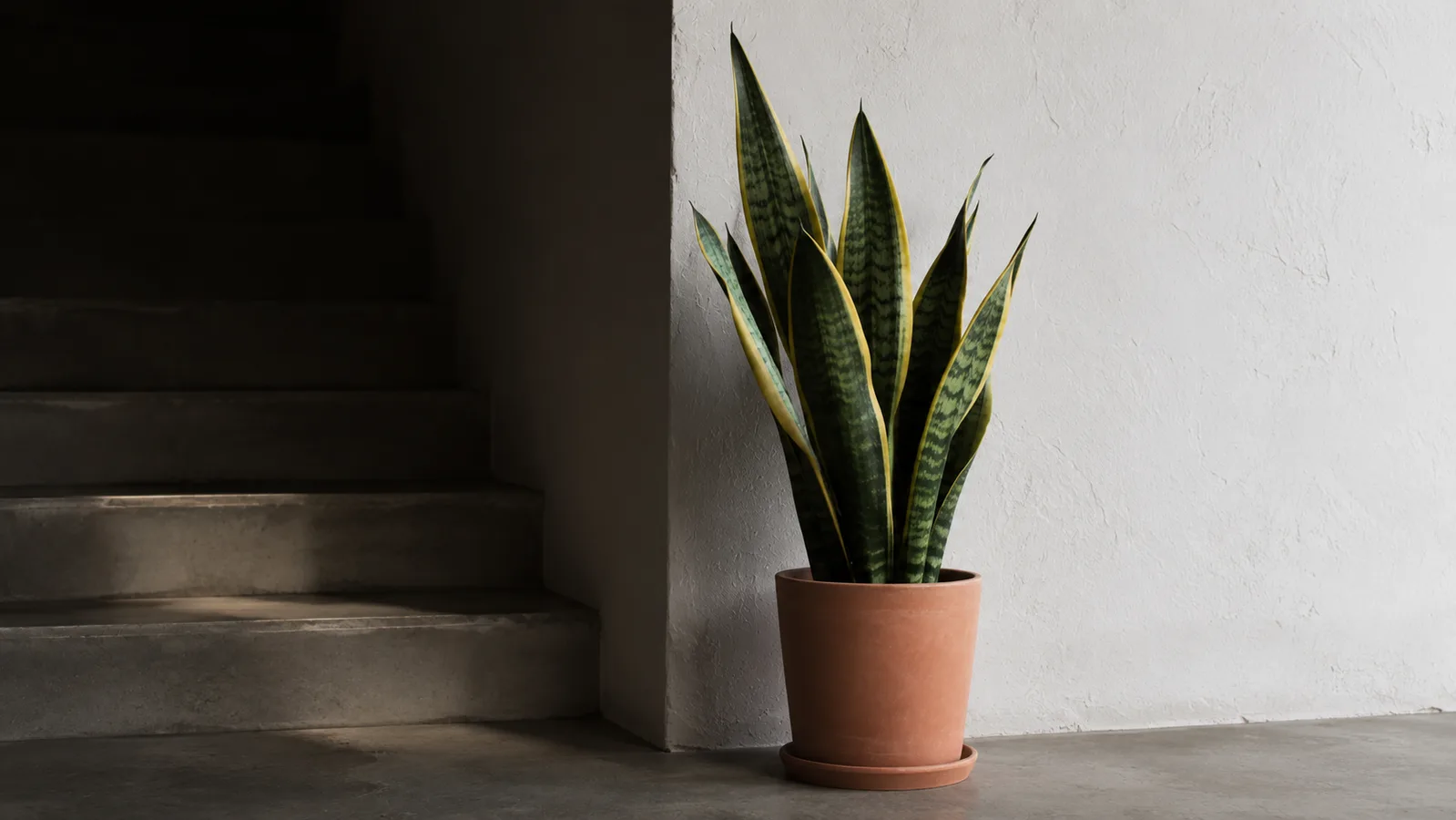
If there were an official ranking of the most tolerant plants in the world, the Sansevieria would sit unchallenged in the top 3. Nicknamed “snake plant” or “mother-in-law’s tongue”, it survives where others wilt: dark hallways, windowless bathrooms, air-conditioned offices, weeks of forgotten watering. Better still: it purifies the air, suits absolute beginners, and offers a graphic silhouette that fits every decor style. Here’s why it deserves a spot in every home — and how to keep it stunning for decades.
A plant with a moving botanical past
The Sansevieria belongs to the Asparagaceae family (yes, like asparagus). Native to tropical regions of West Africa, Madagascar and South Asia, it’s used to extreme conditions: poor soils, dry heat, understory shade or rocky full sun. This versatility explains its exceptional indoor toughness.
Botanical aside: since 2017, taxonomists have reclassified Sansevierias into the Dracaena genus. Sansevieria trifasciata has thus become Dracaena trifasciata. But the trade name “Sansevieria” remains common at garden centres — we’ll use it in this article for clarity.
Why it’s so easy
The Sansevieria uses a rare photosynthesis mode called CAM (Crassulacean Acid Metabolism), shared with cacti and some orchids. In practice, it opens its stomata at night to limit water loss during the day. Result: it stores water in its fleshy leaves and resists prolonged drought. It can also grow under surprisingly low light, unlike most houseplants.
Varieties to know
There are about sixty Sansevieria species, with very varied forms: upright leaves, cylindrical, fan-shaped, spiralled.
Accessible classics
- Sansevieria trifasciata ‘Laurentii’ — the most famous, dark green leaves marbled with bright yellow margins. The absolute standard.
- Sansevieria trifasciata ‘Hahnii’ (Bird’s Nest) — compact version (15-20 cm), short leaves forming a bird-nest rosette. Ideal for offices or small spaces.
- Sansevieria trifasciata ‘Moonshine’ — pale silver-green leaves, almost metallic. Striking decorative effect.
- Sansevieria trifasciata ‘Black Coral’ — very dark green leaves, almost black, fine silver marbling. Elegant gothic vibe.
The originals
- Sansevieria cylindrica — cylindrical leaves upright like sticks, sometimes braided to a point. Sculptural.
- Sansevieria masoniana (Whale Fin) — a single huge leaf shaped like a whale fin. Statement piece.
- Sansevieria boncel — compact fan-shaped form of the cylindrica.
- Sansevieria zeylanica — close to trifasciata but without yellow margins, horizontal silver patterns.
Rarer for collectors
- Sansevieria ‘Bantel’s Sensation’ — vertically striped pure white. Very slow grower, hence rare.
- Sansevieria kirkii ‘Silver Blue’ — spectacular bluish leaves with wavy margins.
- Sansevieria francisii — small, compact star-shape with short triangular leaves.
To identify a Sansevieria you encounter, our quick plant identification guide explains how SPRAIA distinguishes varieties in seconds.
Light: little, but not none
The myth “the Sansevieria grows in the dark” is partly false. It survives for a long time in shade, but it thrives in bright indirect light.
Real light tolerance
| Light level | Behaviour | Verdict |
|---|---|---|
| Prolonged direct sun | Leaf burn | Avoid |
| Bright indirect (1-2 m from south/west window) | Optimal growth, intense colours | Ideal |
| Medium (3-4 m from window, indirect) | Slow but stable growth | Very good |
| Low (corridor, opaque-window bathroom) | Survival, near-zero growth | Acceptable |
| No natural light | Progressive decline over 6-12 months | Avoid |
In practice: the Sansevieria can occupy almost every corner of a home, except a closed cupboard. For optimal conditions, see our complete guide on light for houseplants.
Effect of light on colour
- Bright light: intense yellow/silver colours, fast vertical growth
- Medium light: colours preserved but slow growth
- Low light: progressive reverting of variegations, thinner and softer leaves
Variegated varieties (Laurentii, Bantel’s Sensation) need more light to keep their colours. Pure green varieties (zeylanica) tolerate shade better.
Watering: risk zone number one
If a Sansevieria dies, it’s almost always from overwatering. Its drought tolerance is extraordinary; its resistance to root moisture, very limited.
The absolute rule
Let the substrate dry completely between waterings. And by “completely”, we mean: dry through the full depth of the pot, not just the surface.
Reliable test: push a wooden stake (skewer) all the way down. Pull it out. If it comes out clean and dry, time to water. If dark and moist, wait longer.
Indicative frequency
- Spring-summer: every 10 to 14 days
- Autumn: every 14 to 21 days
- Winter: every 4 to 6 weeks only
Yes, you read that right: in winter, you can skip watering for a month and a half. The plant is in near-total rest and any extra water is dangerous. Our complete watering guide explains this seasonality in detail.
How to water
- Bottom watering if possible: place the pot in a basin of water for 15 minutes, let the substrate drink by capillarity, drain well.
- For top watering, avoid the centre of the rosette: water pooling in the leaf well can cause inner rot.
- Use room-temperature water, ideally left to stand 24 h to evaporate chlorine.
Warning signs
- Yellow or limp basal leaves: overwatering. Stop water immediately and check roots (see our root rot guide).
- Wrinkled, curling leaves: underwatering. Water immediately, plant bounces back in days.
- Brown tips: air too dry or water too hard/chlorinated. Switch water, lower frequency.
Substrate and pot
Mandatory draining substrate
Sansevieria hates prolonged moisture. Its substrate must drain very freely.
Recommended mix:
- 50 % cactus and succulent potting mix
- 30 % perlite or pumice
- 20 % coarse sand or pumice gravel
For enthusiasts, switching to PON mineral substrate works particularly well: Sansevieria tolerates the system better than most green plants, its toughness offsets the learning curve.
The pot
- Material: terracotta recommended (wicks moisture through walls). Plastic also works but demands extra watering vigilance.
- Size: Sansevieria likes feeling slightly cramped. Pick a pot just 2-3 cm wider than the rootball.
- Drainage: drainage holes mandatory. No closed pot, ever.
- Depth: doesn’t matter much — roots are shallow. A shallow pot is even preferable.
Propagation: easy joy
Sansevieria multiplies three ways. The easiest in the world, suitable for absolute beginners.
Method 1: rhizome division (the fastest)
When your plant has produced several clusters (visible from new leaves emerging next to the main rosette):
- Remove the plant from its pot
- Identify the underground rhizomes connecting the clusters
- Cut them with clean shears
- Repot each piece in its own pot with fresh substrate
- Wait 1 week before the first watering
This method produces adult plants immediately. Ideal for sharing with friends.
Method 2: leaf cutting in water or soil
Slower but fun:
- Cut a healthy leaf at the base
- Slice it into 5-7 cm sections (note orientation: roots only grow downward)
- Let cuts dry 24-48 hours (callus formation)
- Plant the base in dry substrate or dip in water
- Wait 2 to 4 months: yes, very slow, but works almost 100 %
Caution: variegated varieties (Laurentii with yellow edges) lose their variegation via leaf cutting. The rhizome is required to preserve variegation. For these varieties, choose division.
Method 3: spontaneous pups
Sansevieria regularly produces pups (offshoots) at the base. When a pup has its own visible roots, you can gently separate it and pot it up.
To go deeper into propagation techniques, our complete water propagation guide covers every method for houseplants.
Sansevieria and air quality
One of its strongest marketing arguments: Sansevieria features in the NASA list of air-purifying plants (Clean Air Study, 1989). It notably filters:
- Formaldehyde (in some furniture, paints, household products)
- Benzene, xylene, toluene (industrial solvents and fumes)
- Trichloroethylene
Unique trait: it continues its CAM metabolism at night, so it releases oxygen while you sleep. That’s why it’s often recommended in the bedroom, unlike most plants (which consume O₂ at night).
Scientific caveat: to measurably purify the air of a 20 m² room, you’d theoretically need dozens of plants. The effect of a single Sansevieria remains symbolic. But combined with other benefits (aesthetic, micro-humidity, well-being), it’s still a plus.
Annual care calendar
| Season | Watering | Light | Fertilizer | Action |
|---|---|---|---|---|
| Spring | Every 10-14 days | Bright indirect | 1×/month (cactus) | Resume divisions and repotting |
| Summer | Every 7-14 days | Bright indirect, no direct | 1×/month | Watch for brown tips |
| Autumn | Every 14-21 days | Maintain exposure | Reduce to 1×/2 months | Pest inspection |
| Winter | Every 30-45 days | Maintain | Stop | Rest, especially no repotting |
Common problems and solutions
Leaves softening and collapsing
Chronic overwatering. Action: stop watering, check root state, possibly emergency repot.
Brown, dry leaf tips
Air too dry, water too mineralized, or natural growth scar. If recent: switch water (filtered or rainwater). Otherwise, gently trim the brown tip following leaf shape.
Leaves folding or curling
Persistent water lack. Hydrate immediately from below. Plant recovers in 2-3 days.
Yellow edge turning brown
Often excess direct sun in summer. Move 1 m back from the window.
Mealybugs
Though tough, Sansevieria can be attacked. Our complete mealybug guide covers every treatment.
Leaves stretching and going soft
Light deficiency. Move closer to a window.
Frequently asked questions about Sansevieria
Everything you wonder about the near-indestructible plant of low-light corners.
- Very rarely: every 2 to 3 weeks in summer, every 4 to 6 weeks in winter. The Sansevieria stores water in its fleshy leaves like a succulent. Absolute rule: wait until the substrate is fully dry before watering. Overwatering kills this plant faster than any other factor.
- It survives in low light but barely grows in total darkness. For real growth, it needs at least moderate indirect light. It tolerates a windowless corner, a hallway, a bathroom with a small window, or a windowless office lit artificially several hours a day.
- Yes, mildly. It contains saponins that cause drooling, vomiting and diarrhea on ingestion. Toxicity stays moderate and rarely serious, but keep it out of reach of animals that chew. For non-toxic alternatives, see our [guide to toxic plants for children and pets](/en/blog/toxic-plants-children-pets-guide/).
- Cause number 1: overwatering. Healthy Sansevieria leaves stand straight and firm. When they become soft and droop outward, roots are usually rotting. Repot immediately, cut black roots, let dry 48 h and replant in a very free-draining substrate (50% potting soil / 50% sand + perlite).
- Three easy methods: 1) Divide clumps at repotting time by separating the rhizomes — fastest method. 2) Leaf cuttings in 5-10 cm sections planted in moist sand (warning: variegated varieties revert to green from leaf cuttings). 3) Water cuttings: a leaf section in a glass of water, roots within 4-6 weeks.
Mistakes to avoid
- Watering on a fixed schedule without checking substrate — the leading cause of death
- Misting leaves — useless, can cause spotting
- Choosing too large a pot — favours water retention and rot
- Putting in a closed cover pot without checking after watering — invisible standing water
- Watering in winter as in summer — radically reduce frequency
- Wetting the rosette centre — possible inner rot
- Repotting too often — Sansevieria likes tightness, repot every 3-4 years suffices
Conclusion
The Sansevieria is probably the most indestructible houseplant you can welcome. Shade-tolerant, capable of surviving weeks without water, pest-resistant, sculptural and air-purifying — it ticks every box for beginners, frequent travellers or anyone wanting to green a tricky corner. The only real trap: excess water. Respect the rhythm “substrate dry through to depth before watering”, and you’ll have a plant that accompanies you 20 years, even more.
With SPRAIA, identify your Sansevieria’s exact variety, get watering reminders adapted to the season (a summer schedule is useless in winter), track every new leaf in a photo journal, and photo-diagnose every suspect symptom. Sansevieria deserves little care, but the right kind. Up to you to give it.