Zamioculcas (ZZ): The Indestructible Plant Explained
Complete guide to Zamioculcas zamiifolia (ZZ): tolerance, watering, light, propagation. The plant that survives anything, even your absence.
By SPRAIA editorial team · Method: botanical sources, field feedback and editorial validation
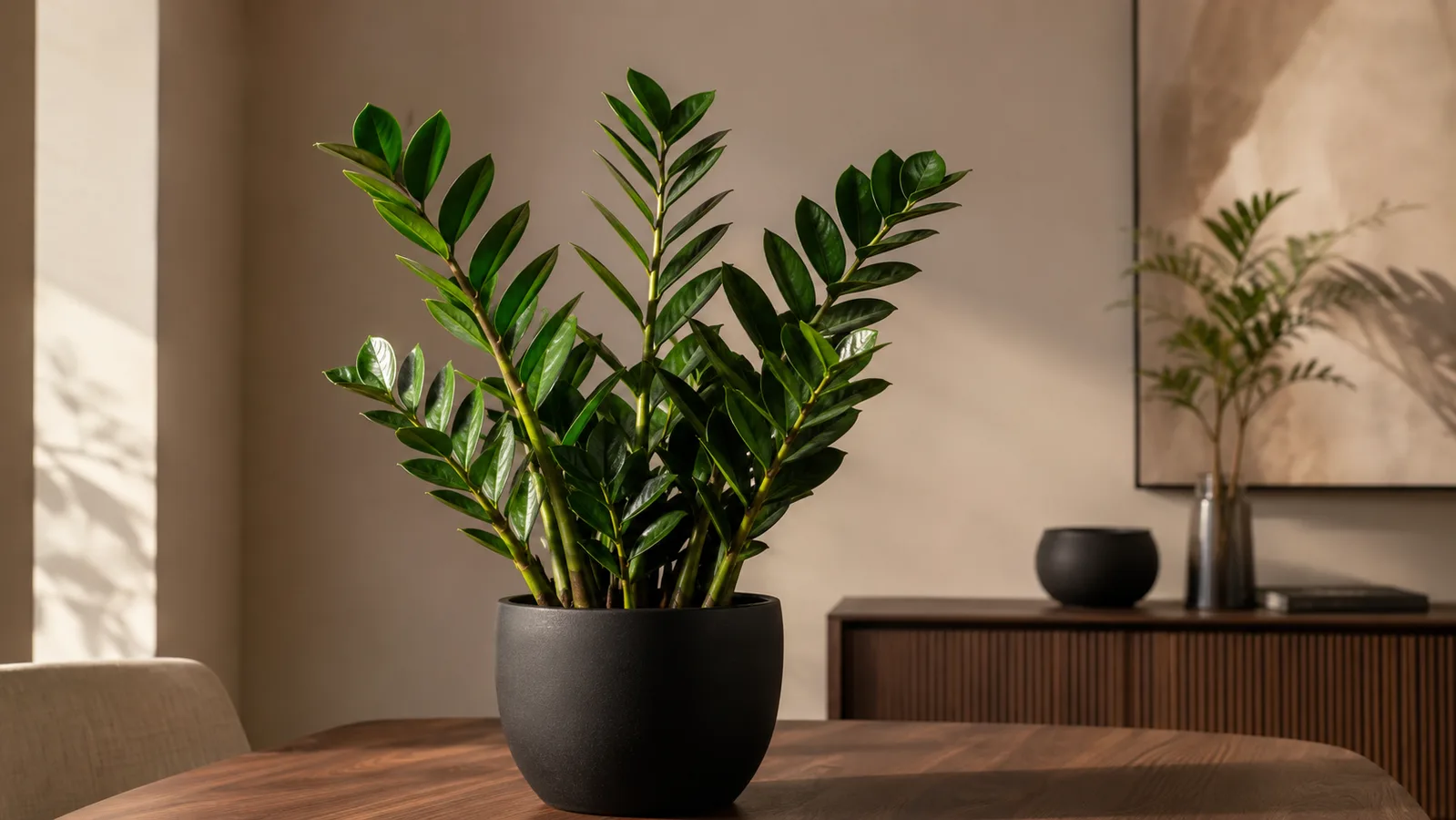
If Sansevieria deserves second place on the podium of indestructible plants, the Zamioculcas zamiifolia — fondly nicknamed “ZZ” — likely takes first. This African plant with dark, almost waxy glossy foliage tolerates everything: months of forgotten watering, low light, dry heated-apartment air, moves, drafts. It’s the plant for frequent travellers, low-light offices, and anyone afraid of having a “killer green thumb”. Here’s everything you need to know to enjoy its almost timeless beauty.
A plant from East Africa
Zamioculcas zamiifolia is native to the arid regions of East Africa (Kenya, Tanzania, Mozambique). In the wild, it grows in rocky understories and zones with long dry seasons. To survive there, it developed a remarkable adaptation: fleshy underground rhizomes, like potatoes, capable of storing water and nutrients for months.
This trait explains its exceptional drought tolerance — and the classic beginner trap of overwatering.
Botanical family
The ZZ belongs to the Araceae family, like Monstera, Philodendron, Pothos and Anthuriums. A tropical family known for its diversity and adaptability (our guide to indoor plant families explores this group in detail).
Available varieties
- Zamioculcas zamiifolia (classic) — dark glossy green leaves, upright form. The reference.
- Zamioculcas ‘Raven’ — spectacular variety with deep black mature leaves (light green when young). Very trendy, pricier.
- Zamioculcas ‘Zenzi’ — compact and stocky version, slow growth, perfect for offices.
- Zamioculcas ‘Lucky White’ — rare, cream variegation on dark green.
- Zamioculcas ‘Variegata’ — irregular yellow/white variegation, highly collectible.
Why is it so tolerant?
Three biological adaptations explain its toughness:
- Reservoir rhizomes — large fleshy tubers storing water for weeks. That’s why you can forget to water without consequence.
- Thick waxy cuticle — drastically limits transpiration, conserves internal water.
- Slow growth — few needs, low stress, few problems.
Practical consequence: the biggest threat to a ZZ isn’t water lack, it’s excess. The opposite of most houseplants.
Light: almost everything works (except direct sun)
Tolerance spectrum
| Condition | Behaviour | Verdict |
|---|---|---|
| Prolonged direct sun | Foliage burn | Avoid |
| Bright indirect | Optimal growth, glossy leaves | Ideal |
| Medium light (typical interior) | Slow but steady growth | Very good |
| Low light (corridor, dim office) | Excellent survival, slowed growth | Acceptable |
| Very low light | Long survival, near-zero growth | Possible |
In practice, you can place a ZZ in any corner getting at least a few hours of light per day. To optimize, keep it 1-3 m from a bright window, no direct sun through the glass.
The ‘Raven’ variety is an exception
The ZZ Raven needs more light to retain its deep black. In too-low light, new leaves come out classic green. A north or east window unblocked works well.
To evaluate the light in your home, see our complete plant light guide.
Watering: the critical zone
The ZZ is probably the most overwatered plant indoors. Its glossy beauty makes you want to “spoil” it — yet it hates that.
The golden rule
Wait until the substrate is completely dry through the full pot depth before watering. Not just the surface: the whole pot.
Simple test: push a wooden skewer to the bottom. If it comes out dry, it’s time. If slightly moist or with substrate stuck to it, wait another week.
Indicative frequency
- Spring-summer: every 14 to 21 days
- Autumn: every 21 to 30 days
- Winter: every 30 to 60 days only
Yes, in winter you can skip watering for 2 months. Normal. The plant is in vegetative rest and draws on its reserves.
To grasp watering logic, see our complete houseplant watering guide.
How to water
- Top watering, generously, until water runs out the drainage holes
- Drain completely: ZZ doesn’t tolerate standing water
- Empty the saucer 15 minutes after watering
- Use room-temperature water, ideally left to stand 24 h
Warning signs
- Limp yellow basal leaves: overwatering. Stop water, check rhizome state (see our root rot guide)
- Wrinkled leaves and soft stems: extreme underwatering. Hydrate immediately
- Brown tips: water too hard or chlorinated. Switch water
- Stems collapsing outward: pot too small or plant overwatered
The tuber test
If you suspect overwatering, gently slip the plant out and inspect the rhizomes:
- Firm, light-beige tubers = healthy
- Soft, dark-beige or black tubers = active rot, urgent intervention
Substrate and pot
Ideal substrate
Very draining, like for succulents:
- 50 % cactus and succulent mix
- 30 % perlite or pumice
- 20 % coarse sand or pine bark
The ZZ also does very well in PON mineral substrate, where overwatering risk is near zero.
The pot
- Material: terracotta recommended for its moisture-wicking. Plastic with sufficient drainage for design black pots (max decor effect on the ZZ Raven).
- Size: pick a pot 2-4 cm wider than the rootball. ZZ likes feeling slightly cramped, its rhizomes fill all the space.
- Drainage: holes mandatory.
- Depth: medium, enough for rhizomes.
Propagation: patience required
The ZZ propagates several ways. None are fast, but all work.
Method 1: rhizome division
The fastest and most reliable. When your plant has become very bushy (multiple stems, visible rhizomes):
- Slip the plant out of the pot
- Identify “clusters” of rhizomes easily separable
- Pull gently or cut with very clean shears
- Each piece must have at least one stem and a few roots
- Repot each piece in its own pot with fresh substrate
- Don’t water for 1 week, time for cuts to heal
Method 2: leaf cutting
Spectacularly slow (4 to 12 months to see a new bud), but fascinating to watch:
- Take a healthy leaf with a bit of petiole
- Let the cut dry 24-48 h
- Plant the base of the leaf in dry substrate (1 cm deep)
- Water very little, just to dampen substrate
- Patience: a small tuber forms at the base, then a new shoot emerges
Ideal if you enjoy long-term experiments.
Method 3: stem cutting
Faster than leaf but means sacrificing a stem:
- Cut an entire stem at the base
- Put in water or plant in substrate
- A small tuber forms in 2-4 months
- When it has a few visible roots, you can repot normally
For general propagation techniques, our complete water propagation guide covers basics applicable to many plants.
Toxicity: caution with children and pets
The ZZ contains calcium oxalate crystals in all its parts. Consequences:
- Irritating sap on skin contact (rare, but possible with prolonged fresh sap)
- Mild toxicity by ingestion: nausea, vomiting, mouth irritation in dogs, cats, rabbits, young children
- Not deadly but unpleasant
Best practices:
- Place the plant out of reach of nibbling pets and young children
- Wash hands after handling (repotting, pruning)
- Wear gloves during division or major pruning
For a complete picture on houseplant toxicity, our toxic plants guide for children and pets (upcoming) will be your reference.
Annual care calendar
| Season | Watering | Light | Fertilizer | Action |
|---|---|---|---|---|
| Spring | Every 14-21 days | Bright indirect | 1×/month (balanced NPK, half dose) | Resume divisions |
| Summer | Every 14-21 days | Bright indirect, no direct | 1×/month | Repot if needed |
| Autumn | Every 21-30 days | Maintain exposure | Reduce to 1×/2 months | Pest inspection |
| Winter | Every 30-60 days | Maintain | Stop | Rest, especially no repotting |
Common problems and solutions
Soft stems collapsing
Chronic overwatering. Action: stop watering immediately, check rhizome state, possibly emergency repot in fresh dry substrate.
Scattered yellow leaves
Often natural ageing of the oldest leaves. If many leaves yellow simultaneously: overwatering. See our yellow leaves diagnostic guide.
Growth seems stalled
Normal in winter and low light. ZZ is a slow plant. A new shoot every 1-3 months in active growth is a normal pace.
Brown dry tips
Air too dry, water too mineral, or natural scar. If recent: switch water. If old: trim the brown tip following leaf shape.
Mealybugs
ZZ is tough but can be attacked. Our complete mealybug guide explains how to intervene.
Stems splaying outward
Plant lacks light (etiolation) or is overwatered. Move closer to a window and space waterings.
Mistakes to avoid
- Watering on a fixed schedule without checking substrate — leading cause of ZZ death
- Choosing too large a pot — favours water retention and rhizome rot
- Putting in a closed cover pot without checking after watering
- Misting leaves — useless, can stain the waxy cuticle
- Wanting it to grow fast — it’s a slow plant by nature, not by sickness
- Repotting yearly — every 2-3 years is plenty
- Handling sap unprotected — possible skin irritation
Frequently asked questions about Zamioculcas (ZZ)
Everything you wonder about the most tolerant plant on the market.
- Surprisingly long — up to 2 or 3 months without trouble for a healthy adult plant. The ZZ stores water in its underground rhizomes (round tubers), exactly like a cactus. Absolute rule: water only when the substrate is completely dry throughout. When in doubt, wait another week.
- Almost always overwatering. ZZ stems turn yellow and mushy at the base before falling off. Immediately remove the plant from its pot, check the rhizomes: if they're soft, black or smelly, cut the rotten parts with a sterilised knife, let dry 48 h in the open air, and repot in a very free-draining substrate (potting soil + perlite + sand). No watering for 10 days.
- Very rarely, but yes. A ZZ bloom looks like a small cream-white spadix surrounded by a green spathe, similar to a miniature Spathiphyllum. It only appears on mature plants (5+ years), perfectly settled and in very good conditions. Many ZZ owners will never see their plant flower, and that's not a problem — its appeal lies in its foliage.
- Yes, moderately. Like most Araceae, ZZ contains calcium oxalate crystals that irritate the mouth and oesophagus when ingested (salivation, vomiting). It's less toxic than Dieffenbachia but still needs to be kept out of reach of curious cats and young children. See our [guide to toxic plants](/en/blog/toxic-plants-children-pets-guide/).
- Two methods: 1) Division of rhizomes at repotting — gently separate the tubers with their stems and replant each section in its own pot; results in a few weeks. 2) Leaf cutting — cut a leaflet and plant it vertically in damp sand. Count 4 to 12 months to see a small rhizome appear then a new stem. Slow method but fascinating to watch.
Conclusion
The Zamioculcas zamiifolia is probably the most tolerant plant you can welcome, even more than Sansevieria on certain aspects (notably very low light). Its secret: rhizome-tubers that store water for weeks, a waxy cuticle limiting transpiration, and slow growth that makes it nearly maintenance-free. The only real rule: patience and sparing watering. Its glossy graphic beauty, upright silhouette and longevity (10-20 years easily) make it a profitable decor investment.
With SPRAIA, identify your precise variety (classic, Raven, Zenzi…), get watering reminders matched to the season and your home, and track its slow but steady growth in a photo journal that highlights every new stem. The ZZ asks for little — give it the minimum, and it will give you decades of serene presence.