Propagating Plants in Summer: The Best Season, Step by Step
Why summer is the best time to multiply your plants, and how to master stem cuttings, leaf cuttings, division, air layering and offsets.
By SPRAIA editorial team · Method: botanical sources, field feedback and editorial validation
If you’ve always wanted to multiply your plants for free, summer is your big window of opportunity. Propagating in summer isn’t a calendar coincidence: it’s the time when heat and light push roots out in days rather than weeks. A Pothos cutting that takes a month to root in January can do it in ten days in late August. In this guide, we explain why the season matters so much, then walk through each method — stem in water, leaf, division, air layering, offsets — so you can pick the right technique for your plant and avoid the mistakes that make everything rot.
Why summer is the ideal season for propagation
A plant doesn’t make roots by magic: it needs energy, and that energy comes from photosynthesis. In summer, three factors line up perfectly.
- Heat — most tropical houseplants root best between 22 and 28 °C (72–82 °F). At these temperatures, cell division speeds up and tissues produce roots noticeably faster than at 16–18 °C.
- Light — long, intense days maximize photosynthesis, and therefore the sugar reserves available to fuel root formation. A cutting placed near a bright window (without direct sun) gets off to a far stronger start than in winter.
- Active growth — in spring and summer, your plant is in its full growing season. Natural hormones (auxins) are circulating, tissues are young and responsive. Taking a cutting during this phase means working with the plant rather than against it.
In autumn and winter, by contrast, most plants slow down or go dormant. A cutting taken in December often survives, but it stalls: it waits for spring to root and risks rotting during that long wait. In short, between June and the end of August, everything is in your favor.
One nuance: succulents and cacti also enjoy summer, but they need more patience and a very free-draining substrate. More on that below.
Stem cuttings in water: the go-to method
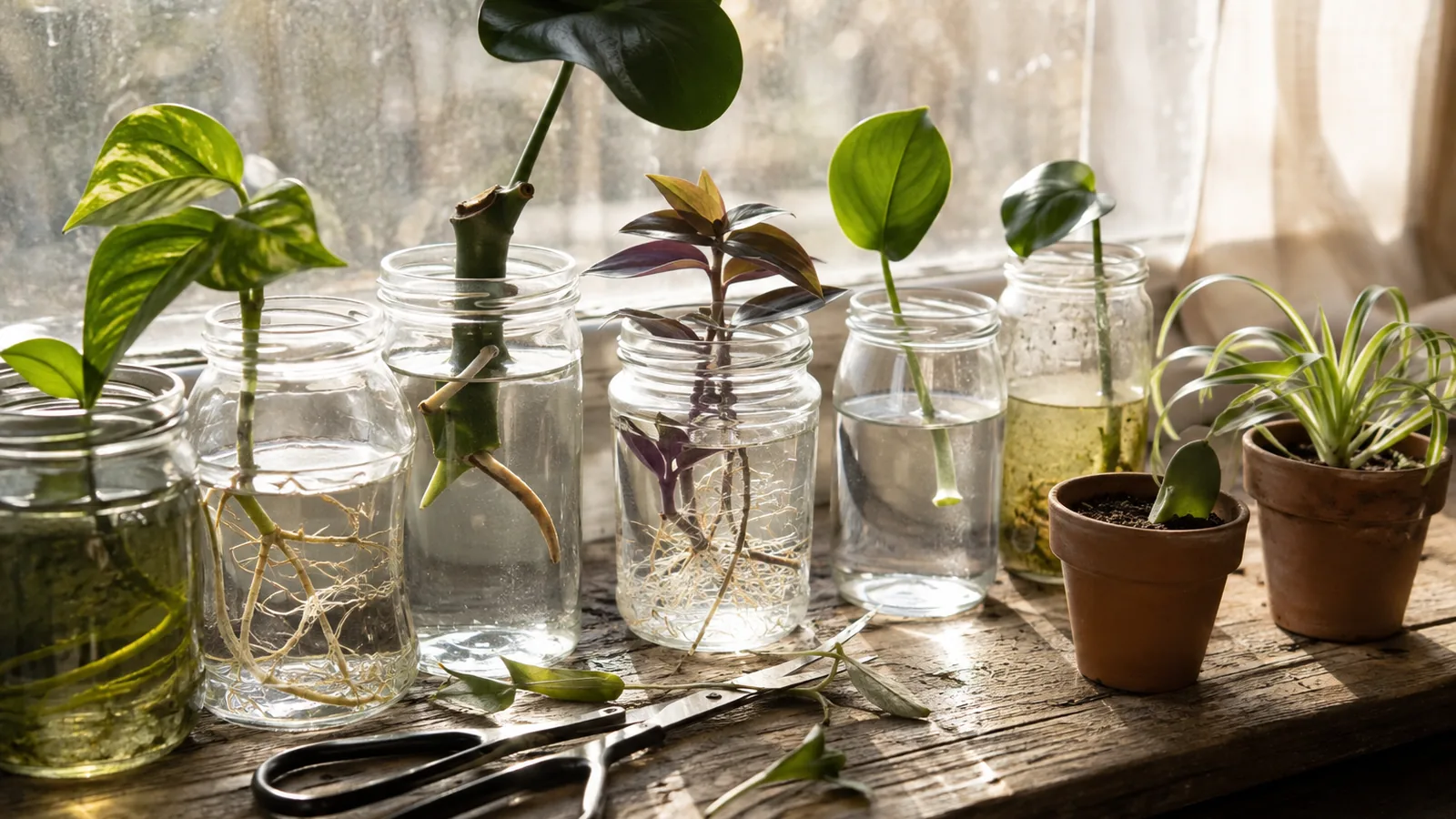
This is the simplest, most visual technique, and the best suited to soft-stemmed plants: Pothos, Philodendron, Monstera, Tradescantia, Scindapsus. You cut a stem, put it in water, and watch the roots grow.
How to do it
- Find a node — the small bump where leaves and aerial roots emerge. That’s where new roots will form. Your cutting must include at least one node, ideally two.
- Cut cleanly — pruners or scissors disinfected with alcohol, a clean cut 1 cm below the node. A crushed cut is an open door to rot.
- Remove the lower leaves — no leaf should sit in the water, they would rot.
- Place in water — a clear glass, room-temperature water, node(s) submerged. Transparency lets you watch the roots and spot cloudy water.
- Bright indirect light, never direct sun on the glass (magnifying-glass effect = warm water and burn).
- Change the water every 3–4 days to re-oxygenate it and prevent bacteria.
In summer, expect 5 to 10 days for the first roots on a Pothos, 7 to 14 days for a Philodendron, 14 to 21 days for a Monstera. These are exactly the star plants of the complete water propagation guide, worth a read for plant-by-plant details. The Pothos remains the best beginner candidate, and if you’re unsure which Monstera variety you own, identifying it first saves you from propagating a fussy plant by mistake.
Leaf cuttings: succulents and Peperomia
Some plants don’t need a whole stem: a single leaf is enough to grow a complete plant. That’s the case for succulents (Echeveria, Sedum, Crassula) and Peperomia.
For succulents
- Detach a healthy leaf with a clean sideways motion — the base of the leaf must stay intact, that’s where the new rosette will emerge.
- Let it callus over for 2 to 3 days in open air: the wound must dry and form a callus. Skipping this step is the number-one mistake, and the leaf rots.
- Lay the leaf on a well-draining substrate that’s lightly moist, without burying it.
- Mist lightly every 3–4 days rather than watering. A root, then a mini-rosette, appears in 2 to 4 weeks.
Summer is perfect here because heat activates both callusing and rooting. For everything else (watering, light, soil), the indoor succulents care guide pairs perfectly with this method.
For Peperomia
Peperomia leaves can also be propagated, with a bit of petiole (the leaf stalk). Plant it halfway into a light substrate, under high humidity, and new shoots emerge from the base within a few weeks.
Division: Calathea, ferns and clumping plants
Some plants aren’t propagated by cuttings: they’re divided. This applies to plants that grow as clumps from several points at soil level — Calathea, ferns, Spathiphyllum, Sansevieria, most indoor grasses.
The principle: during a summer repot, you separate the root ball into several independent plants, each with its own roots and foliage.
- Remove the plant from its pot and gently loosen the soil around the roots.
- Find the natural separations — clumps often come apart on their own when pulled gently. Otherwise, cut with a clean knife.
- Each division must have both roots AND leaves — that’s the condition for it to survive on its own.
- Repot immediately into fresh substrate and water in.
Division is almost risk-free because each new plant already has its own root system. In summer, recovery is fast. The Calathea care guide details the substrate and humidity these demanding plants need after division.
Air layering and offsets: for the special cases
Air layering
For woody-stemmed plants that root poorly in water — Ficus, giant Monstera, Dracaena — air layering is the pro’s solution. You get a branch to root before cutting it, without ever stressing the mother plant.
- Find a node or an aerial root on the stem.
- Make a shallow cut below the node (optional, but it speeds things up).
- Wrap the area in moist sphagnum moss, then in clear plastic film held with ties.
- Keep the sphagnum moist. In summer, roots appear in 3 to 6 weeks.
- Once a good cluster of roots has formed, cut below the mass and pot it up.
It’s the ideal method for multiplying a Ficus elastica that has outgrown its space while pruning it.
Offsets
Some plants do all the work for you by producing babies: Aloe vera sends out offsets at its base, and the Chlorophytum (spider plant) sends out runners bearing already-rooted plantlets. Just detach the offset (with its roots) and pot it up. It’s the easiest propagation there is, and summer speeds up their recovery.
Tools, rooting hormone and the conditions to meet
The minimum equipment: clean pruners or scissors, clear glasses or small pots, a free-draining substrate, and sphagnum moss for air layering. Nothing expensive.
Rooting hormone, useful or not? For easy plants (Pothos, Philodendron, Tradescantia), it’s unnecessary: they root on their own. It becomes worthwhile for woody stems and stubborn cuttings (Ficus, collector’s plants), where it increases the success rate. In short: a gimmick for the easy ones, a real boost for the difficult ones.
The conditions to meet:
- Heat: 22–28 °C (72–82 °F). A heat mat helps if your home runs cool.
- High humidity: 60–80 % speeds up rooting. A mini-greenhouse or a clear plastic bag over the cutting creates that cocoon effect.
- Bright but indirect light: enough light for photosynthesis, never direct sun that dehydrates and burns. If you’re unsure about a spot’s brightness, the built-in SPRAIA light meter gives you a reliable reading in a second, and the light guide helps you interpret the numbers.
Mistakes to avoid and when to repot
Even in summer, some mistakes sabotage your cuttings:
- Rot — a dirty cut, a submerged leaf, water that’s never changed, a soggy substrate. The leading cause of failure. Cut clean, change the water, drown nothing.
- Too much direct sun — the cutting has no roots yet to offset evaporation. It dehydrates and scorches. Bright indirect light, always.
- Impatience — tugging on a cutting to “check” the roots breaks them. Let it be, observe without touching.
- Repotting too early — a cutting with two tiny roots won’t survive the shock of soil.
When should you repot a rooted cutting? Wait until the roots reach 3 to 5 cm and there are several of them (not just one). For a water cutting, the transition to soil calls for a gentle touch: light substrate, generous watering for the first few days, humidity maintained while the water roots adapt to soil. Our repotting guide explains the right technique so you don’t break the fragile young roots.
In short: summer isn’t just a good time to propagate, it’s the time. Heat, light and active growth combine to turn a simple piece of stem into a new plant within days. Pick the method suited to your plant, meet the right conditions, avoid rot and impatience — and you’ll harvest a whole windowsill of new plants before autumn. Make the most of this window: it only lasts a few months.
Frequently asked questions
- Yes, but rooting is slower and the failure rate higher in autumn and winter, when the plant slows its growth. Spring and summer (April to September) remain the best window, with roots often appearing two to three times faster than in the cold season.
- It depends on the plant: 5 to 10 days for a Pothos, 7 to 14 days for a Philodendron, 14 to 21 days for a Monstera, 2 to 4 weeks for a succulent leaf, and 3 to 6 weeks for air layering. Summer heat and light noticeably speed up the process.
- Not for easy plants like Pothos, Philodendron or Tradescantia, which root on their own. Hormone becomes useful for woody, stubborn stems (Ficus, collector's plants), where it genuinely improves the success rate.
- The usual causes are a dirty cut, a leaf submerged in the water, water that's never changed, or a soggy substrate. Cut with a disinfected tool, remove the lower leaves, change the water every 3–4 days and don't overwater soil cuttings.
- Wait until several roots reach 3 to 5 cm. Then repot into a light substrate, water generously for the first few days and keep good humidity while the roots adapt, especially for a cutting moving from water to soil.